INTRODUCTION
Corporate social responsibility (CSR) refers to the responsibility of enterprises for their impacts on society, makingcompanies socially accountable to themselves, stakeholders, and the public. It involves practices and policies intended tohave a positive influence beyond legal obligations and profit maximization. The European Commission defines CSR as enterprises taking responsibility for their societal impacts, emphasizing that businesses must comply with laws, act ethically, and contribute to communities.
Some countries have implemented mandatory CSR regulations India requires qualifying companies to spend 2% ofaverage net profits on CSR activities, Indonesia mandates CSR fund allocation particularly in natural resources sectors, and Mauritius requires 2% of chargeable income for government-approved CSR activities.
CSR encompasses four key dimensions: economic responsibilities, legal responsibilities, ethical responsibilities, and discretionary (philanthropic) responsibilities. In practice, CSR initiatives often involve environmental sustainability efforts, ethical labor practices, philanthropy, responsible sourcing, transparency, supply chain sustainability, and workplace diversity.
In education specifically, CSR activities frequently include building school facilities, providing learning materials and technology, offering scholarships, and supporting teacher training programs. Effective CSR requires genuine commitment and stakeholder engagement rather than just public relations efforts.
Corporate Social Responsibility (CSR) refers to the obligation of businesses to contribute positively to society while conducting their operations. It means companies should not only aim for profit maximization but also consider the social,environmental, and ethical impacts of their activities.
Corporate Social Responsibility (CSR) is a fundamental concept in modern business that emphasizes the role of companies in contributing to the welfare of society. Traditionally, businesses were primarily focused on profit-making, but with growing awareness about environmental issues, social inequality, and ethical practices, companies are now expected to go beyond profits.CSR reflects the idea that businesses are not isolated entities; they operate within society and therefore have obligations toward various stakeholders such as employees, customers, communities, and the environment. It promotes the idea of sustainable and ethical business practices that balance economic growth with social and environmental well-being.
In the present global scenario, CSR has become an essential part of corporate strategy and governance. Companies integrate CSR into their policies and operations to ensure long-term sustainability and to build trust among stakeholders.
MEANING OF CORPORATE SOCIAL RESPONSIBILITY
Corporate Social Responsibility means the responsibility of a company to conduct its business in a way that is ethical, socially beneficial, and environmentally sustainable.
It involves:
· Taking responsibility for the impact of business activities
· Contributing to economic development
· Improving the quality of life of society
· Protecting the environment
In simple words, CSR means “giving back to society while doing business.” DEFINITIONS OF CORPORATE SOCIAL RESPONSIBILITY
1. World Business Council for Sustainable Development (WBCSD)
CSR is defined as: “The continuing commitment by business to behave ethically and contribute to economic development while improvingthe quality of life of the workforce and their families as well as of the local community and society at large.”
2. European Commission
CSR is defined as: “The responsibility of enterprises for their impacts on society.
3. Academic/General Definition
CSR can also be understood as: “A business approach that contributes to sustainable development by delivering economic, social, and environmental benefits for all stakeholders.”
CONCEPT OF CORPORATE SOCIAL RESPONSIBLITY
The concept of CSR is based on the idea that businesses should act as responsible corporate citizens. It goes beyondlegal obligations and focuses on voluntary actions that benefit society.
Key Elements of the CSR Concept
Stakeholder Approach :
Meaning : The Stakeholder Approach is a key concept in CSR which states that a business should consider the interests of all stakeholders, not just shareholders (owners), while making decisions.
Definition of Stakeholder:
A stakeholder can be defined as: “Any individual or group that has an interest in the functioning and performance of a business.”
The concept was widely developed by R. Edward Freeman, who emphasized that businesses must create value for all stakeholders.
FEATURES OF STAKEHOLDER APPROACH
The stakeholder approach in Corporate Social Responsibility (CSR) is characterized by several important features thatmake it essential for modern business practices. One of its key features is that it is inclusive and participative in nature.This means that a company takes into account the interests of all stakeholders such as employees, customers, suppliers, investors, government, and the community, rather than focusing only on shareholders. It also encourages the activeparticipation of these stakeholders in decision-making processes, ensuring that their views and concerns are considered.This inclusiveness helps in building trust, cooperation, and better relationships between the company and society.
Another important feature is that the stakeholder approach focuses on ethics and fairness. Companies are expected to conduct their operations in an ethical manner by following principles such as honesty, transparency, and integrity. Fairness ensures that no stakeholder is exploited or treated unjustly. For example, employees should receive fair wages and safe working conditions, customers should be provided with quality products and truthful information, and businesses should avoid corrupt or deceptive practices. This ethical orientation strengthens the reputation of the company and promotes responsible behavior.
The stakeholder approach also emphasizes a long-term perspective. Instead of concentrating only on short-term profits,companies adopting this approach consider the long-term impact of their decisions on stakeholders and society. They aim to build lasting relationships, ensure sustainable growth, and avoid actions that may harm future interests. For instance,investing in employee development, maintaining customer satisfaction, and adopting environmentally friendly practices contribute to long-term success and stability.
Lastly, the stakeholder approach promotes sustainable development, which involves balancing economic, social, and environmental responsibilities.
ADVANTAGES OF STAKEHOLDER APPROACH
The stakeholder approach in Corporate Social Responsibility (CSR) provides several important advantages that help businesses grow responsibly while maintaining strong relationships with society. One of the key advantages is that it improves the corporate image of the company. When an organization actively considers the interests of all its stakeholders—such as employees, customers, communities, and the environment—it is seen as responsible and ethical. This creates a positive public perception and strengthens the company’s reputation. A good corporate image not only attracts customers but also builds trust among investors, government authorities, and society at large, making the companymore credible and respected.
Another major advantage is that it increases customer loyalty. In today’s competitive market, customers prefer to associate with companies that are socially responsible and transparent in their dealings. When businesses focus on providing quality products, fair pricing, and honest communication, customers develop confidence in the brand. Additionally, when companies engage in social and environmental initiatives, customers feel emotionally connected to them. This trust and connection encourage repeat purchases and long-term relationships, which are essential for business success.
The stakeholder approach also enhances employee satisfaction, which is crucial for the efficient functioning of anyorganization. When employees are treated as valuable stakeholders, they are provided with fair wages, safe working conditions, equal opportunities, and a supportive work environment. Such practices make employees feel respected and motivated. As a result, their productivity increases, and they become more committed to the organization’s goals. High employee satisfaction also reduces turnover rates and helps in retaining skilled workers, which ultimately benefits the company in the long run.
Lastly, the stakeholder approach supports sustainable development by ensuring a balance between economic growth, social welfare, and environmental protection. Companies that follow this approach do not focus solely on short-termprofits but also consider the long-term impact of their actions. They adopt eco-friendly practices, reduce waste and pollution, and contribute to community development through various initiatives. This responsible behavior ensures thatnatural resources are conserved and social well-being is improved, thereby meeting the needs of the present without compromising the needs of future generations.
EVOLUTION OF CORPORATE SOCIAL RESPONSIBILITY
The concept of Corporate Social Responsibility (CSR) has evolved significantly over time, reflecting changes in societal expectations, business practices, and global challenges. In its early stage, CSR was primarily based on traditional philanthropy. During this period, businesses focused mainly on profit-making and considered social responsibility as aseparate, voluntary activity. Companies and wealthy business owners would donate money to charitable causes such asbuilding schools, hospitals, temples, or providing relief during disasters. These activities were not integrated into business strategies but were seen as acts of goodwill or charity, often carried out after earning profits. The main objective was to give back to society, but there was little emphasis on accountability, sustainability, or long-term impact.
As time progressed, the concept of CSR began to expand into what is now known as modern CSR practices. In this stage, businesses started recognizing that they have a direct impact on society and the environment through their operations. CSR became more structured and integrated into corporate policies and decision-making processes. Companies began focusing on areas such as employee welfare, environmental protection, ethical business practices, and community development. Instead of one-time charitable donations, organizations started implementing long-term programs like skill development, education initiatives, healthcare services, and environmental sustainability projects. CSR also became more transparent and accountable, with companies reporting their activities and outcomes.
The most significant development in the evolution of CSR is the shift from charity to sustainability. Modern businesses now understand that social responsibility is not just about donating money but about creating lasting positive impact. This shift emphasizes sustainable development, where companies aim to balance economic growth with social welfare and environmental protection. Businesses adopt practices such as reducing carbon emissions, using renewable energy, promoting fair trade, and ensuring responsible supply chains. CSR is now seen as a strategic approach that contributes to long-term business success while addressing global challenges like climate change, poverty, and inequality. This transformation highlights that CSR is no longer optional or peripheral but an essential part of responsible and sustainable business operations.
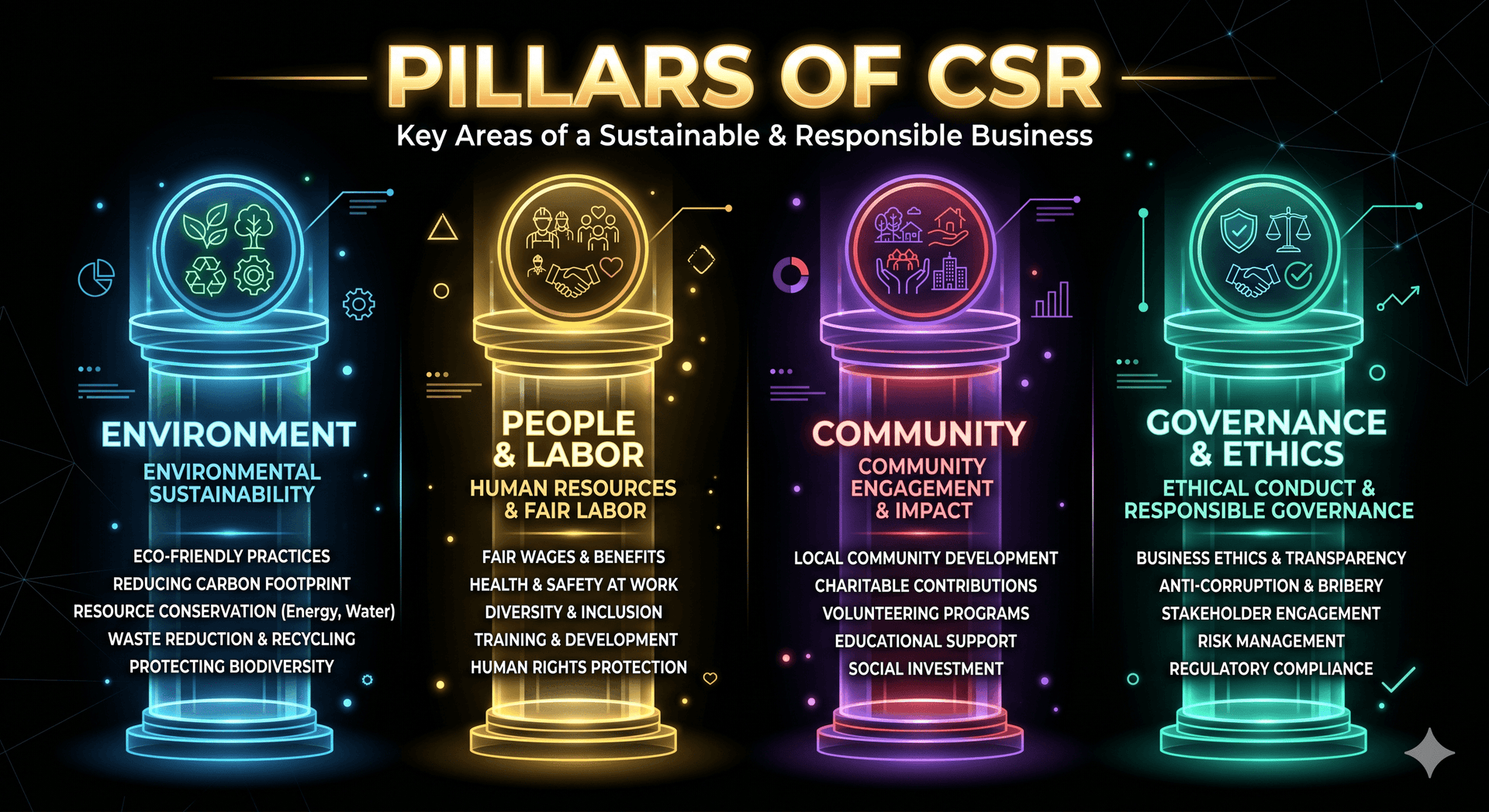
KEY COMPONENTS OF CORPORATE SOCAIL RESPONSIBILIT
(A) ENVIRONMENTAL RESPONSIBILITY
Environmental responsibility refers to the duty of businesses to minimize their negative impact on the environment and promote sustainability. One important aspect is reducing carbon footprint, which means lowering greenhouse gas emissions produced by business activities such as manufacturing, transportation, and energy use. Companies adopt energy-efficient technologies, shift to cleaner production methods, and reduce fuel consumption to achieve this goal. Another crucial element is waste management and recycling, where organizations ensure proper disposal of waste, reusematerials, and recycle products to reduce environmental pollution. Businesses also focus on the use of renewable energysuch as solar, wind, and hydro power instead of relying on non-renewable sources like coal and petroleum. This helps in reducing environmental degradation and conserving energy. Additionally, conservation of natural resources is essential,where companies use resources like water, minerals, and forests responsibly and avoid over-exploitation. By adopting these practices, businesses contribute to environmental protection and long-term sustainability.
(B) SOCIAL RESPONSIBILITY
Social responsibility focuses on the well-being of people and society at large. One of the key aspects is employee welfare and safety, which includes providing fair wages, safe working conditions, healthcare benefits, and opportunities for growth. Companies are responsible for ensuring that their employees are treated with dignity and respect. Another important element is gender equality and diversity, where organizations promote equal opportunities for all individuals regardless of gender, caste, religion, or background. This creates an inclusive and fair workplace. Businesses also engage in community development programs, such as building schools, supporting healthcare facilities, improving infrastructure, and providing employment opportunities in local communities. Furthermore, respect for human rights isa critical component, requiring companies to avoid exploitation, child labor, forced labor, and discrimination. By fulfilling these responsibilities, businesses contribute to a more just and equitable society.
(C) ECONOMIC RESPONSIBILITY
Economic responsibility involves conducting business in a manner that is financially sound, ethical, and beneficial to society. One important aspect is providing fair wages and ethical profits, where companies ensure that employees are paid adequately and profits are earned through honest means without exploitation or unfair practices. Another key point ismaintaining transparent financial practices, which includes accurate reporting, accountability, and openness in financial dealings. Transparency builds trust among investors, stakeholders, and the public. Businesses must also ensurethe avoidance of corruption, meaning they should not engage in bribery, fraud, or unethical financial activities. Following laws and maintaining integrity is essential for long-term success. Additionally, sustainable business growth is an important component, where companies focus on long-term profitability without harming society or the environment. This ensures stability and continuous development of the business while benefiting all stakeholders.
(D) PHILANTHROPIC RESPONSIBILITY
Philanthropic responsibility refers to voluntary activities undertaken by companies to promote social welfare and improve the quality of life in society. One major aspect is donations and charity, where businesses contribute funds or resources to support social causes such as poverty alleviation, education, and healthcare. Companies also focus on supportingeducation and healthcare by building schools, providing scholarships, funding hospitals, and organizing health camps. Another important activity is disaster relief, where organizations provide immediate assistance during natural disasters such as floods, earthquakes, or pandemics by offering financial aid, food, shelter, and medical support. Additionally, businesses engage in scholarships and social programs to support underprivileged students and communities, helpingthem access education and improve their standard of living. These philanthropic efforts reflect the company’s commitmentto giving back to society beyond its core business activities.
CORPORATE SOCIAL RESPONSIBILITY UNDER INDIAN LAW
In India, Corporate Social Responsibility (CSR) is legally regulated under the provisions of the Companies Act, 2013, which makes CSR a mandatory obligation for certain categories of companies. India is one of the first countries in the world to legally mandate CSR, reflecting the importance of corporate contribution to social and economic development.The law ensures that companies not only focus on profit-making but also actively participate in improving society and protecting theenvironment. CSR provisions are mainly covered under Section 135 of the Act, along with the Companies (CSR Policy) Rules, 2014.
Applicability of CSR (Section 135)
Section 135 of the Companies Act, 2013 lays down the criteria for the applicability of CSR. According to this provision, CSR is mandatory for companies that meet any one of the following financial thresholds during any financial year. Firstly, if a company has a net worth of ₹500 crore or more, it falls under the CSR obligation. Net worth refers to the total valueof the company’s assets minus its liabilities. Secondly, CSR applies if a company has a turnover of ₹1000 crore or more, where turnover means the total revenue generated from business activities. Thirdly, if a company earns a net profit of ₹5crore or more, it is required to comply with CSR provisions. The applicability is based on meeting any one of these criteria, not all, making it broad in scope. Once a company falls under these limits, it must comply with CSR requirements even if it does not meet the criteria in subsequent years, subject to certain conditions.
CSR Requirements under the Act
The Companies Act, 2013 prescribes specific obligations for companies that fall under CSR applicability. One of the primary requirements is the formation of a CSR Committee by the Board of Directors. This committee typically consists of three or more directors, including at least one independent director (in certain cases). The role of the CSRCommittee is to formulate and recommend a CSR policy, identify suitable CSR activities, and monitor the implementation of such activities to ensure effectiveness and compliance.
Another important requirement is that companies must spend at least 2% of their average net profits made during the three immediately preceding financial years on CSR activities. This provision ensures that companies allocate a fixedportion of their profits toward social welfare. If a company fails to spend the required amount, it must provide valid reasons in its Board’s Report, ensuring transparency and accountability.
Additionally, the CSR activities undertaken by companies must fall within the scope off Schedule VII of the Companies Act, 2013. This schedule provides a list of permitted CSR activities, such as promoting education, eradicating hunger and poverty, improving healthcare, ensuring environmental sustainability, supporting gender equality, rural development, and disaster management. By specifying these areas, the law ensures that CSR efforts are directed toward meaningful and impactful social causes
CASE STUDIES OF CORPORATE SOCIAL RESPONSIBILITY IN INDIA
TATA GROUP – EDUCATION & HEALTHCARE
The Tata Group is widely regarded as a pioneer in Corporate Social Responsibility in India. Its CSR philosophy is deeplyrooted in the vision of its founder, Jamsetji Tata, who believed that businesses exist to serve society. A significant portionof Tata’s profits is channelled into social development through charitable trusts such as the Tata Trusts.
In the field of education, the Tata Group has made substantial contributions by establishing institutions like the Tata Institute of Social Sciences (TISS) and supporting scholarships for students in India and abroad. It also runs programs aimed at improving primary education, digital learning, and skill development, especially in rural and underprivileged areas.
In terms of healthcare, Tata has played a vital role by establishing world-class hospitals such as the Tata MemorialHospital in Mumbai, which is known for cancer treatment and research. The group also undertakes various healthinitiatives such as mobile medical units, maternal and child health programs, and rural healthcare services.
These initiatives align with CSR principles by promoting social welfare, improving quality of life, and ensuring access to essential services. Tata’s CSR model reflects a long-term commitment to sustainable development rather than short-term charity.
RELIANCE INDUSTRIES – RURAL DEVELOPMENT
Reliance Industries Limited (RIL), one of India’s largest corporations, has made significant contributions to CSR, particularly in the area of rural development through the Reliance Foundation, led by Nita Ambani. The company focuses on improving the quality of life in rural areas by addressing key issues such as water scarcity,agriculture, education, and healthcare. One of its major initiatives is the
Bharat-India Jodo (BIJ) Program, which works towards rural transformation by empowering farmers with better agricultural practices, irrigation systems, and market access.
Reliance also undertakes projects related to water conservation, including rainwater harvesting and watershed development, which help farmers improve crop productivity and income. In addition, the company supports rural healthcare through mobile medical units and telemedicine services.
These CSR activities demonstrate a strong commitment to inclusive growth by uplifting rural communities, reducing poverty, and promoting sustainable livelihoods. Reliance’s approach highlights how large corporations can contribute to national development goals.
INFOSYS – EDUCATION & SUSTAINABILITY
Infosys is another leading company known for its structured and impactful CSR initiatives, primarily carried out through the Infosys Foundation, founded by Sudha Murty. The company focuses on areas such as education, healthcare, ruraldevelopment, and environmental sustainability.
In the area of education, Infosys has contributed significantly by building schools, libraries, and providing digital learning resources. It also supports programs aimed at improving the quality of education in government schools and offers scholarships to meritorious students from economically weaker sections. Infosys is also committed to environmental sustainability. The company has implemented green practices such as energy-efficient campuses, reduction of carbon emissions, water conservation, and waste management systems. Infosys campuses are designed to be eco- friendly and sustainable, reflecting its commitment to environmental responsibility. Through these initiatives, Infosys demonstrates how CSR can be integrated into corporate strategy to achieve both social impact and environmental sustainability. Its efforts contribute to long-term development and set an example for responsible corporate behavior.
CONCLUSION
Corporate Social Responsibility (CSR) has emerged as a vital component of modern business practices, reflecting the growing expectation that companies should go beyond profit-making and contribute positively to society. The importanceof CSR lies in its ability to create a balance between economic growth and social welfare. By adopting responsible practices, businesses not only enhance their reputation and build trust among stakeholders but also contribute to the overall development of the community. CSR helps in improving corporate image, increasing customer loyalty, and ensuring employee satisfaction, thereby strengthening the long-term success of an organization.
CSR also plays a significant role in promoting sustainable development. It encourages companies to operate in a manner that protects the environment, supports social equity, and ensures economic stability. Through initiatives such as reducingcarbon emissions, conserving natural resources, promoting education and healthcare, and supporting rural development, businesses contribute to meeting present needs without compromising the ability of future generations to meet their ownneeds. Thus, CSR acts as a bridge between business growth and environmental and social responsibility.
Looking toward the future of CSR, it is expected to become even more integrated into core business strategies rather thanremaining a separate activity. Companies will increasingly focus on innovation, sustainability, and ethical governance. There will be greater emphasis on transparency, accountability, and measurable impact of CSR activities. With rising global challenges such as climate change, inequality, and resource scarcity, CSR will play a crucial role in addressing these issues. In the coming years, businesses that actively engage in responsible and sustainable practices will not only gain competitive advantage but also contribute meaningfully to building a better and more inclusive world.