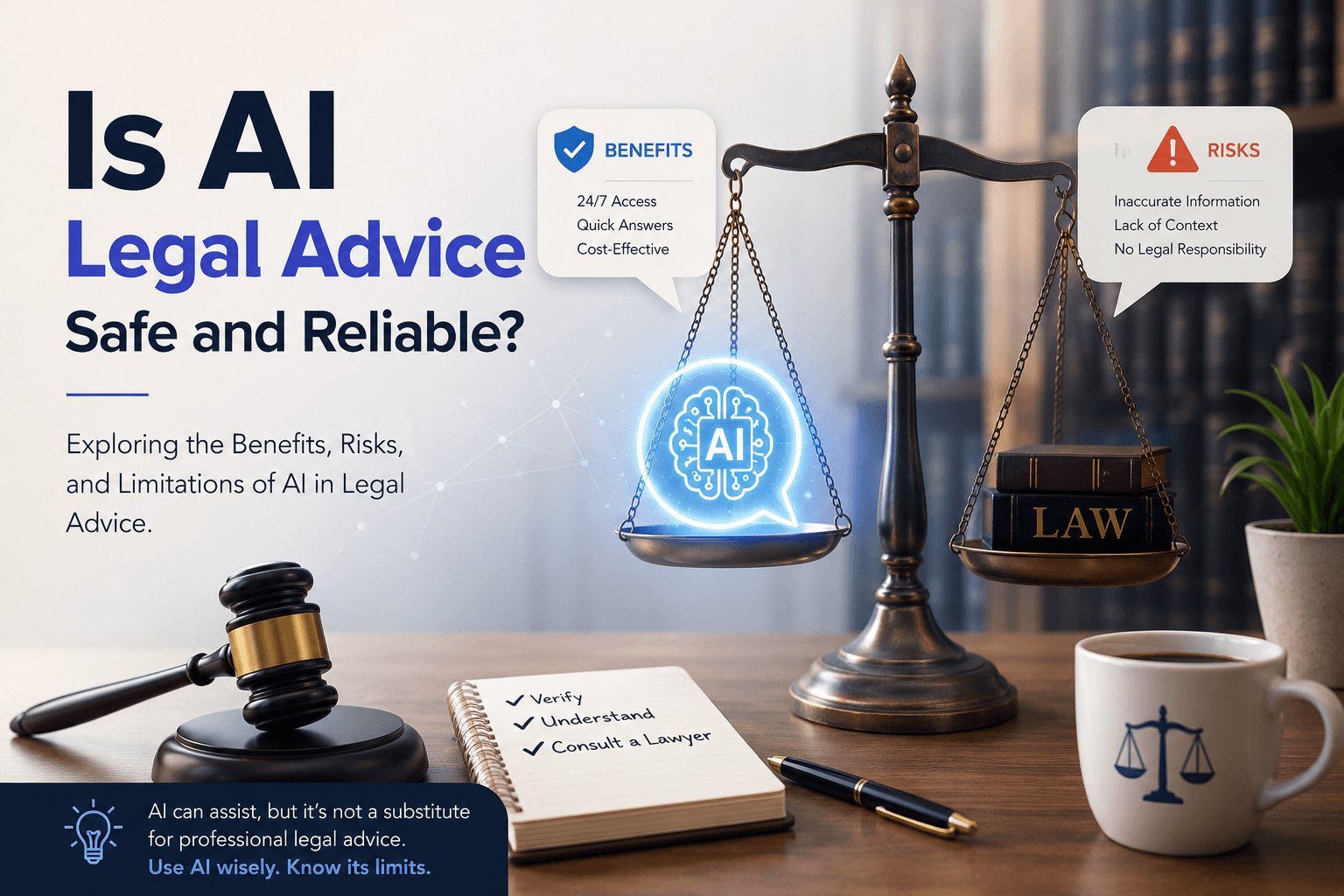
AI legal advice in India is not safe to rely on as a final answer without verification. It can be useful for explaining legal language, organizing facts, and drafting a first pass, but AI tools can miss context, misstate the law, or generate incorrect citations. The practical rule for both clients and lawyers is simple: use AI for assistance, verify the output against trusted sources, and get a qualified lawyer to review it before you act on it in any high-stakes matter.
Why blind trust creates legal risk
The biggest problem is not that AI produces legal content. The real problem is that it often produces it in a confident, polished tone that makes weak analysis sound reliable.
That is risky in India and in many other jurisdictions. Legal outcomes depend on facts, procedure, timing, the forum hearing the matter, and the exact wording of the documents involved. If a prompt is incomplete, the system may fill gaps with assumptions. In legal work, those assumptions can change advice, deadlines, or strategy.
This affects two groups in particular:
- Clients, founders, professionals, and business owners who want a quick answer about a notice, contract, employment issue, property dispute, family matter, or compliance question.
- Lawyers, law firm teams, and in-house legal departments who use AI to accelerate drafting, summarization, research, or review and then risk relying on unverified output.
In both situations, the failure point is usually the same: nobody checks the answer carefully enough. For a broader look at this issue, see our guide to AI-generated legal work reliability.
Is AI legal advice safe in India for everyday users?
Usually not if you intend to act on it directly. It is better understood as a tool for legal information, issue-spotting, and preparation than as a substitute for individualized legal advice.
In India, people commonly ask AI tools what to do after receiving a legal notice, whether a termination is lawful, how to respond to a landlord or tenant dispute, whether a contract clause is enforceable, or what steps to take in a family or property conflict. AI can help translate jargon, identify the documents you may need, and suggest questions to ask a lawyer. That can be genuinely useful.
The danger starts when a general answer is treated as tailored advice. A response may sound specific while still overlooking a filing deadline, a notice requirement, a forum-selection clause, an arbitration clause, or a factual detail that changes the legal position completely. Even within India, the right answer can turn on the forum, procedural posture, regulator, contract wording, and the exact documents exchanged between the parties.
If you want a practical view of where the line is, read our article on using AI for legal documents without lawyer review and our explainer on whether AI can replace a lawyer for legal documents.
Why lawyers in India should be cautious too
Lawyers face a different version of the same risk: speed can create overconfidence. A draft that appears polished can still contain unsupported propositions, weak reasoning, or invented authorities.
One widely reported example is Mata v. Avianca in the Southern District of New York in 2023, where lawyers submitted non-existent cases generated by AI. The lesson is not limited to one court system. It is a general professional responsibility point: if you cite an authority, file a document, or advise a client, you remain responsible for checking whether the content is real, current, and applicable.
For lawyers in India, that means checking applicable professional conduct rules, court or tribunal filing requirements, client confidentiality obligations, and internal AI-use policies before relying on AI in legal work. It also means confirming that any case law, statute, regulation, or quotation produced by the system is independently verified before it appears in advice, drafting, or submissions.
For a safer workflow, see our 5-step checklist for lawyers using AI safely and our review of how accurate AI legal document review is.
Where AI is useful in Indian legal work
Used properly, AI can reduce low-value manual work and help legal teams move faster. Lexi has processed 5,000,000+ documents across 200,000+ cases for 200+ organizations. Reported customer outcomes include up to 45% more cases per attorney and 10+ hours saved per lawyer per week, but results depend on workflow, team adoption, and review practices.
That kind of value usually comes from assistance tasks, not from handing over final judgment. Common examples include:
- Summarizing long contracts, notices, pleadings, judgments, and internal records.
- Creating a first draft for review instead of a final document ready to sign or file.
- Extracting dates, obligations, defined terms, payment triggers, and risk points from large document sets.
- Comparing versions and highlighting meaningful redlines.
- Organizing facts into timelines, issue lists, or chronologies.
- Converting dense legal language into plain-English updates for clients or business teams.
These use cases improve speed and structure, but they do not remove the need for legal judgment. For practical examples, see how lawyers actually use AI in practice and how AI helps lawyers organize case files.
What makes AI output unsafe in Indian legal matters
Missing or incomplete facts
Small details often decide legal outcomes. Dates, signatures, payment history, governing-law clauses, prior correspondence, regulatory context, and procedural posture can all affect the answer. If those details are absent, the output may be neat but materially wrong.
Invented or misused authorities
Some systems generate citations that do not exist or use real authorities for propositions they do not actually support. That is why legal output should be checked against primary sources or trusted secondary sources before it is used in advice, drafting, or court work.
Jurisdiction and forum confusion
AI systems can blend principles across countries, legal systems, or procedural settings unless the prompt is highly specific. In India, the right approach may depend on whether the issue is contractual, regulatory, civil, criminal, labour-related, or before a particular court, tribunal, or authority.
Overconfident language
One of the most misleading features of AI output is tone. It can present uncertainty as certainty, and options as conclusions. In legal matters, confidence is not proof.
Confidentiality and data handling concerns
Before uploading contracts, dispute papers, employee data, or internal communications, users should understand how the platform stores data, who can access it, and whether inputs may be used to improve the model. For lawyers and legal teams, confidentiality obligations may apply regardless of convenience.
If safety and confidentiality are your main concern, see our related guide on whether AI legal advice is safe for lawyers and clients.
How to use AI more safely in India
Safer use is mostly about process discipline. The more important the matter, the more structured your verification should be.
- Provide complete context. Include the timeline, documents, parties, forum, and the exact question you want answered.
- Ask the tool to show uncertainty. Prompt it to identify assumptions, missing facts, counterarguments, and alternative interpretations.
- Request source support. Ask for authorities, then verify each one independently before relying on it.
- Do not sign, file, or send unreviewed output. High-stakes documents need human review.
- Protect sensitive information. Remove unnecessary personal or confidential material and check platform permissions and internal policies.
- Use structured legal workflows where possible. Tools built for review, redlining, drafting, and verified citation workflows are generally safer than generic chat used alone.
For teams adopting AI in practice, Lexi supports law firms, corporate legal teams, litigation teams, and in-house counsel with workflows for drafting, review, redlining, and research.
When AI is helpful and when you should call a lawyer
AI is helpful when you need to get oriented quickly, extract information from documents, prepare a first draft, or identify issues to investigate further. It is a weak substitute for advice when the matter involves rights, deadlines, filings, liability exposure, negotiation strategy, or facts that need legal interpretation.
In practice, you should escalate to a qualified lawyer when:
- You have received a legal notice or court-related communication.
- You are about to sign, terminate, or dispute an important contract.
- The issue involves money, property, employment termination, family law, compliance, or potential criminal exposure.
- A wrong step could waive rights, trigger penalties, or weaken your position.
If you are new to this area, start with our guide on how to get started with legal AI.
FAQ
Can I use AI to reply to a legal notice in India?
You can use AI to summarize the notice, identify the issues, and prepare a draft or a list of questions. But sending that response without lawyer review can be risky, especially if deadlines, admissions, or procedural rights are involved.
Is ChatGPT safe for Indian legal advice?
Generic AI tools such as ChatGPT can be useful for general legal information, issue-spotting, and drafting a first pass, but they should not be treated as final legal advice. They can miss local context, invent authorities, or sound more certain than the facts support. Verify the output against trusted sources and get lawyer review before you rely on it in a real matter.
Can AI draft legal documents for use in India?
Yes, AI can help produce a first draft of contracts, notices, summaries, and responses. But whether that draft is safe to use depends on the facts, the document type, and the quality of human review. The closer a document gets to signature, filing, or dispute use, the more important lawyer review becomes.