Introduction
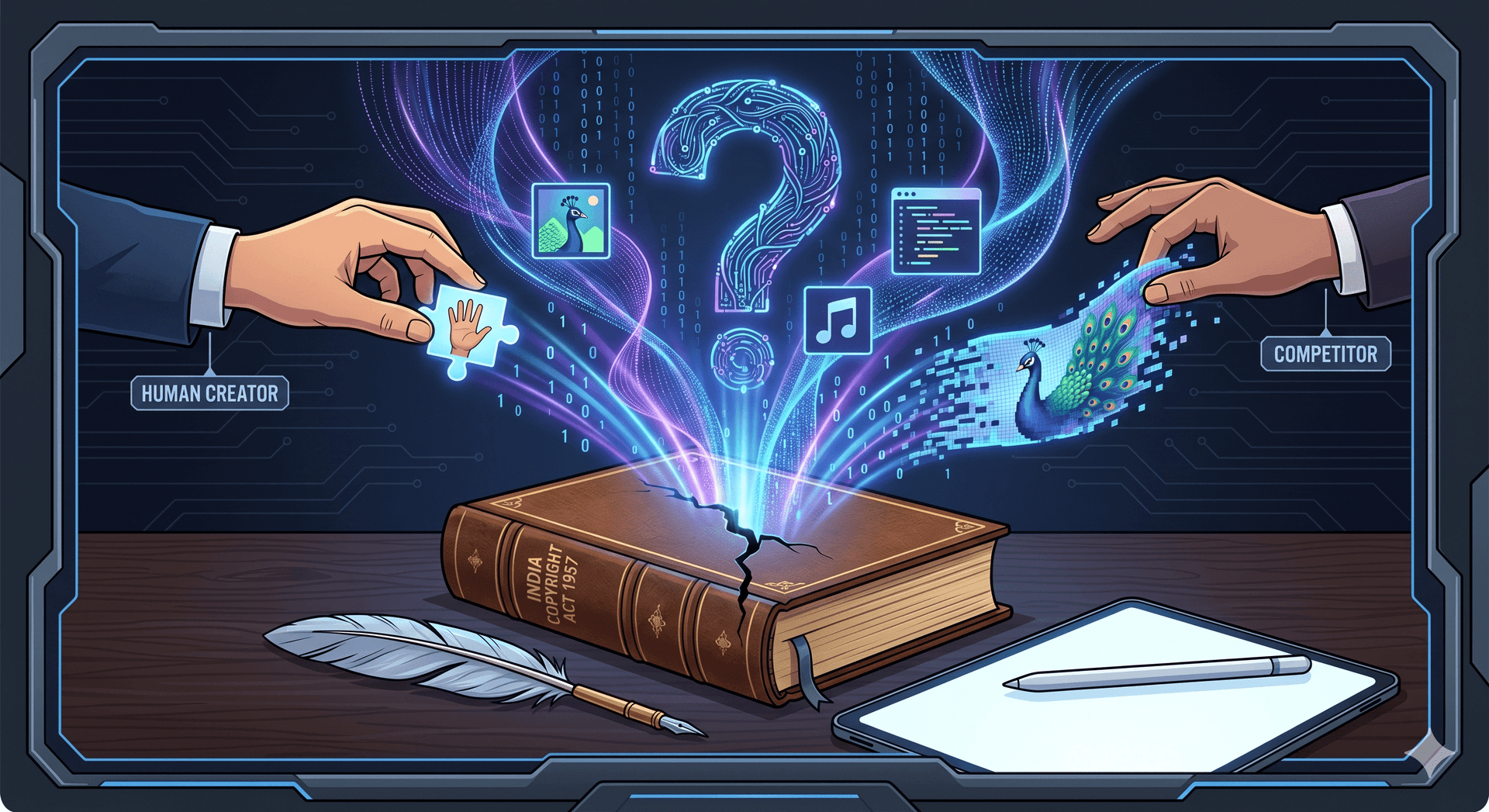
Imagine this. A company in Bengaluru uses Mid-journey to create pictures for its advertising campaign. The pictures are really good look original, and the designer only had to work on the prompts for forty minutes to get them right. A competitor sees the campaign takes screenshots of the pictures and uses them in their advertisements. The company’s lawyer sends a letter telling the competitor to stop. The competitors lawyer writes back with a question that under Indian law nobody can answer clearly: who really owns those pictures?
This is not a made-up story. Things like this are happening now in Indias digital economy and the law that is supposed to answer these questions the Copyright Act of 1957 was written at a time when only humans could create things. It does not have an answer for a world where machines can create lots of things on their own.
The Law Was Made for Humans
The Copyright Act says who the author of a work is and it depends on the type of work. For creative things like books, music and art the author is the person who made it. That is simple. For things made by computers the Copyright (Amendment) Act, 1994 added Section 2(d)(vi), which says the author is “the person who causes the work to be created”. At the time this was an idea. It expected that computers might make things that deserved protection and it tried to make sure that the human in charge got the credit.
This law was made for computer programs that do exactly what they are told to do. A word processor does not own the document you write with it. Photoshop does not own the pictures you edit with it. In those cases, it is clear that the human is in control of everything that matters.
Artificial Intelligence is different. Tools like DALL-E, ChatGPT and Stable Diffusion are trained on lots of data. Make things in a way that nobody, not even the people who made them can fully understand or control. When you give them a prompt the thing they make is shaped by how they were made the data they were trained on and a bit of randomness. You made a choice when you wrote the prompt. The machine did too.
Does someone who uses Midjourney to make a picture really make it happen according to the law? Maybe. Does someone who types a sentence into ChatGPT and gets an essay really make it happen? That does not seem right. Indian courts have not answered these questions yet. The law does not give a clear answer.
What Other Countries Are Doing
India is not the country struggling with this. Some countries have least started to figure out what to do.
The United States Copyright Office has been very active. They have made rules and decisions in 2023 and 2024 that say if a machine makes something all by itself without any help it does not get copyright protection. If a human has a lot of control over what is made through careful prompting choosing what to use and editing, then the human’s contribution can get copyright protection. The Zarya of the Dawn case in 2023 showed this. The Copyright Office said that the text of a novel that used Midjourney pictures could get copyright protection, but the pictures themselves could not.
The EU AI Act, which started in August 2024 takes an approach. It does not directly say who owns what. It makes companies that make artificial intelligence systems tell people what data they used to train them. This is important for people who want to know if their work was used without permission.
The UK is similar to India because they both have a law system. Section 9(3) of the Copyright, Designs and Patents Act 1988 the provision that directly India’s Section 2(d)(vi) provides that for computer generated works, the author is “the person by whom the arrangements necessary for the creation of the work are undertaken. Asked if the law still works with artificial intelligence. They have not changed the law yet. It is good that they are talking about it. India has not had this conversation yet.
The Real Cost of Not Doing Anything
Not knowing who owns things made by machines is not a theoretical problem. It has consequences for businesses and creators in Indias digital economy.
Think about what this means in practice. Companies cannot be sure if they own the things they make with intelligence cannot safely let others use them and cannot know if someone copying them is breaking the law. Every contract that involves things made with intelligence is uncertain. For a country that wants to be a hub for information technology and digital media this is a problem.
This uncertainty also creates incentives. If things made by machines do not get copyright protection companies might not invest in making things with intelligence because they cannot protect what they make. If courts say that the companies that make the machines own what is made it would give much power to a few big technology companies, most of which are not from India.
Then there is the question of the data used to train machines. Indian law has not dealt with this yet. Making a machine that can generate things means using lots of existing creative works. Whether that ingestion constitutes copyright infringement under the 1957 Act or whether it qualifies as fair dealing under Section 52 is unclear. This question has already led to lawsuits in the United States and the United Kingdom. India cannot remain insulated from it indefinitely.
Three Things Indian Law Needs to Change
To fix this India does not need to change its copyright law. It just needs to make some targeted changes to make the law work with intelligence.
First the law needs to be changed to deal with intelligence clearly. It needs to say that copyright protection is given to humans who have a lot of control over what's made through things like careful prompting and editing. Things made with human help should not get full copyright protection. What counts as "a lot of control" will need to be decided case by case. At least the law will be clear.
Second India should create a special right for things made purely by machines. For things that do not meet the standard for control the law should give a shorter protection period, like fifteen years. This would protect companies that invest in making things with intelligence without giving them the same rights as human creators. The UK fifty-year term for computer-generated works is too long for an age where machines can make thousands of things a day.
Third the law needs to clarify the question of training data. It should make an exception for text and data mining for AI training purpose modelled on Article 4 of the EU’s Copyright in the Digital Single Market Directive. This would give companies that make machines the certainty they need while still protecting the rights of creators. The exception should require companies to keep records of the data they use and make those records available to creators if they ask.
The Silence Is Not Neutral
It might seem like there is no rush to fix this because Indian courts have not made any mistakes about artificial intelligence and copyright yet. This underestimates how fast the technology is changing and how much business is already being done in the grey area.
The Copyright Act of 1957 has been able to adapt to changes over the years from print to digital from individual creators to companies. Artificial intelligence is different because it challenges the idea that copyright is based on human creativity, in the first place.
This is not a question that the current law can answer. The longer it goes unanswered the more it will cost, not just in theory but in the real decisions that businesses and creators have to make every day about what they can and cannot do with artificial intelligence.
References
1. Copyright Act, 1957 (India). https://copyright.gov.in/documents/copyrightrules1957.pdf
2. US Copyright Office, Copyright and Artificial Intelligence Part 2: Copyrightability (2024), https://www.copyright.gov/ai/copyright-and-artificial-intelligence-part-2-copyrightability-report.pdf
3. Regulation (EU) 2024/168 (AI Act), https://eur-lex.europa.eu/legal-content/EN/TXT/?uri=CELEX:32024R1689
4. UK IPO Consultation on AI and IP (2022) https://www.gov.uk/government/consultations/artificial-intelligence-and-ip-copyright-and-patents
5. Copyright, Designs and Patents Act 1988 (UK), s. 9(3) https://www.legislation.gov.uk/ukpga/1988/48/section/9
6. Directive (EU) 2019/790 on Copyright in the Digital Single Market, Art. 4 https://eur-lex.europa.eu/legal-content/EN/TXT/?uri=CELEX%3A32019L0790