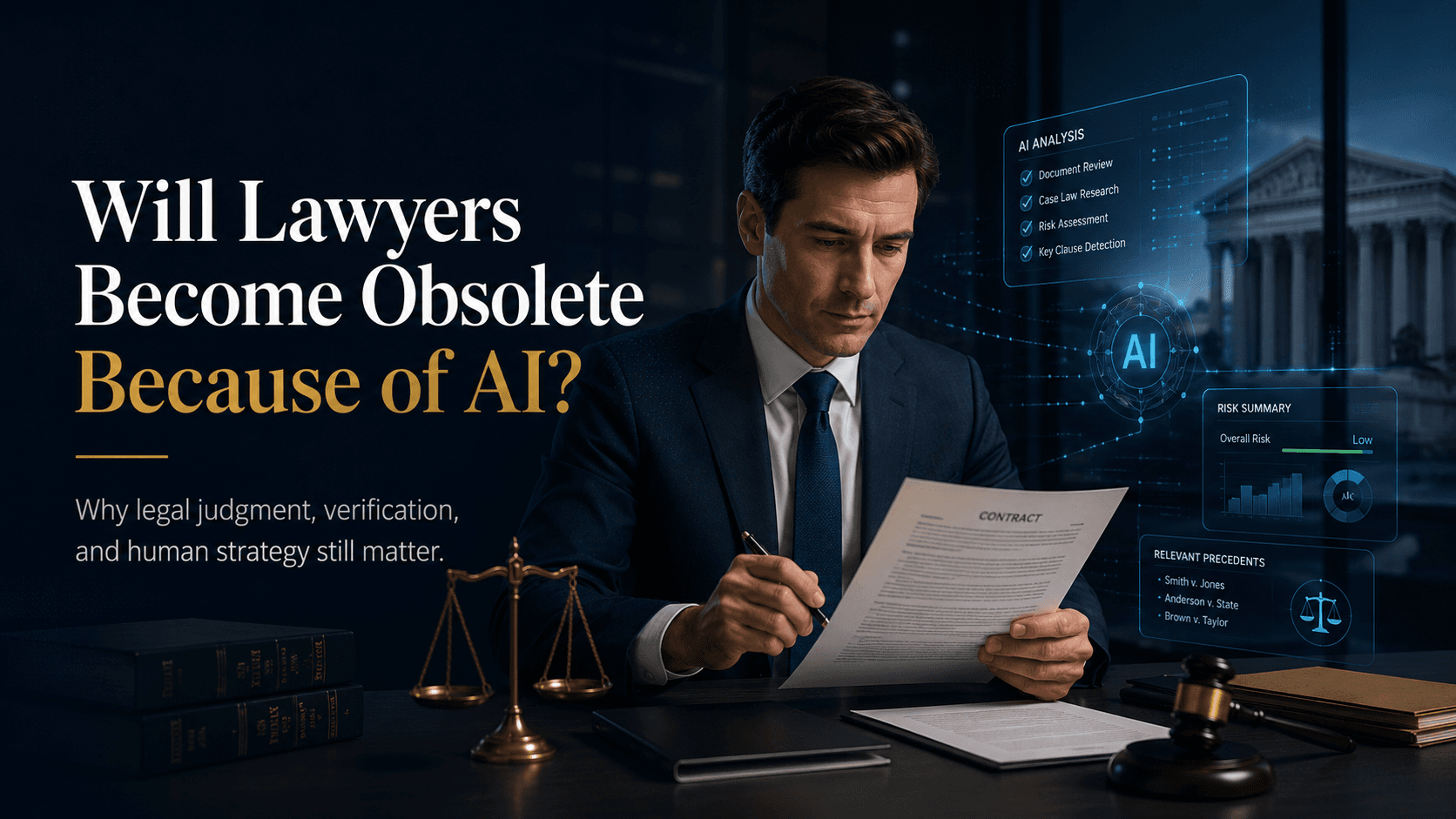
Short answer: No. AI is unlikely to make lawyers obsolete. It can automate parts of legal work, such as first-pass drafting, summarization, document organization, and contract review, but lawyers remain essential for judgment, ethics, strategy, negotiation, and accountability.
In practice, AI is already changing how legal teams handle first-pass work. Tools can assist with research, drafting, summarization, and contract review, but they do not replace legal judgment, professional responsibility, client counseling, or courtroom accountability. The better way to understand the shift is this: AI is making some legal tasks faster, not making the legal profession disappear.
That distinction matters because search interest often treats "lawyers" and "legal tasks" as if they were the same thing. They are not. Legal practice involves applying rules to incomplete facts, advising under uncertainty, balancing legal and commercial risk, and standing behind the final work product. If you want the broader industry context, see how AI is changing the legal profession.
Why the answer is no
The strongest reason lawyers are not becoming obsolete is that legal work is not only about producing text. It is about making decisions when the facts are messy, the law is contested, the stakes are high, and the client needs more than a summary.
AI can already help with many task-level activities, especially work that is repetitive, text-heavy, or document-driven. In many jurisdictions, that includes:
- reviewing contracts for missing, unusual, or inconsistent clauses
- summarizing long judgments, pleadings, correspondence, or matter files
- creating first drafts of notices, clauses, memos, and research notes
- organizing facts, timelines, exhibits, and issue lists into a usable structure
- helping lawyers compare versions, redlines, and recurring drafting patterns
But legal practice is not just the production of text; it is judgment under uncertainty, applied to client goals, procedural risk, and real-world facts. Software does not independently assume fiduciary duties, appear in court, negotiate relationships, or accept professional responsibility for a filing, opinion, or strategy call. In many jurisdictions, those obligations still sit squarely with a qualified lawyer, and you should always check your local bar rules, court guidance, confidentiality duties, and supervision requirements.
If your real question is whether clients will still need human lawyers, the answer is closely related but slightly different. This companion article addresses that directly: will AI replace my lawyer.
What AI is actually replacing
AI is not best understood as a substitute for the profession. It is better understood as a substitute for slower workflows inside the profession.
For years, a large share of legal time went into first-pass work: initial summaries, basic issue spotting, clause comparisons, chronology building, document sorting, and rough drafts that were always going to be rewritten by a lawyer. Those are the areas where AI can create immediate leverage.
That shift changes expectations inside legal teams. Clients and partners are less likely to view purely manual handling of routine work as the default when technology can produce a usable starting point faster. As a result, the value of the lawyer moves upward in the workflow toward:
- framing the problem correctly
- testing whether the AI output is legally sound
- deciding which authorities, facts, and risks actually matter
- adapting the draft to the client’s objectives and negotiating position
- taking responsibility for what is ultimately sent, signed, filed, or argued
This is one reason the profession is changing tasks faster than it is eliminating roles. For a practical view of how that plays out day to day, read how lawyers actually use AI in practice.
Why human judgment remains central
Even excellent AI output still needs a lawyer because legal quality is not measured only by fluency. It is measured by accuracy, relevance, strategy, and consequences.
A lawyer must still decide whether a proposed clause fits the deal, whether a litigation argument is worth the credibility cost, whether a concession creates downstream exposure, and whether a technically available point should be left unused. Those are not merely editorial choices. They are judgment calls shaped by law, facts, timing, relationships, and risk tolerance.
Human judgment also matters because legal matters rarely arrive in clean, fully structured form. Clients may provide incomplete documents, conflicting instructions, vague objectives, or commercially sensitive constraints. A capable lawyer interprets what is missing, asks better follow-up questions, and spots when the obvious path is not the best one. AI can support that process, but it does not replace the person responsible for steering it.
This is also why legal AI should be used as an assistant, not as an autonomous decision-maker. If you want a safety framework for that approach, see how lawyers can use AI safely: a 5-step checklist.
What AI will change inside law firms and legal departments
The impact of AI is real even if obsolescence is the wrong conclusion. Law firms, corporate legal teams, litigation practices, and in-house counsel are all under pressure to move faster without lowering quality. AI fits that need when it is deployed in supervised workflows.
In practical terms, many legal teams now use AI to accelerate the earliest stage of the work rather than the final stage. That can reduce the time spent assembling first drafts, extracting key terms from contracts, summarizing large matter files, or creating working timelines from scattered documents. The lawyer then reviews, corrects, and decides.
That model is especially relevant across law firms, corporate legal teams, litigation teams, and in-house counsel workflows, where speed matters but accountability cannot be outsourced.
In Lexi's customer reporting, some teams have seen outcomes such as 45% more cases per attorney and 10+ hours saved per lawyer per week. Those gains come from reducing time spent on repetitive review, drafting, and search tasks, not from removing lawyers from the workflow. Lexi has also processed 5,000,000+ documents across 200,000+ cases for 200+ organizations, which reflects the scale at which supervised legal AI is already being used.
The biggest risk is not AI itself, but unverified output
The strongest argument against the "lawyers will become obsolete" narrative is that AI still creates verification work. A system may produce something polished and persuasive that is nevertheless incomplete, inaccurate, or unsupported. In legal practice, that is not a minor issue; it is the core professional risk.
One widely reported example is Mata v. Avianca, Inc. in the U.S. District Court for the Southern District of New York in 2023, where lawyers were sanctioned after submitting a brief that included fake cases generated during AI-assisted research. The lesson from that case is not that one jurisdiction's sanctions order creates a universal rule for every market. The broader lesson is simpler and more durable: lawyers must verify authorities and factual assertions before relying on AI-generated content in live matters.
That principle applies across many jurisdictions even though the exact professional rules differ. A prudent workflow should include checking citations, reading the source material, validating procedural posture, confirming quotations, and making sure the output actually answers the client’s question. If you want a deeper discussion of that reliability issue, read is AI-generated legal work reliable.
What this means for junior lawyers and law students
For people entering the profession, the practical takeaway is not to resist AI and not to trust it blindly. The durable skill is supervised use.
Lawyers early in their careers should learn how to give structured instructions, review outputs critically, and improve them with legal reasoning. In many teams, that is becoming as important as basic drafting discipline because the first draft may increasingly come from a tool, while the quality difference comes from the lawyer’s review.
The most useful habits include:
- stating the jurisdiction, facts, procedural posture, and task clearly
- asking for structured outputs rather than generic prose
- verifying every citation, quotation, and legal proposition
- editing for strategy, client objectives, and tone
- treating AI output as a starting point, not a finished answer
The lawyers most exposed to disruption are not necessarily those who use AI. Often, they are the ones who either refuse to learn it or use it recklessly without being able to spot errors. For a practical next step, see AI for junior lawyers: 5 practical ways to work faster without losing judgment.
Where Lexi fits
Lexi is best understood as a legal AI associate that helps lawyers move through first-pass work faster while keeping the human lawyer in control. Depending on the workflow, that can include drafting in the firm’s style, redlining contracts, organizing large matter files, and surfacing authorities and citations for lawyer review.
That positioning matters because the goal is not to remove legal judgment from the process. The goal is to reduce avoidable manual effort so lawyers can spend more time on analysis, negotiation, verification, and advice. In other words, the tool supports lawyering; it does not become the lawyer.
The bottom line
AI is unlikely to make lawyers obsolete because the profession depends on judgment, ethics, advocacy, strategic decision-making, and accountability. What AI is making harder to defend is the old assumption that every repetitive legal task must be done manually from scratch.
The profession will keep changing, and some roles will be redesigned around faster drafting, smarter review, and tighter supervision of automated output. But that is not the same thing as replacement. The lawyers who thrive will be the ones who can use AI to work more efficiently without surrendering accuracy, professional responsibility, or independent judgment.
FAQ
Will AI replace lawyers completely?
Probably not. AI can automate parts of legal work, especially first-pass drafting, summarization, and document review, but lawyers remain responsible for judgment, ethics, strategy, negotiation, and client representation.
Which legal jobs are most affected by AI?
The most affected work is repetitive, document-heavy, and rules-based: contract review, legal summarization, issue spotting, first-pass drafting, and document organization. The impact varies by practice area, operating model, and jurisdiction, but AI is generally changing tasks faster than it is eliminating legal roles.
Do law students and junior lawyers need to learn legal AI now?
Yes. Learning how to prompt well, verify outputs, and edit for legal accuracy is quickly becoming a practical professional skill. Lawyers who can supervise AI effectively are likely to work more efficiently than those who avoid it entirely or trust it too easily.