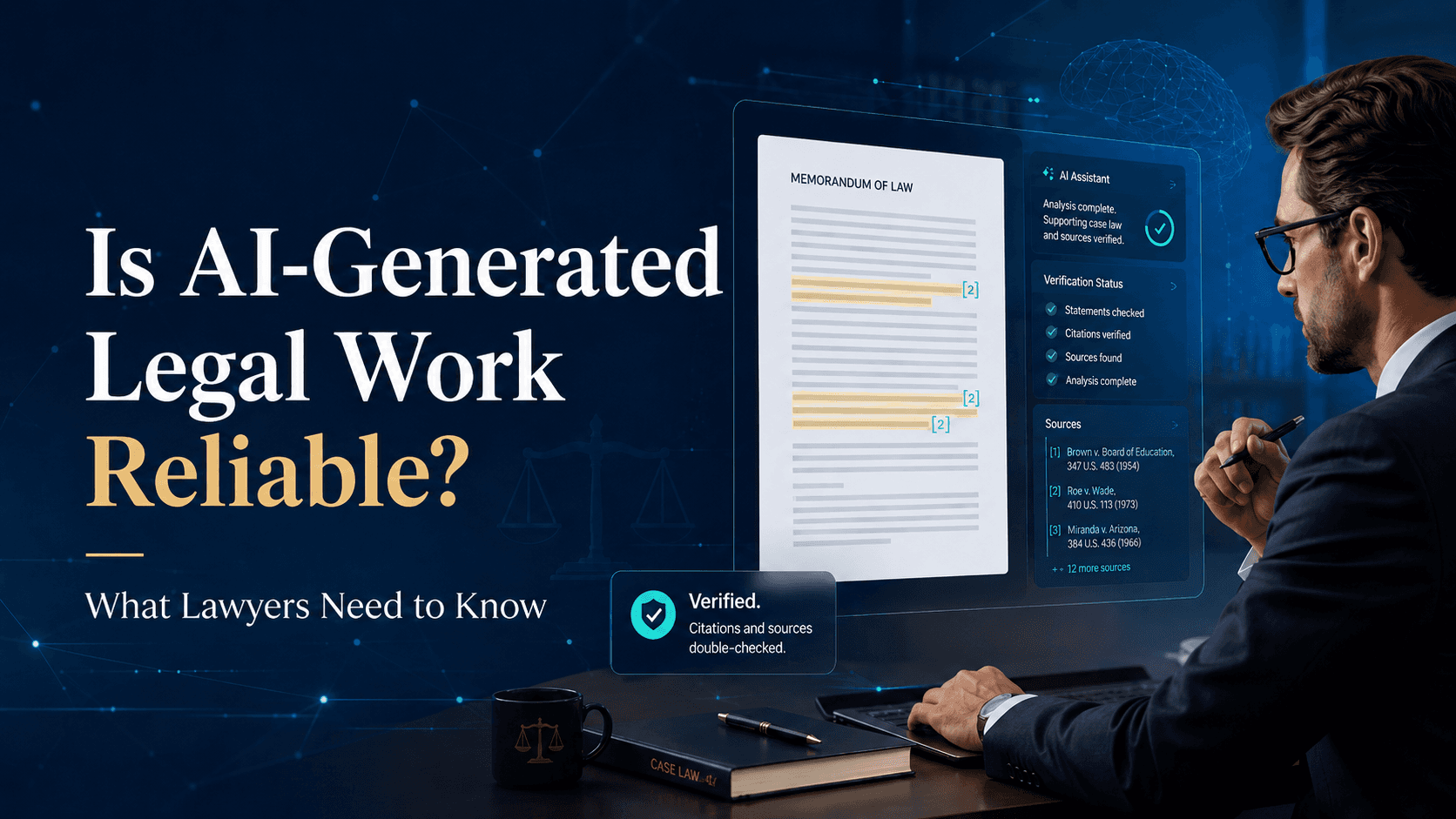
AI-generated legal work can be reliable, but not on its own. It is most trustworthy when a lawyer gives clear instructions, uses a legal-specific workflow, and verifies the sources, citations, and strategic fit before relying on the result. In other words, the safest standard is not “AI wrote it,” but “AI helped produce it and a lawyer checked it.”
That middle ground is where most practical legal teams now operate. Some lawyers are still skeptical, while others already use AI every day for drafting, research, review, and issue spotting. The useful question is not whether AI can produce legal work at all. The useful question is whether the output is accurate, source-backed, jurisdiction-aware, and responsibly reviewed.
At Lexi, our view is simple: AI should accelerate legal work, not replace professional judgment. Used well, it helps lawyers move faster on research, drafting, contract review, and document analysis. Lexi has helped legal teams process 5,000,000+ documents across 200,000+ cases for 200+ organizations, with customers reporting 45% more cases per attorney and 10+ hours saved per lawyer per week. But speed only matters if the final work product remains careful, defensible, and lawyer-led.
When AI-generated legal work is reliable
AI-generated legal work is generally reliable when three conditions line up:
- The prompt gives the system clear facts, context, jurisdiction, tone, and task.
- The tool is designed for legal workflows rather than general writing alone.
- A lawyer verifies the law, citations, reasoning, and practical fit before use.
If any of those conditions are missing, the output may still sound polished. That is exactly why legal teams need a review layer. Fluent language is not the same thing as legal accuracy.
If you are building an AI workflow inside a firm or legal department, it helps to think in terms of assistance rather than substitution. This is also why many teams start with defined use cases such as law firm workflows, corporate legal work, litigation support, or in-house legal operations before expanding wider.
Why some AI legal output goes wrong
Most weak AI legal work starts earlier than the final draft. It begins with incomplete instructions.
A vague prompt creates a vague answer. In law, vague is not just unhelpful. It can create risk. The system may assume missing facts, apply the wrong jurisdiction, miss procedural posture, or produce a draft that looks complete while overlooking the real issue.
Weak prompt vs better prompt
Weak prompt: “Draft a response to this notice.”
Better prompt: “Draft a concise response to a breach of contract notice under the relevant jurisdiction listed below. Use these facts, preserve a cooperative tone, deny liability only where supportable, identify the three strongest defenses, do not invent citations, and flag missing facts before finalizing.”
The second prompt does not make the system infallible. It gives it boundaries. That matters because legal quality depends heavily on context: what happened, where it happened, what stage the matter is in, and what outcome the lawyer is trying to achieve.
If you want a practical framework for using these tools well, see how to get started with legal AI and how lawyers can use AI safely: a 5-step checklist.
Why legal-specific workflows matter
General-purpose AI can produce clean prose across many subjects. Legal work demands more than clean prose.
Lawyers need source traceability, document context, jurisdiction sensitivity, and output that can be checked against underlying materials. A useful legal workflow also needs to fit how lawyers actually work: revising precedent, redlining contracts, summarizing large record sets, surfacing issues, and drafting in a consistent style.
That is why the better question is not “Can AI write?” It is “Can the lawyer see why the answer is right, what sources support it, and what still needs judgment?”
Lexi is built around that standard. It helps lawyers draft in the firm’s style, review and redline documents, and work from verified citations rather than unsupported assertions. That distinction matters because legal work is judged by whether it is accurate, supportable, and useful in the matter at hand.
The verification layer is where trust is created
The safest workflow is never generate-and-paste. It is generate, inspect, verify, and adapt.
Before using an AI-generated memo, clause, argument outline, or research summary, lawyers should check the following:
- Does every case, statute, regulation, section, or clause actually exist?
- Does the source say what the system claims it says?
- Is the source from the right jurisdiction and still good law where that concept applies?
- Does the authority fit the client’s facts and procedural posture?
- Is there contrary authority, an exception, or a missing limitation?
- Does the draft sound more certain than the law really is?
This review step is not evidence that AI is useless. It is how careful legal work already happens with junior drafts, templates, and internal precedent. AI changes the speed of the first pass. It does not remove the need for legal judgment.
For a deeper look at this point, see AI-assisted vs AI-generated papers and how accurate AI legal document review is.
What citation mistakes have already taught the profession
The best-known AI failure in legal practice is not awkward writing. It is fabricated or unsupported authority presented with confidence.
That risk became impossible to ignore after Mata v. Avianca, Inc., 678 F. Supp. 3d 443 (S.D.N.Y. 2023), where lawyers were sanctioned after court filings included nonexistent cases generated by ChatGPT. The lesson from that decision is not that lawyers should never use AI. The lesson is that lawyers cannot delegate verification to the tool.
Bar associations and courts in many jurisdictions have since issued guidance emphasizing existing duties of competence, confidentiality, supervision, and candor when using generative AI. The exact rules vary by jurisdiction, so lawyers should always check local court rules and professional conduct guidance. But the common theme is consistent: responsible use requires human oversight.
What good AI-generated legal work looks like
Reliable AI-assisted legal work usually has visible markers that lawyers can test:
- It is tied to the actual facts of the matter rather than generic filler.
- It distinguishes settled law from arguable positions and uncertainty.
- It points back to sources rather than asking for blind trust.
- It flags missing facts and open questions instead of hiding them.
- It gives the lawyer a draft that is workable, editable, and strategically usable.
This is why “AI-generated legal work” can be a slightly misleading phrase. In practice, the higher-quality model is AI-assisted legal work. The lawyer remains responsible for analysis, strategy, client advice, and the final product. The tool helps produce a stronger starting point faster.
If your concern is whether these outputs can be trusted in live matters, the closer question may be whether AI legal advice is safe and reliable or whether it is safe to use AI for legal documents without lawyer review. In most serious matters, review is the line between convenience and risk.
Where AI is strongest in legal work today
AI tends to be most useful in work that is document-heavy, repetitive, research-heavy, or structurally consistent. Common examples include:
- Legal research support, including first-pass issue identification and memo structuring.
- Drafting support for notices, clauses, correspondence, and argument sections.
- Contract review to spot risky clauses, inconsistencies, missing protections, and unusual terms.
- Document summarization for timelines, obligations, parties, issues, and open questions.
- Knowledge reuse, including applying preferred house style and prior drafting patterns.
These are leverage points, not substitutes for legal advice. The goal is to reduce repetitive work so lawyers can spend more time on judgment, negotiation, advocacy, and client strategy.
That practical distinction also appears in everyday workflows such as how lawyers actually use AI in practice, what AI catches in contract review and where lawyers still matter, and how lawyers can use AI to summarize legal documents safely.
So, is AI-generated legal work reliable?
Yes, with the right workflow and no, not as an unchecked final authority.
That is the practical answer most lawyers can use. Reliability depends on clear inputs, legal-specific systems, and lawyer verification. When those pieces are in place, AI can help produce faster research, cleaner first drafts, more consistent review, and better issue spotting. When those pieces are absent, confidence can outrun accuracy.
The most useful way to think about AI in law is as controlled acceleration. It can compress the time spent on first-pass work while keeping the lawyer responsible for what matters most: legal accuracy, strategic judgment, and client outcomes.
That is the standard Lexi is built around: helping legal teams move faster without giving up control of the final work product.
FAQ
Can AI-generated legal work be used without a lawyer reviewing it?
In low-stakes situations, people may choose to use AI outputs on their own, but in serious legal matters that approach creates obvious risk. AI can miss jurisdiction-specific rules, fabricate authority, or overstate conclusions. In many jurisdictions, lawyers still need to supervise and verify the final work before relying on it.
How do lawyers check whether AI-generated legal work is accurate?
Lawyers should verify every cited source, confirm the authority applies in the relevant jurisdiction, check whether the law is current, and test whether the reasoning fits the client’s facts. They should also look for omitted counterarguments, exceptions, and missing facts.
Is AI-generated legal drafting more reliable than general AI writing?
It can be, especially when the system is built for legal workflows and supports source-backed outputs, document context, and consistent drafting standards. Even then, reliability comes from the combination of the tool and the lawyer’s review process, not from automation alone.