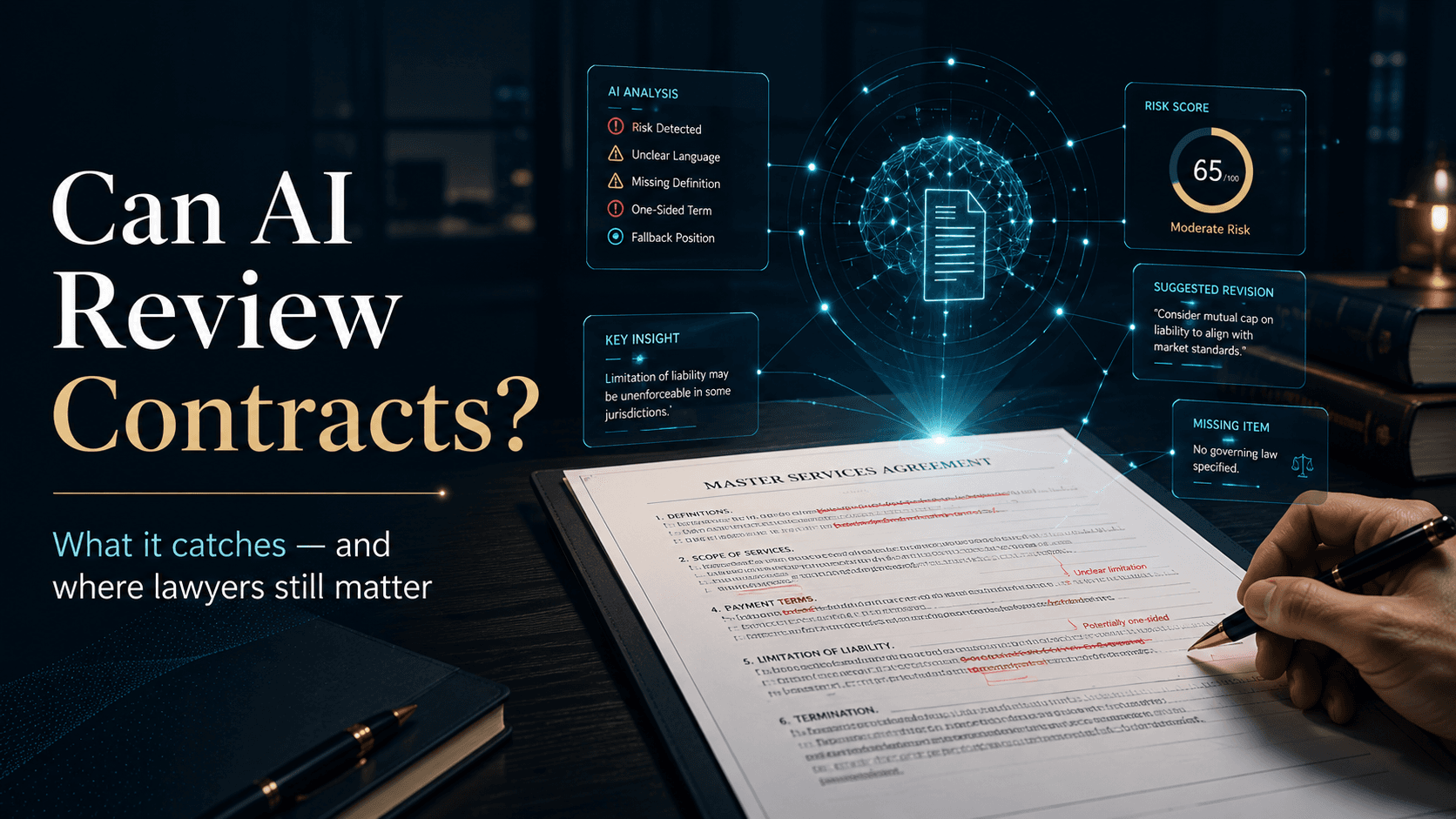
Yes, AI can review contracts in a meaningful way. It can flag hidden renewal terms, inconsistent definitions, missing protections, unusual liability positions, and other issues that are easy to miss in a manual first pass. But AI should support lawyers, not replace them: legal judgment, negotiation strategy, client context, and final approval still belong with a qualified legal professional.
Contract review is often described as a test of judgment. That is true, but it is also a test of attention and stamina. Legal teams are expected to read dense documents carefully, compare clauses against business intent, catch inconsistencies, and still preserve enough focus to advise clearly. That is why AI contract review is becoming useful across many jurisdictions: it turns first-pass review from a slow manual search into a more systematic risk-finding process.
The real question is not whether software can read a contract. It can. The better question is what AI can reliably catch, where lawyers still matter, and how teams should use tools like Lexi without giving up professional control. If you are evaluating broader reliability questions, see how reliable AI is for creating legal contracts and what lawyers should know about AI-generated legal work.
AI contract review is not just keyword search
One common misconception is that AI contract review is simply a more advanced version of Ctrl+F. In that view, the software scans for words like indemnity, termination, liability, renewal, or confidentiality and little else.
Strong contract review systems do more than hunt for keywords. They analyze the agreement as a connected document. That means linking definitions to obligations, checking whether clauses conflict with each other, noticing when expected protections are missing, and surfacing terms that appear unusual for the type of contract under review.
That matters because contracts are not just lists of clauses. They are systems of rights, duties, deadlines, carve-outs, exceptions, and consequences. A clause that looks harmless in isolation may become risky when read alongside a definition, a notice mechanism, or a limitation-of-liability section elsewhere in the document.
Other platforms in this area include Harvey and Legora, but Lexi’s differentiator is that it helps legal teams redline contracts in the firm’s style instead of stopping at generic issue spotting.
What AI can catch in contracts
The most valuable use cases are often the quiet ones: a routine-looking clause with an outsized business effect, a definition that changes the scope of an obligation, or a date-driven provision buried in the middle of dense text. In practice, AI is especially helpful for patterns like these:
Hidden renewal and notice obligations
Auto-renewal language is a classic example. A contract may require notice well before the end of the term. If that deadline passes, the client may be locked into another period before anyone realizes the renewal has already triggered.
AI can flag the renewal clause, extract the notice period, connect it to the contract term, and make the consequence easier to see. That is especially useful when a legal team is reviewing high volumes of similar agreements. For related workflow ideas, see how lawyers can use AI to summarize legal documents safely.
Internal contradictions
Some risk comes not from aggressive language but from inconsistency. A contract may describe the relationship one way in its title or recitals and another way in the operative provisions. Definitions may imply one commercial structure while payment or control clauses suggest something else.
AI can compare the purpose, defined terms, obligations, and commercial mechanics to identify provisions that do not fit together. Human lawyers are still needed to decide whether the mismatch is harmless drafting noise or a serious substantive problem.
Missing or one-sided protections
AI can also help identify what is not there. A missing limitation-of-liability clause, a one-sided indemnity, vague termination rights, absent confidentiality language, or unclear remedies can all create risk even when the contract appears complete on a quick read.
Omissions are easy to miss during a busy review because they do not announce themselves. The software’s value is in checking the document against expected protections for that agreement type, then prompting the reviewer to decide whether the absence is acceptable.
Unusual deviations from standard positions
AI is useful for surfacing terms that are stricter, broader, or more lopsided than expected, such as:
- uncapped liability
- broad audit rights
- aggressive liquidated damages
- long non-renewal notice periods
- survival clauses that outlast the commercial deal
- termination rights that benefit only one side
Not every unusual term is wrong. Some are commercially justified. The point is that unusual terms deserve focused attention before the contract is signed or returned with redlines.
Definition and cross-reference errors
A defined term may be used inconsistently. A cross-reference may point to the wrong section. A payment obligation may depend on a definition that is broader than intended. A termination right may rely on a notice procedure buried elsewhere in the agreement.
These issues are tedious to catch manually, especially in longer contracts. AI can make technical inconsistencies more visible before they become negotiation problems or post-signing disputes.
A practical example: the auto-renewal clause
Consider a commercial agreement with an auto-renewal provision buried deep in the document. The clause requires a party to give notice far in advance to opt out. There is no summary at the front and no visual warning in the text.
The risk is not that the clause is impossible to understand. The risk is that no one sees it in time. AI contract review can identify the renewal language, pull out the notice requirement, connect it to the contract term, and flag the likely business consequence for human review.
That flag is not the legal answer. It is the starting point for better advice. A lawyer still decides whether the clause is market-standard, negotiable, commercially acceptable, or too risky for the client’s objectives.
Where lawyers still matter
AI is strong at spotting review issues, but there is a clear line between issue spotting and legal advice. Software does not fully understand the client relationship, negotiation leverage, internal risk tolerance, or the real-world cost of being wrong. It also does not carry professional accountability.
This is why many bar associations and professional bodies have emphasized supervision, confidentiality, and competence when lawyers use generative tools. And the broader lesson from widely reported incidents like Mata v. Avianca in the Southern District of New York in 2023 is straightforward: legal professionals cannot outsource responsibility to a model.
The practical model is AI plus lawyers, not AI instead of lawyers:
- AI handles the first pass and surfaces likely issues.
- The lawyer checks the document against the client’s goals and bargaining position.
- The legal team decides what to accept, revise, negotiate, or escalate.
- Final advice and sign-off remain with a qualified legal professional.
This approach is also more realistic for legal operations. The goal is not to remove lawyers from contract review. The goal is to reduce repetitive review work so more time goes to judgment, negotiation, and strategy. If you want a broader view, read how lawyers actually use AI in practice.
How Lexi fits into the contract review workflow
Lexi is built for this middle ground. It helps legal teams move through contracts faster while keeping lawyers in control of judgment and output quality. Across 200+ organizations, Lexi has helped legal teams work more efficiently, with reported outcomes including 45% more cases per attorney and 10+ hours saved per lawyer per week.
In a contract review workflow, Lexi can help teams:
- identify key clauses and obligations across an agreement
- surface hidden renewal, termination, indemnity, confidentiality, liability, and payment issues
- spot contradictions between clauses, definitions, and the stated purpose of the contract
- highlight missing or unusually one-sided protections
- prepare redlines in the firm’s style for lawyer review
- support review across practice settings, including law firms, corporate legal teams, in-house teams, and litigation teams
The practical benefit is simple: less time spent hunting for issues, more time spent deciding what those issues mean. That division of labor is where lawyers add the most value.
A simple review lens before signing or approving a contract
Whether a contract is reviewed manually or with AI support, the best habit is to read for consequences, not comfort. Most people look first at what they are getting. Better review starts with what they may be giving up, assuming, or leaving unclear.
Before approving a contract, ask:
- How does this agreement renew, end, or extend?
- What happens if the relationship breaks down?
- Who pays if something goes wrong?
- Which obligations survive termination?
- Are remedies, liability limits, and indemnities balanced?
- Does the document match the commercial deal the parties believe they made?
AI can help surface where those answers are hidden. Lawyers still determine whether the answers are acceptable. If you want a safer implementation framework, see how lawyers can use AI safely and how accurate AI legal document review is.
The takeaway
So, can AI review contracts? Yes. It can catch hidden terms, flag unusual obligations, identify internal contradictions, and make first-pass review faster and more consistent.
But it does not replace legal judgment. It improves the conditions in which legal judgment is exercised.
The best contract review workflow is not a choice between software and lawyers. It is software catching what a tired human eye may miss, and a lawyer deciding what matters, what should change, and what the client should do next. Because professional rules differ across many jurisdictions, legal teams should also check their local bar guidance, confidentiality obligations, and client policies before adopting any AI-enabled review process.
FAQ
Can AI review contracts better than a lawyer?
AI can be faster and more consistent at spotting patterns, missing clauses, and technical inconsistencies in a first pass, but it is not better than a lawyer at applying legal judgment, negotiating strategy, or advising a client in context.
What kinds of contracts can AI review?
AI can assist with many common agreement types, including commercial contracts, vendor agreements, NDAs, service agreements, employment-related documents, and leases. Performance still depends on document quality, workflow design, and lawyer oversight.
Is it safe to use AI for contract review?
It can be, if legal teams use tools with appropriate security controls, keep lawyers in the loop, verify important outputs, and follow applicable professional rules. For a deeper look, read whether it is safe to use AI for legal documents without lawyer review.