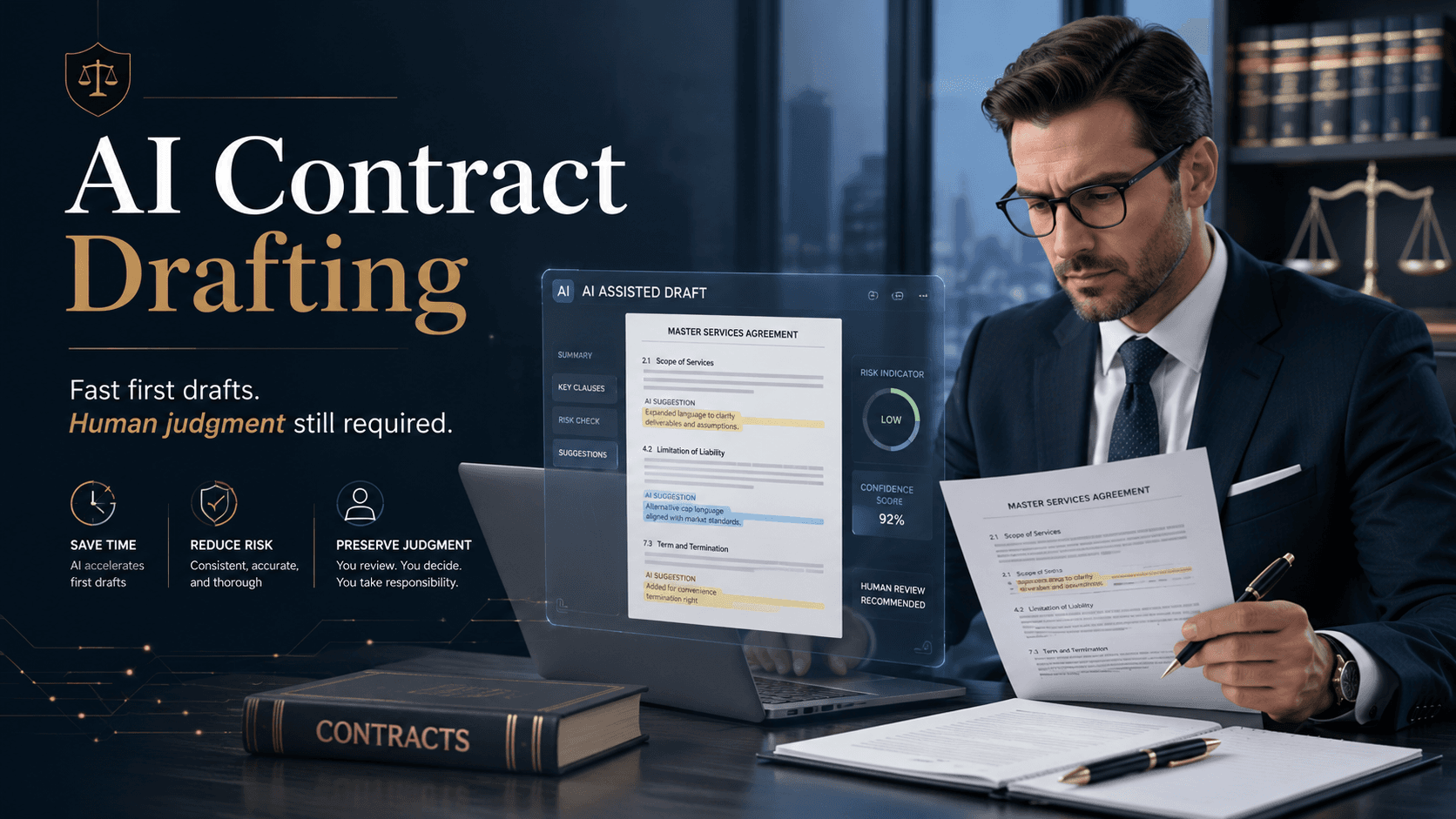
AI is reliable for creating legal contracts as a first-draft tool, not as a substitute for legal judgment. It can speed up structure, clause assembly, summarization, redlining, and revision, but the final contract still needs human review to confirm facts, reflect the parties’ intent, and comply with the rules of the relevant jurisdiction. In practice, the safest answer is simple: use AI to draft faster, and use a lawyer to make the contract dependable.
That has been my experience as a practicing lawyer. When I first started using AI for contracts, I expected immediate time savings. What I did not expect was how much I had to unlearn before those savings became real.
Like many lawyers trying AI for the first time, I started with a general-purpose tool and used it for simpler agreements such as employment contracts. The first drafts often needed heavy revision. That was not because the technology was useless. It was because my prompts were incomplete, and because a general system does not automatically know the legal context, drafting preferences, clause hierarchy, or risk allocation choices I would expect in professional contract work.
That early experience taught me the first serious lesson about AI drafting: reliability depends heavily on the quality of the input. If the instructions are vague, the output will usually be vague. If the facts are wrong, the draft may look polished while still being wrong in substance. For legal work, that gap matters.
Why AI can be reliable for contract drafting
AI is most reliable when you ask it to do work that is pattern-based and document-heavy. Contracts often follow recognizable structures. Definitions, payment terms, indemnities, limitations of liability, governing-law clauses, notice provisions, and termination mechanics all appear in recurring forms across many matters. That makes drafting assistance a natural use case for legal AI.
With a legal-specific system, the difference becomes obvious. Instead of starting from a blank page, I can begin with a structured draft that already resembles a contract a lawyer would recognize. That does not remove my responsibility, but it does reduce low-value manual effort. Lexi, for example, is designed for legal workflows and can draft in a firm’s style, redline contracts, and support citation-grounded legal work. Across 200+ organizations, Lexi has helped legal teams process 5,000,000+ documents and 200,000+ cases, with reported outcomes such as 45% more cases per attorney and 10+ hours saved per lawyer per week.
That kind of reliability is practical rather than absolute. It means the system can usually produce a usable starting point faster than a lawyer drafting from scratch. It does not mean the system can decide what should be in the contract for this client, in this transaction, under this risk profile.
If you are evaluating how AI fits into a legal workflow more broadly, how lawyers actually use AI in practice and how to get started with legal AI are useful places to begin.
What improved when I moved from generic AI to legal AI
The biggest change was not magic accuracy. It was better legal structure from the start. A legal-focused drafting system understands that contract work is not just elegant writing. It is logic, sequencing, internal consistency, and risk allocation. A missing exception, an undefined term, or an inconsistent remedy clause can create real downstream problems.
One feature I rely on heavily is translation between English and regional-language material. In many markets, multilingual drafting and review are part of daily legal work. Here, reliability is not only about grammar. It is about preserving the legal meaning of obligations, carve-outs, and conditions. A tool that handles legal language more carefully is far more useful than one that merely sounds fluent.
I also put value on review support. AI is not only for first drafts. It can help compare versions, identify changed obligations, summarize deviations, and surface issues worth checking. That complements the kind of disciplined review lawyers already do. If that use case is relevant to you, see can AI review contracts and how accurate is AI legal document review.
Why I still read every line before anything goes out
I still review every contract personally before it reaches a client or counterparty. That is not resistance to technology. It is basic professional responsibility.
A contract is not just a formatted document. It is a written allocation of business risk. AI does not interview the client, understand the commercial backstory, sense which fallback positions are acceptable, or appreciate which clause will matter most if the relationship breaks down. A lawyer does.
That is why AI reliability has to be framed correctly. The question is not whether the draft sounds legal. The question is whether it accurately reflects the client’s goals, the negotiated deal, and the legal environment that governs the agreement. A model can help with wording. It cannot own the judgment.
This is also where overtrust becomes dangerous. Widely reported incidents involving fabricated citations in legal filings, including Mata v. Avianca in the Southern District of New York in 2023, are reminders that confident-looking output is not the same as verified output. That case involved legal research and briefing rather than contracts, but the lesson carries over: lawyers must verify what AI produces.
Where AI works well and where human involvement must increase
I do not think the right rule is “use AI only for simple contracts.” The better rule is that every contract needs lawyer involvement, but the intensity of that involvement changes with the stakes.
Lower-risk, repeatable agreements
For documents such as NDAs, basic employment agreements, routine service agreements, or standard internal templates, AI can be highly useful. If the prompt is complete and the template logic is clear, the system can generate a strong starting version quickly. The review is still necessary, but it is usually more targeted.
Higher-risk, negotiated, or bespoke agreements
For settlement agreements, major commercial contracts, financing documents, cross-border arrangements, or transaction-critical contracts, lawyer involvement should increase substantially. In those matters, every defined term, trigger, remedy, limitation, and exception deserves closer scrutiny. AI may still produce the foundation, but the margin for error is smaller and the cost of a mistake is much higher.
This is especially true across jurisdictions. A clause that is common in one market may need different wording, different assumptions, or different enforcement analysis elsewhere. No blog post can tell you local law for every market, and no AI output should be treated as universal. Check your local bar rules, supervisory obligations, confidentiality duties, and applicable contract law before relying on any generated draft.
Will AI-drafted contracts hold up legally?
Yes, an AI-drafted contract can hold up legally if the final agreement satisfies the usual requirements of enforceability in the relevant jurisdiction. In other words, the fact that AI helped prepare the draft does not automatically make the contract invalid. What matters is whether the agreement properly reflects the parties’ consent, uses enforceable terms, and complies with applicable law and formalities.
The real risk is not that AI touched the document. The real risk is that someone mistakes a generated draft for a finished legal product.
That is why I advise lawyers and clients to separate two questions:
- Can AI help create the initial contract language faster? Usually yes.
- Can AI alone guarantee that the contract is correct for the deal, the parties, and the jurisdiction? No.
If you are thinking about whether non-lawyers should rely on generated documents by themselves, is it safe to use AI for legal documents without a lawyer review and can AI replace a lawyer for my legal documents cover that question directly.
How to get more reliable contract drafts from AI
In my experience, better results come less from clever prompting tricks and more from disciplined legal workflow. Reliability improves when the lawyer gives the system enough context and then reviews the result with the same seriousness they would apply to a junior draft.
- State the contract type clearly and identify the parties.
- Describe the business deal in concrete terms, not shorthand.
- Specify the governing jurisdiction if relevant and avoid assuming one set of local rules applies everywhere.
- Identify non-negotiable clauses, fallback positions, and deal-breakers.
- Ask for defined terms, internal consistency, and plain-language issue spotting.
- Compare the output against your precedent or firm style before sharing it.
- Review liability, indemnity, termination, dispute-resolution, payment, confidentiality, and assignment clauses line by line.
- Confirm that the final draft reflects the client’s real commercial objective, not just a technically neat template.
For teams trying to build a safer process around this, how lawyers can use AI safely offers a practical checklist.
What this changes for lawyers, especially junior lawyers
One reason I think contract AI will keep spreading is that it removes some of the least valuable friction from legal work. Drafting first versions from scratch has traditionally consumed a large share of junior lawyers’ time. AI can reduce that burden and let younger lawyers spend more time learning negotiation strategy, issue spotting, client communication, and judgment.
That shift should not be confused with replacing lawyers. If anything, it raises the value of lawyers who can review, refine, and take responsibility for the final product. The profession still depends on judgment. The tool changes the workflow, not the duty. I discuss that broader shift in how AI is changing the legal profession.
For legal teams that want this kind of support in context, Lexi is used across law firms, corporate legal teams, in-house departments, and litigation teams.
The takeaway
So, how reliable is AI for creating legal contracts? Reliable enough to accelerate drafting, organize clauses, and improve the first version. Not reliable enough to replace lawyer review, client-specific judgment, or jurisdiction-specific legal analysis.
That is the right level of trust. Let AI save time. Let lawyers decide what the contract should say, what risks it should allocate, and whether it is ready to sign. In contract work, reliability does not come from generation alone. It comes from generation plus verification.
FAQ
Can AI write a legally binding contract?
AI can help draft contract language, but whether the final agreement is legally binding depends on the usual requirements in the relevant jurisdiction, such as valid consent, lawful terms, and proper execution. The AI’s involvement does not decide enforceability by itself.
Is it safe to use AI for contract drafting without a lawyer?
For low-stakes personal use, some people may use AI as a starting point, but relying on it without lawyer review creates real risk. A contract can look polished while still missing important protections, using the wrong assumptions, or failing to fit local law.
What parts of an AI-generated contract should lawyers verify first?
Start with the business terms, defined terms, liability allocation, indemnities, termination rights, dispute-resolution clauses, payment mechanics, confidentiality language, and any jurisdiction-specific wording. Those areas often determine whether a contract works when a dispute arises.