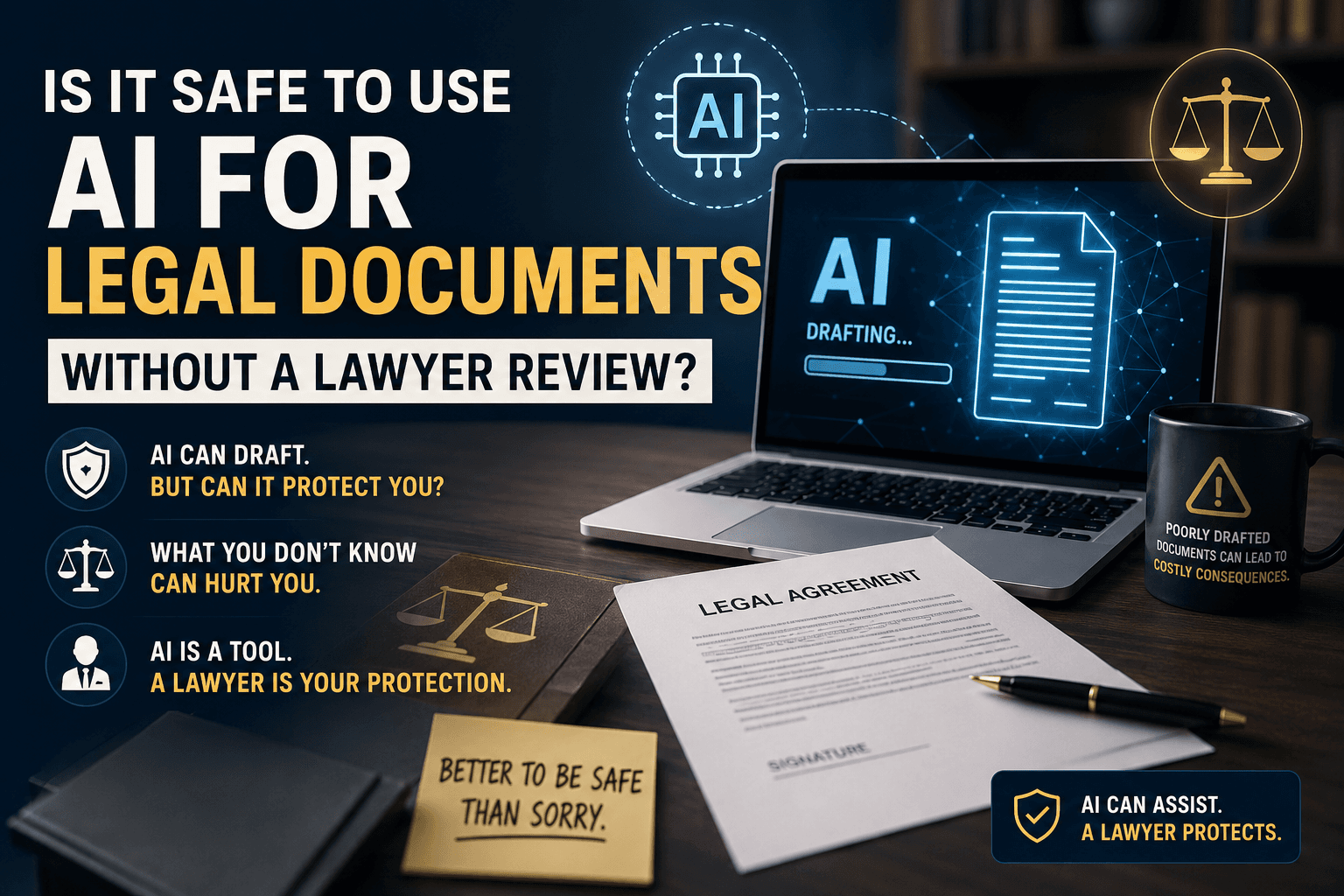
AI legal documents without lawyer review are usually not the safest choice for any document that creates real obligations, transfers risk, or could lead to a dispute later. AI can help produce a fast first draft, but it cannot reliably spot missing protections, local enforceability issues, or business risks the way a qualified lawyer can. In practice, the safest approach is to use AI as a drafting assistant and get a lawyer to review the final document before you sign.
The promise of AI in legal drafting is real
Let me be clear at the outset: I use AI to draft legal documents. Contracts, employment agreements, lease agreements, NDAs, and more. Used properly, it can save significant time and give you a coherent starting point much faster than drafting from a blank page.
That benefit is real. So is the limit.
In my own workflow, AI is one step inside a broader legal process:
- I gather detailed facts, commercial objectives, and risk concerns from the client.
- I frame the drafting task with legal context, relevant jurisdictional considerations, and the protections the document needs.
- I generate a draft with AI.
- I review, revise, and test the clauses against the deal, the facts, and the applicable legal framework.
- I walk the client through the document so they understand what it does, what it does not do, and where the trade-offs are.
That is why AI works well in professional hands. It is an accelerator, not a substitute for legal judgment. If you want a practical overview of how lawyers use these tools in real workflows, see how lawyers actually use AI in practice.
The biggest misconception: thinking a prompt is enough
Most problems start with a simple assumption: if the prompt sounds clear, the legal document must be good enough.
Someone types, “Draft a lease agreement,” or “Write a consulting contract,” and the output looks polished. It has headings, definitions, signatures, and legal-sounding language. That appearance of completeness is exactly why people trust it too quickly.
The real danger is not only what AI writes. It is what the user does not know to ask for.
A legally useful prompt often depends on background knowledge such as:
- Which clauses are standard for this type of transaction
- Which fallback positions are acceptable if the other side pushes back
- Which local rules may affect enforceability, notice, formalities, consumer rights, employment protections, stamp duties, registration, or governing law
- Which future scenarios should be addressed now rather than fought over later
- Which words create obligations that the client never intended to accept
A non-lawyer usually is not missing these points because they are careless. They are missing them because legal drafting is partly about anticipating risks that are invisible until you have seen disputes happen. That is also why AI does not replace a lawyer for legal documents in any reliable, general sense.
The hidden risk: you cannot request protections you do not know exist
This is the issue many discussions skip over. AI responds to instructions. It does not automatically understand your strategic position the way your lawyer does.
If the other side has legal advice and you do not, they may spot weaknesses immediately. Missing or underdeveloped provisions around termination, indemnity, liability caps, warranties, confidentiality, dispute resolution, payment mechanics, IP ownership, or notice can shape the outcome of a dispute long before anyone reaches court or arbitration.
You cannot tell AI to include a protection you do not know you need.
And even when AI includes a clause, that does not mean the clause is well calibrated for your situation. A clause can be too broad, too narrow, internally inconsistent, hard to enforce, or commercially unrealistic. A contract does not become safe just because it sounds formal.
For a deeper look at where automated review helps and where lawyers still matter, see can AI review contracts.
What can actually go wrong with AI legal documents without lawyer review?
The consequences are practical, not theoretical. Once signed, many documents create real rights and obligations regardless of whether they were drafted by a human, a template, or AI. In many jurisdictions, parties are generally bound by what they sign, subject to local rules and defenses. That is why “the AI wrote it” is not a meaningful safety net.
Common problems include:
- Important clauses are missing entirely.
- Key business terms are vague or inconsistent across sections.
- Defined terms do not match how they are used later in the document.
- The governing law, forum, or dispute process is poorly chosen.
- One party assumes liability exposure far beyond what they intended.
- The document conflicts with local formalities or mandatory legal protections.
- The text copies generic language that does not fit the actual transaction.
Even a short agreement can create expensive disputes if payment triggers, deliverables, exit rights, or remedies are unclear. The cost of review up front is often small compared with the cost of fixing a bad document after the relationship breaks down.
Why confidence is not the same as reliability
One reason AI-generated legal work can be risky is that fluent language creates false reassurance. A clean draft is easy to confuse with a careful draft.
Lawyers have now seen the wider danger of over-trusting generative systems in legal work. In Mata v. Avianca (S.D.N.Y. 2023), lawyers were sanctioned after submitting fake case citations generated by AI. That case involved legal research rather than contract drafting, but the lesson carries over: persuasive formatting can conceal serious errors.
The same pattern appears in documents. The draft may read smoothly while still failing on the issues that matter most: allocation of risk, enforceability, negotiation leverage, and fit for the actual facts. If you want a broader discussion of this reliability problem, read is AI-generated legal work reliable.
Are some documents lower risk than others?
Yes, some are lower risk. But “lower risk” does not mean “safe without review.”
As a practical matter, AI is less dangerous when the document is simple, the stakes are low, the relationship is straightforward, and both parties understand the arrangement well. A basic internal checklist or a rough first draft for discussion may be fine as a starting point.
The risk rises quickly when the document involves:
- Significant money or long-term obligations
- Employment, equity, financing, IP, real estate, or regulatory exposure
- Cross-border elements or more than one possible jurisdiction
- Unequal bargaining power between the parties
- Potential future disputes over scope, quality, deadlines, or payment
For these matters, skipping review is usually a poor trade. If the document matters enough to sign, it usually matters enough to review properly.
What about using AI for a first draft only?
That is often the right use case. AI can be valuable at the drafting stage because it helps you organize facts, generate alternatives, compare structures, and move faster from instructions to a workable draft.
At Lexi, this is the practical model: AI helps lawyers draft in the firm's style, review language faster, and work through documents at scale, while legal judgment remains with the lawyer. Across 200+ organizations, Lexi has helped teams process 5,000,000+ documents and 200,000+ cases, with reported gains such as 45% more cases per attorney and 10+ hours saved per lawyer per week. The point of those gains is not to remove judgment. It is to free time for judgment where it matters most.
If you are evaluating safe adoption, the right question is not whether AI should touch legal documents. It already does. The better question is where automation ends and legal accountability begins. For a practical starting point, see how to get started with legal AI.
The safest way to use AI for legal documents
If you plan to use AI in drafting, use it in a way that reduces risk rather than hiding it.
1. Give complete facts, not a one-line request
Include the parties, purpose, payment terms, timeline, deliverables, risk concerns, negotiation history, and any unusual scenarios you are worried about. Generic instructions produce generic documents.
2. Treat the first draft as incomplete by default
Do not assume the draft contains every clause you need or that each clause says what you think it says. Read it skeptically.
3. Check jurisdiction and local formalities
Rules on enforceability, mandatory rights, consumer protection, employment protections, notice, registration, stamping, witnessing, and e-signatures vary across jurisdictions. Check your local bar rules and local law where relevant.
4. Review for business risk, not just grammar
The key questions are who bears the risk, what happens if something goes wrong, how the relationship ends, and what remedies exist. A grammatically clean document can still be a bad deal.
5. Get lawyer review before signature when the stakes are real
This is the step that turns AI from a convenience into a safer workflow. If you want a practical framework, see how lawyers can use AI safely: a 5-step checklist.
Who should be especially cautious?
Some users are more exposed than they realize. Be particularly careful if you are:
- A founder signing vendor, investment, employment, or IP documents
- A small business owner relying on a customer or supplier contract for cash flow
- An employee reviewing restrictive covenants, compensation terms, or termination provisions
- A landlord or tenant using a template for a property arrangement
- Anyone signing a document prepared by the other side without independent review
In each of these situations, a missing clause or a poorly framed clause can matter far more than the time or money saved by skipping review.
The bottom line
AI legal documents without lawyer review can be useful as drafts, but they are not reliably safe for important legal matters. AI is good at producing structure and language. It is not dependable on its own for judgment, negotiation strategy, or tailoring risk allocation to your exact situation.
My view as a practicing lawyer is simple: use AI to move faster, not to remove professional review where the document could materially affect your rights, obligations, money, or future disputes. If it matters enough to sign, it usually matters enough to have checked by a lawyer.
FAQ
Can I use AI to draft a contract and then sign it without a lawyer?
You can, but for anything beyond a very low-stakes document, it is usually risky. AI can miss important protections, produce vague terms, or use language that does not fit your jurisdiction or your actual deal.
Are AI-generated legal documents enforceable?
In many jurisdictions, a document can still be enforceable even if AI drafted it. Enforceability depends on the facts, the applicable law, and the document’s content and formalities, not on whether a human or AI wrote the first draft.
When should I always get lawyer review for an AI-drafted legal document?
Get lawyer review whenever the document involves significant money, long-term obligations, employment, intellectual property, real estate, financing, regulatory exposure, cross-border issues, or any meaningful chance of a dispute later.