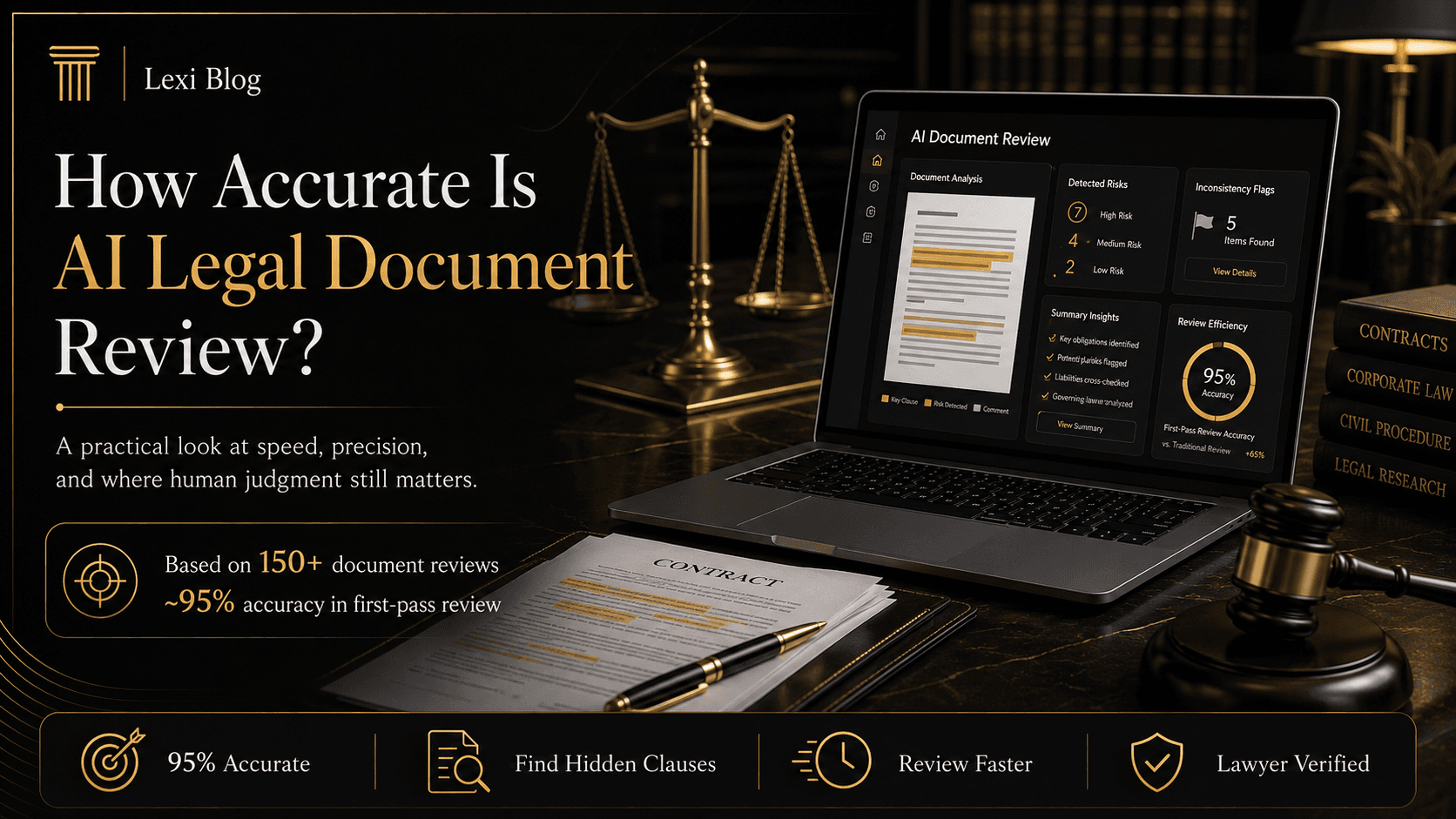
AI legal document review is accurate enough to be genuinely useful for first-pass issue spotting, clause extraction, summarization, and consistency checks, but it should not replace lawyer judgment. In practice, the right question is not whether AI is perfect. It is whether it helps lawyers find important issues faster, more consistently, and with less fatigue. For many teams, the answer is yes.
Used properly, AI review can surface non-standard clauses, highlight internal conflicts, and accelerate long-document analysis in minutes rather than hours. But accuracy still depends on the document type, the prompt or workflow, the quality of the underlying system, and lawyer verification before advice is given or redlines are sent.
What “accurate” means in AI legal document review
Accuracy in legal review is not just about whether a tool extracts the right text. It usually includes several different tasks:
- Identifying key clauses and defined terms
- Spotting unusual, missing, or one-sided provisions
- Summarizing obligations, risks, and deadlines correctly
- Linking related provisions across a document
- Producing reliable citations or references when legal authorities are involved
That is why a single headline percentage can be misleading. A tool may be strong at finding assignment, indemnity, limitation-of-liability, termination, or confidentiality clauses, but weaker at understanding negotiation posture or business context. Lawyers should evaluate accuracy task by task, not as a vague marketing claim.
Where AI legal document review is usually most accurate
AI tends to perform best when the task is structured and the source material is available in full. That includes:
- Clause extraction from contracts, NDAs, employment agreements, leases, and procurement documents
- First-pass comparison against a playbook or preferred positions
- Summaries of long agreements and supporting exhibits
- Issue spotting across repetitive or high-volume document sets
- Draft redlines and comments for lawyer review
These are the kinds of workflows where consistency matters and fatigue hurts human reviewers. If you want a practical overview of adjacent use cases, see how lawyers actually use AI in practice and how lawyers can use AI to summarize legal documents safely.
Lexi is designed for these real legal workflows, including drafting in the firm’s style, redlining contracts, and helping lawyers work through documents faster across law firms, corporate legal teams, litigation teams, and in-house teams.
Where AI review is less reliable without a lawyer
AI can be impressive at finding language, but legal review is not only a search problem. Many of the hardest calls are contextual. That is where lawyer oversight remains essential.
- Commercial judgment: A clause can be risky but still acceptable in the context of the deal.
- Negotiation strategy: The right fallback position depends on leverage, timing, and client objectives.
- Jurisdiction-specific enforceability: Rules vary across many jurisdictions, so local-law assumptions should always be checked.
- Missing facts outside the document: AI does not inherently know the relationship history, side communications, or practical constraints unless they are provided.
This is also why lawyer review matters even when the first pass is excellent. If you are weighing whether non-lawyer use is enough, read is it safe to use AI for legal documents without a lawyer review and can AI replace a lawyer for my legal documents.
Why lawyers should be careful with unsupported accuracy claims
It is tempting to describe legal AI as flawless or to attach precise percentages to performance. But unless those numbers come from a clear, reproducible methodology, they should be treated cautiously. A better way to evaluate accuracy is to test the system on your own documents and compare the output against a known-good human review standard.
In other words, ask questions such as:
- Did it identify the provisions my team actually cares about?
- Did it miss anything material?
- Were the summaries faithful to the source text?
- Did the redlines match our playbook and drafting style?
- How much lawyer time did it save after verification?
Lexi has processed more than 5,000,000 documents across 200,000+ cases for 200+ organizations, and users report outcomes such as 45% more cases per attorney and 10+ hours saved per lawyer per week. Those are more meaningful indicators of operational value than isolated demo claims, because they reflect how legal teams actually work at scale.
How to judge AI legal document review accuracy in your own practice
The best evaluation is a controlled pilot. Pick a document set your team knows well and test the AI against your normal workflow.
1. Use a representative sample
Include different document types, lengths, and complexity levels. A tool that performs well on a short NDA may behave differently on a long lease, procurement agreement, or employment pack.
2. Create a review rubric
Score the output on clause identification, issue spotting, summary quality, redline usefulness, and citation reliability where relevant.
3. Compare against expert review
Have experienced lawyers assess what the tool found, what it missed, and what was overstated. The goal is not to embarrass either the AI or the humans. It is to find the best combined workflow.
4. Measure time saved after verification
Fast output is only helpful if the checking burden is reasonable. For many teams, the real gain is not full automation but a much stronger first draft or first review pass.
5. Check confidentiality and governance
Accuracy is only part of trust. Legal teams should also assess data handling, access controls, retention policies, and any local professional-responsibility obligations. Many jurisdictions and bar bodies have issued guidance that technology competence and confidentiality still apply when lawyers use AI.
If you are early in the process, how to get started with legal AI offers a practical framework.
What responsible use looks like
Responsible use means treating AI as an accelerant for legal work, not a substitute for legal accountability. That includes clear review steps, matter-appropriate supervision, and caution around legal authorities.
The warning signs are well known. In Mata v. Avianca (S.D.N.Y. 2023), lawyers were sanctioned after filing a brief containing fake citations generated by AI. The lesson was not that AI is useless. It was that verification is non-negotiable, especially where legal authorities are involved. For a broader discussion, see is AI-generated legal work reliable.
Well-designed legal AI workflows help reduce risk by grounding outputs in the source document, generating redlines a lawyer can inspect, and supporting verified citations rather than opaque assertions. That kind of workflow is materially different from copying a prompt into a general chatbot and trusting the answer.
The bottom line
So, how accurate is AI legal document review? Accurate enough to deliver real value in first-pass legal work, especially for spotting issues, extracting clauses, summarizing documents, and accelerating review at scale. Not accurate enough to remove the need for lawyer judgment, local-law analysis, or final verification.
The most productive approach is not AI versus lawyers. It is AI plus lawyers: a faster, more consistent review process where software handles the repetitive first pass and counsel makes the decisions that actually require legal judgment.
FAQ
Can AI review contracts accurately enough for law firms?
Yes, for many first-pass review tasks. AI can often identify key clauses, summarize obligations, and suggest redlines quickly. Law firms should still require lawyer validation before sending advice or final markup.
Is AI legal document review more accurate than manual review?
It can be more consistent than tired or time-pressured manual review on repetitive tasks, but that does not make it universally better. The strongest results usually come from combining AI speed with lawyer oversight.
Should clients rely on AI legal document review without a lawyer?
Usually no, especially where risk allocation, enforceability, negotiation strategy, or jurisdiction-specific issues matter. AI can help organize and flag issues, but legal advice should be reviewed by a qualified lawyer under applicable local rules.