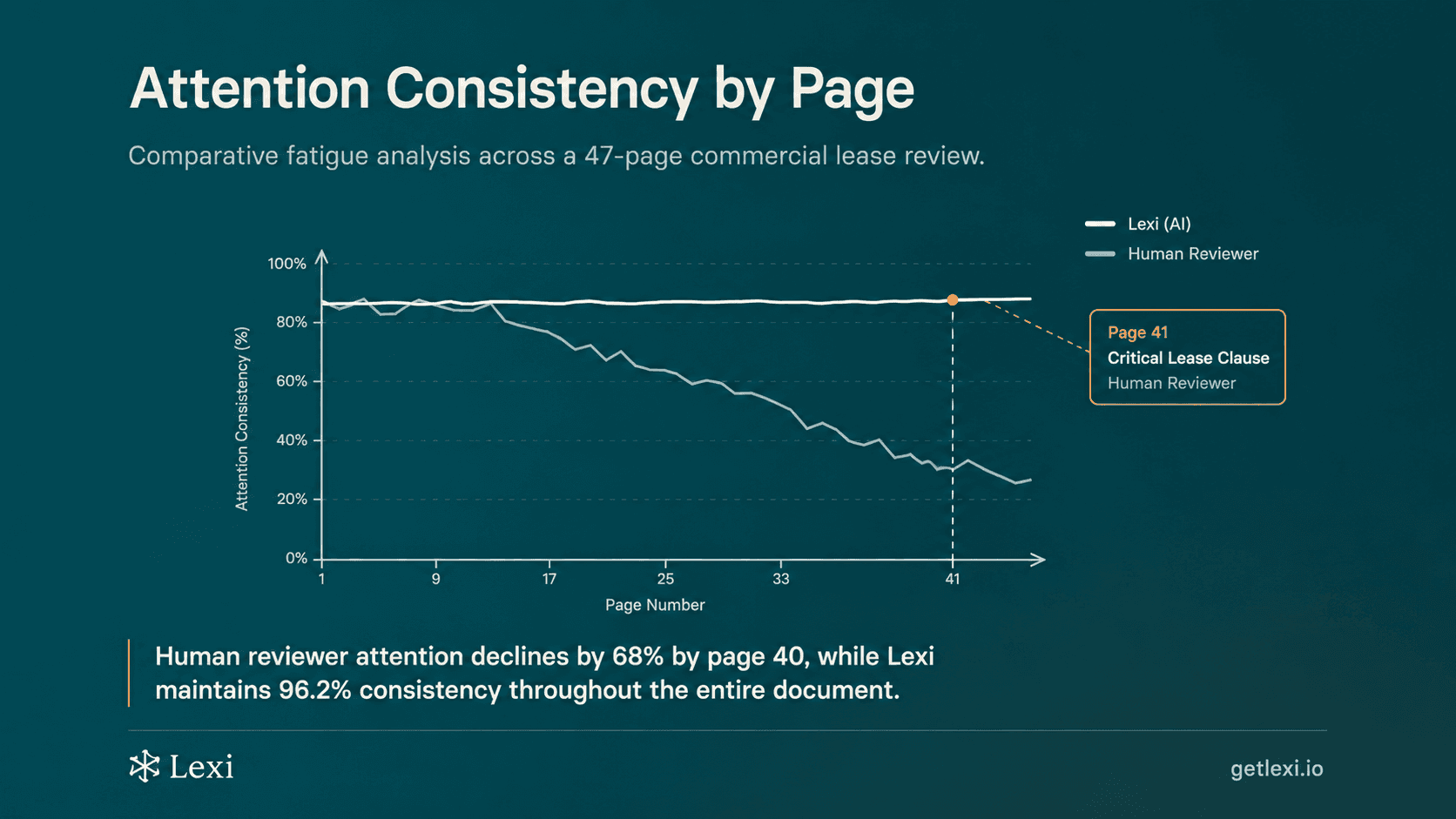
AI vs human attention in legal document review is not really a contest between legal judgment and software. Lawyers still provide the judgment, context, and client advice that matter most. The real difference is that human attention naturally drops during long, repetitive review, while AI can apply the same pattern-checking process across every page. The safest approach in many jurisdictions is not AI alone or human review alone, but AI-assisted legal review with lawyer oversight.
Every lawyer has felt this problem, even if they do not usually describe it in those terms. A review often starts with high concentration. Early definitions get close attention, core obligations are checked carefully, and unusual drafting stands out quickly. But as the document continues, the language becomes more repetitive, the clauses more familiar, and sustaining the same level of scrutiny becomes harder.
The issue is usually not legal knowledge. Experienced lawyers generally know what they are looking for in a lease, supply agreement, financing document, or employment contract. The harder part is maintaining the same quality of attention on page 47 as on page 1.
That is why the attention problem matters. Legal review quality depends not only on expertise, but also on consistency. If attention fluctuates, risk detection fluctuates with it.
The problem in legal review is often sustained attention, not lack of expertise
Commercial documents are rarely difficult because a lawyer cannot understand the subject matter. They are difficult because important terms are scattered across long drafts filled with boilerplate, defined terms, carve-outs, exceptions, schedules, and cross-references.
A commercial lease is a good example. Material risk can sit in rent adjustment language, assignment restrictions, repair obligations, indemnities, insurance provisions, default clauses, termination mechanics, force majeure wording, or liability limitations. Any one of those provisions may become critical later. The fact that a clause appears deep in the document does not make it less important.
What changes over time is human vigilance. One of the classic findings in psychology is the vigilance decrement: as a repetitive monitoring task continues, performance tends to decline. Norman Mackworth's well-known 1948 work on sustained attention helped establish that basic pattern. Lawyers do not stop being competent during a long review. But they are still human, and long stretches of repetitive reading can reduce the likelihood that a subtle but important clause gets flagged at the right moment.
That is one reason the broader discussion around how AI is changing the legal profession should include attention and consistency, not just speed.
Why AI can outperform humans on consistency but not on judgment
AI-assisted review systems do not get bored, rushed, or mentally dulled by page count in the way people do. If properly designed, they can scan the entire document for the same categories of issues, compare clauses against playbooks, and surface deviations in a consistent way from start to finish.
That consistency is valuable in several common review tasks:
- Spotting missing clauses or unusual wording
- Comparing obligations across sections and schedules
- Flagging deviations from standard fallback positions
- Identifying terms that conflict with internal policies or prior drafts
- Summarizing large documents so lawyers can review the highest-risk areas first
But consistency is not the same thing as legal judgment. AI may identify a clause as non-standard without knowing whether that deviation is commercially acceptable for this client, this deal, and this negotiating posture. It may surface language that looks risky in isolation but makes sense in the wider transaction structure.
That is why the right comparison is not "AI replaces the reviewer". It is "AI handles repetitive detection, while lawyers handle judgment, strategy, and accountability." If you want the practical version of that distinction, see how lawyers actually use AI in practice.
The hidden risk in long contracts is uneven scrutiny
Many review mistakes happen not because a lawyer missed the law, but because the document did not receive even scrutiny throughout. A reviewer may give close attention to the opening sections, skim familiar boilerplate later, then re-focus only when an obviously negotiated clause appears. That creates an uneven review pattern.
In practice, uneven scrutiny can lead to missed issues such as:
- A carve-out buried in an indemnity clause
- An auto-renewal term hidden in operational language
- A notice requirement tied to a short deadline
- A payment exception inside a force majeure provision
- A governing law or dispute resolution clause that differs from the expected template
- An attachment or schedule that changes the economics of the main text
These are not exotic errors. They are the kind of issues that become visible when attention is fresh and easier to miss when review fatigue sets in.
This is also why teams should be cautious about treating long, repetitive review as purely a staffing problem. Adding more hours does not eliminate the cognitive limits that come with sustained concentration. Better systems matter just as much as more effort.
What a safer AI-assisted review workflow looks like
The most reliable legal review workflows combine machine consistency with lawyer verification. For many firms and in-house teams, that means using AI for first-pass issue spotting, clause comparison, summaries, and redlines, then having a lawyer confirm the substance, priority, and advice.
A practical workflow often looks like this:
- Run an initial AI review against the draft and any available playbook
- Ask for a clause-by-clause summary of obligations, exceptions, and fallback positions
- Generate or review redlines for provisions that depart from the client's preferred language
- Have a lawyer verify each flagged issue in the source text
- Check citations, cross-references, defined terms, dates, and schedules manually before sending advice
- Document any assumptions or unresolved commercial points for the client or deal team
This is especially useful for teams handling high volumes of agreements. Lexi has processed 5,000,000+ documents across 200,000+ cases for 200+ organizations, helping legal teams review work more consistently, save time, and focus lawyer attention where judgment matters most. For legal practices adopting this model, the relevant workflows often differ by setting, whether that is law firms, corporate legal teams, in-house counsel, or litigation teams.
Why lawyers should be careful about overtrusting either humans or AI
Human review has blind spots, but AI review also has failure modes. A tool may over-flag benign clauses, miss factual context outside the document, or produce an overconfident summary that sounds plausible without being complete. In research settings, the risks are even clearer: courts in many jurisdictions now expect lawyers to verify AI-assisted work carefully, and the sanctions decision in Mata v. Avianca in the Southern District of New York is the best-known warning against unverified AI-generated citations.
The lesson is broader than research. Whether the task is drafting, summarization, or contract review, professionals should not outsource final trust to either memory or automation. They should build verification into the workflow.
If your team is evaluating where that line should be drawn, these related guides may help:
- How accurate is AI legal document review?
- Can AI review contracts? What it catches and where lawyers still matter
- How lawyers can use AI safely: a 5-step checklist
What this means for legal teams deciding between AI and manual review
If the question is whether AI is better than humans at legal document review in general, the answer is no. If the question is whether AI is better than humans at maintaining steady attention across long, repetitive text, the answer is often yes. Those are different questions, and confusing them leads to bad decisions.
Legal teams should evaluate review quality across three separate dimensions:
- Consistency: does the process apply the same scrutiny from beginning to end?
- Judgment: can the reviewer assess commercial context, negotiation strategy, and client-specific risk?
- Verification: is there a reliable method for checking what was flagged, missed, or summarized?
Humans are strongest on judgment. AI is often strongest on consistency. Strong workflows are built around both.
For teams just starting, the goal is not to automate every review task immediately. It is to remove avoidable attention loss from low-value repetition, while preserving lawyer control over interpretation and advice. A good next step is learning how to get started with legal AI in a way that fits your practice and your local professional obligations.
FAQ
Is AI better than humans at reviewing legal documents?
AI is often better at consistent first-pass scanning across long documents, but lawyers are still better at legal judgment, negotiation context, and final advice. In many jurisdictions, the safest model is AI-assisted review with lawyer oversight.
Why do lawyers miss clauses in long contracts?
One common reason is attention fatigue. As review becomes repetitive, vigilance can drop, especially in later pages, schedules, or boilerplate sections. That does not mean the lawyer lacks expertise; it means sustained attention has limits.
How can law firms use AI safely in document review?
Use AI to summarize, compare clauses, flag deviations, and suggest redlines, but require a lawyer to verify the source text, confirm legal significance, and check any citations or factual claims. Local bar rules and client confidentiality obligations should also be reviewed before deployment.