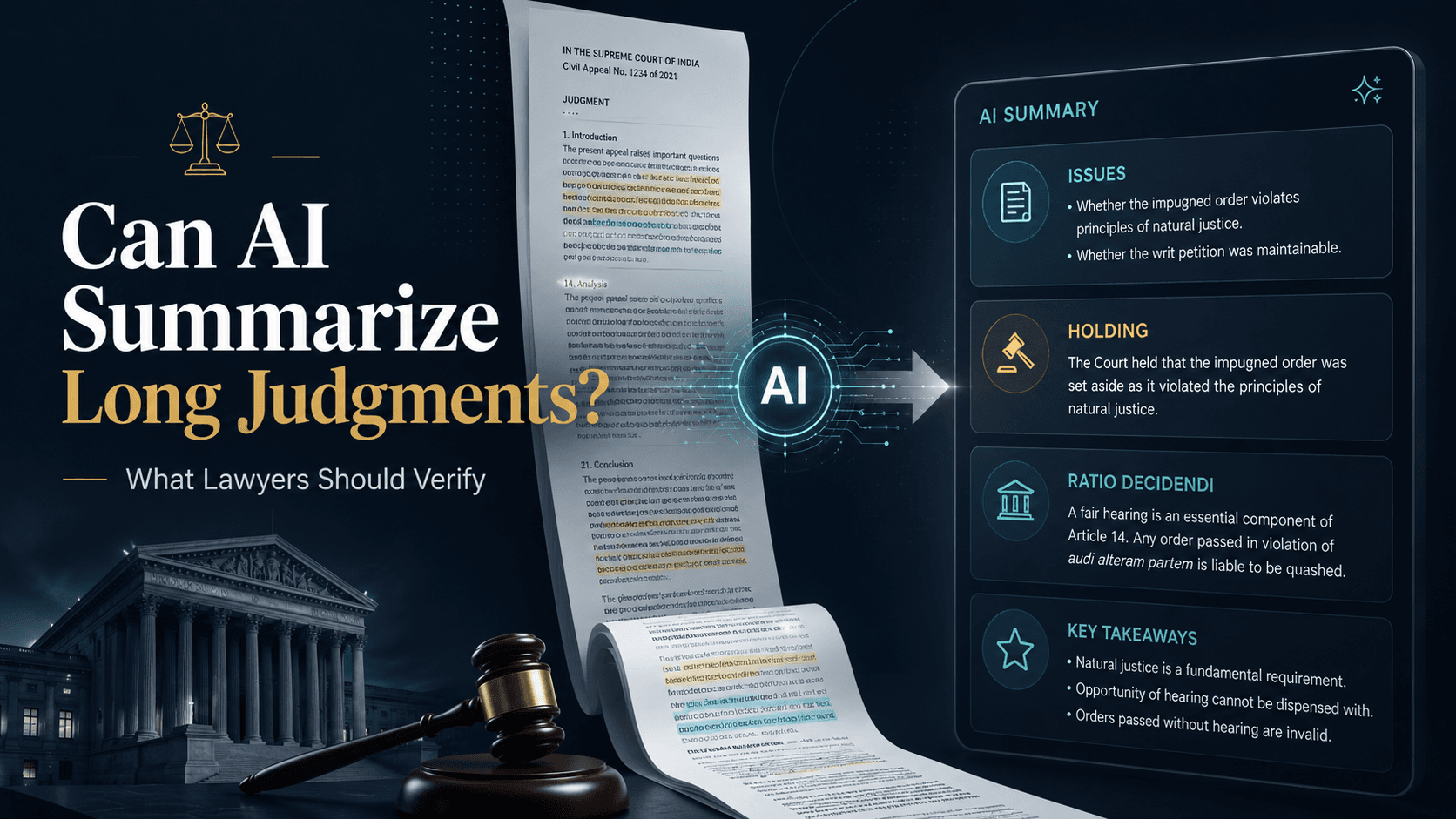
AI can summarize long judgments into a useful first-pass brief, but lawyers should verify the issues decided, the court’s reasoning, the scope of the holding, and any cited authorities before relying on the output. The safest workflow is simple: use AI to map the judgment, then have a lawyer confirm what the court actually held and how narrowly or broadly it applies.
A judgment is not an ordinary document. It may move between facts, procedure, arguments, statutory interpretation, and relief before reaching the conclusion that matters for your case. That is why the real challenge is not just shortening the text. It is preserving the structure of the court’s reasoning.
Why long judgments are hard to summarize accurately
Many judgments resolve several questions at once. A court may deal with maintainability, limitation, evidence, interpretation, relief, and costs in the same decision. That means there is often no single sentence that captures the whole result.
If you skim only for the outcome, you may miss the reasoning that makes the judgment persuasive, distinguishable, or irrelevant to the matter in front of you. For legal teams handling large volumes of case law, AI can reduce that first-pass reading burden, but only if the summary preserves issue-by-issue logic instead of flattening everything into one conclusion.
This is also why lawyers increasingly use AI as a workflow assistant rather than a substitute for professional judgment. If you are building a safe adoption process, our guide on how to get started with legal AI explains how to set review rules from the start.
How AI summarizes court judgments
A strong AI summary does more than compress pages into a paragraph. It should identify and organize the judgment into legal components first, then synthesize them into a usable brief. In practice, that usually means separating:
- material facts,
- procedural history,
- issues before the court,
- the parties’ key arguments,
- the court’s reasoning on each issue,
- the holding or findings,
- the ratio or governing rationale, and
- the final order, relief, or disposition.
That structure matters because a summary is only useful when it helps the reader understand how the court got from the facts to the outcome. If the path disappears, the summary may read well but still be unsafe to use in research, drafting, or oral argument.
What a good AI judgment summary should include
A legally useful summary should capture not only what happened, but what limits the decision. At minimum, lawyers should expect the summary to identify:
- the material facts that drove the dispute,
- the procedural posture,
- the specific legal issues framed by the court,
- the main submissions from each side,
- the court’s conclusion on each issue,
- the reasoning supporting those conclusions,
- the final relief granted or refused,
- any limiting language tied to facts, procedure, or statutory context, and
- the key authorities or provisions the court relied on.
Without those elements, a summary may look clean while hiding exactly the nuance a lawyer needs. This is especially important if the judgment is being used for research memos, case strategy, internal knowledge management, or drafting support. Related questions also come up in AI for legal research, where speed is useful only if verification remains built into the process.
Where AI judgment summaries can fail
Over-compression
The most common failure is reducing a multi-issue judgment to one broad sentence such as “the court dismissed the petition” or “the appeal was allowed.” That may be technically correct while still being legally incomplete. A court may reject one argument, accept another, and limit its ultimate decision to a narrow point.
Overstating the holding
AI can also present the holding more broadly than the court intended. If a judgment applies a principle only to a particular factual situation or procedural posture, removing that qualification can make a narrow ruling look like a general precedent.
Breaking the link between issue and reasoning
Some summaries list the issues and then separately describe the ratio, but fail to show which reasoning resolved which issue. That forces the lawyer to rebuild the map manually, which defeats much of the point of using AI in the first place.
Missing caution around citations and authorities
Lawyers should be especially careful with cited authorities. In Mata v. Avianca, Inc. (S.D.N.Y. 2023), a widely reported sanctions decision, the court dealt with fabricated citations submitted after lawyers relied on generative AI output. The lesson is not that AI has no value. It is that legal professionals must verify authorities against original sources before relying on them in court filings or advice.
If your team is evaluating reliability more broadly, see is AI-generated legal work reliable and how accurate AI legal document review is.
Why issue-by-issue summaries matter
Consider a judgment that addresses three separate questions:
- whether the matter is maintainable,
- whether the claim is time-barred, and
- whether interim relief should be granted.
A weak summary might say only that the court refused relief. But that leaves out the most useful part. The court may have accepted maintainability, rejected the limitation objection, and still refused interim relief because the factual threshold for urgency or irreparable harm was not met.
For a lawyer, those distinctions are not minor. The case may still be highly useful on maintainability or limitation even though the applicant lost on interim relief. A good summary preserves those layers so the judgment can be used correctly in a new matter.
What lawyers should verify before relying on an AI summary
A lawyer does not always need to reread every page from start to finish. But verification should be targeted and disciplined. Before using an AI-generated summary of a judgment, check the following:
- Issue matching: confirm that each issue in the summary was actually framed or decided by the court.
- Holding accuracy: make sure the court’s conclusion on each issue is stated correctly.
- Reasoning support: test whether the summary reflects the court’s analysis rather than only the result.
- Scope and qualifications: look for limiting language tied to facts, statutes, or procedure.
- Citation verification: check that the cited cases, statutes, and quotations are real and accurately described.
- Practical relevance: decide whether the judgment truly supports the argument or drafting position you want to make.
This review model fits many jurisdictions because the underlying risk is universal: a short summary can hide the exact nuance that matters most. Local court practice and bar guidance may differ, so legal teams should also check their own professional rules on supervision, confidentiality, and filing obligations.
A practical workflow for using AI to summarize court judgments safely
The safest use of AI is as a first-pass assistant, not the final authority. A practical workflow usually looks like this:
- Step 1: Upload or point to the judgment. Ask for a structured summary by facts, issues, arguments, reasoning, holding, and relief.
- Step 2: Review by issue. Compare the output against the parts of the judgment that matter most to your research question.
- Step 3: Verify authorities. Check every case, statute, quotation, and proposition in the original source or trusted database.
- Step 4: Capture limitations. Note factual qualifiers, procedural posture, and language that narrows the ruling.
- Step 5: Decide use. Use the summary as a research aid, internal brief, or drafting input only after lawyer review.
Teams that want a repeatable process may also find it useful to follow a checklist-driven approach. Our post on how lawyers can use AI safely covers the operational side of building that habit.
How Lexi helps legal teams summarize judgments with context
Lexi is designed for legal work where speed is useful only if legal control remains with the professional team. It helps lawyers turn long judgments into structured first-pass briefs organized around the way lawyers actually read: facts, issues, submissions, reasoning, holdings, ratio, relief, and scope.
That matters because the value is not simply making the judgment shorter. The value is helping the lawyer get to the relevant sections faster without losing the map of how the court reasoned. Lexi also supports workflows where citations and legal propositions are checked before the work is used externally.
Across 200+ organizations, Lexi has helped legal teams work faster on high-volume document tasks. The platform has processed 5,000,000+ documents and 200,000+ cases, with reported outcomes including 45% more cases per attorney and 10+ hours saved per lawyer per week. For firms and legal departments working across large research sets, that kind of efficiency matters only when review remains structured and defensible.
Depending on your role, you can explore how this fits into broader legal workflows for law firms, litigation teams, and in-house legal teams.
The takeaway
Yes, AI can summarize long judgments well enough to save substantial time at the start of legal review. But the summary is only as useful as its fidelity to the court’s actual reasoning. Lawyers should verify the issues, holdings, scope, and authorities before treating any summary as reliable.
The best workflow is not “AI reads, lawyer trusts.” It is “AI maps, lawyer verifies, lawyer decides.” That approach lets teams move faster without treating convenience as proof.
FAQ
Can AI summarize court judgments accurately enough for legal research?
It can produce a strong first-pass summary, especially for long decisions, but lawyers should still verify the issues, reasoning, and authorities in the original judgment before relying on it in research or drafting.
What should lawyers check in an AI-generated case summary?
Focus on issue matching, holding accuracy, the link between reasoning and result, any limiting language, and all citations or quotations. Those are the areas where a fluent summary can still mislead.
Is it safe to use AI to summarize judgments for court filings?
It can be safe as part of an internal workflow, but not as a substitute for lawyer review. Check your local bar rules and court expectations, and always verify citations, quotations, and propositions against original sources before filing.