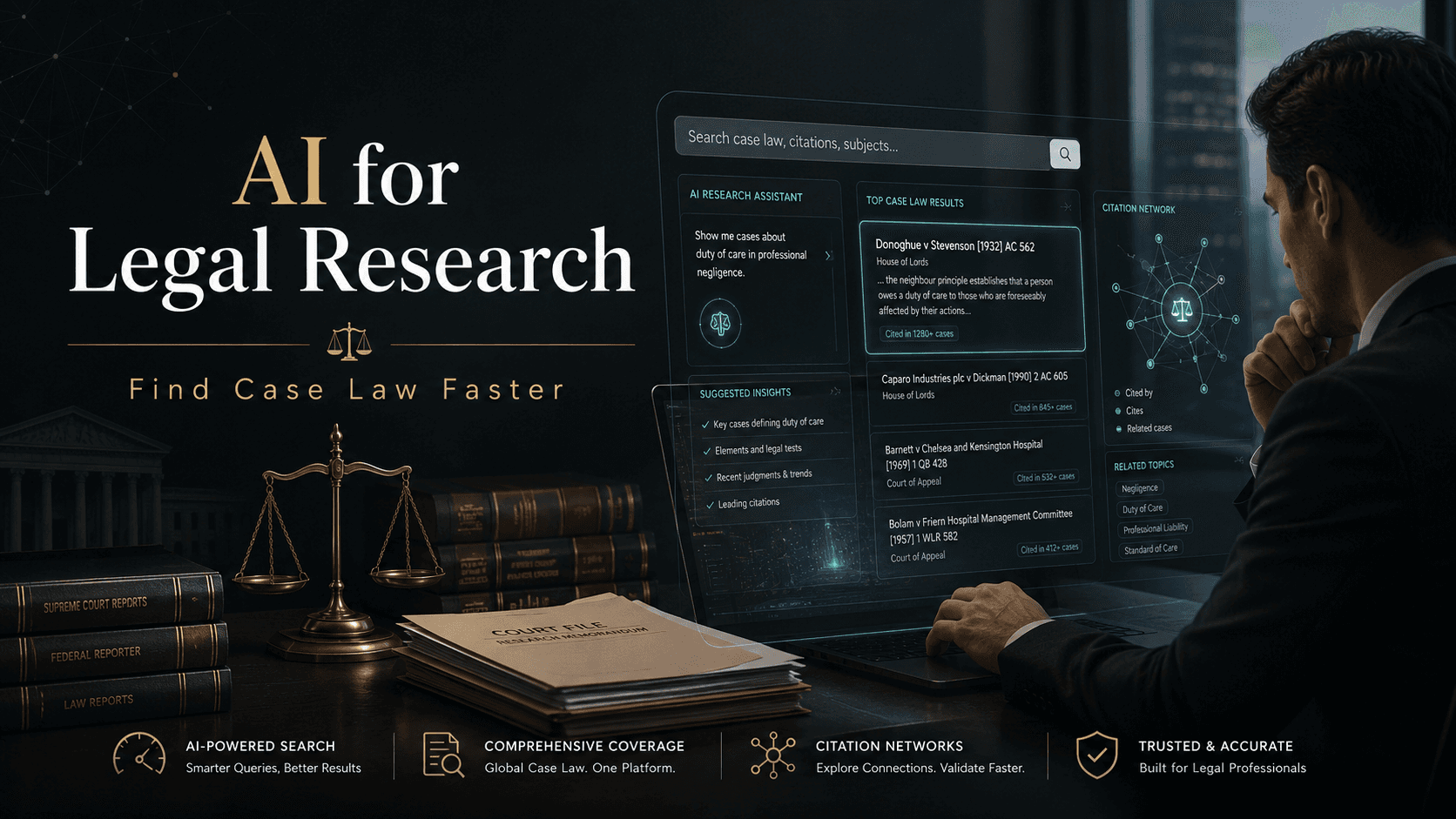
AI for legal research helps lawyers find relevant case law faster by turning facts into issues, search paths, and candidate authorities. But speed only matters if every citation is traceable to a real source, checked for currency, and reviewed by a lawyer before it becomes advice, a memo, or a filing.
Why legal research still takes so much time
Legal research is rarely slow because information is scarce. It is slow because legal teams must convert messy facts into the right legal issues, search terms, and authorities. A client describes a problem in business or personal terms. The lawyer has to translate that into claims, defenses, procedural posture, forum-specific rules, and the exact proposition that needs support.
Then comes triage. Search results often include near-matches, outdated authorities, irrelevant jurisdictions, and cases that sound useful until you read the actual holding. Much of the work is not finding material, but ruling out material that does not truly fit.
That filtering is valuable legal work, but it is not where lawyers create the most value. The highest-value judgment usually comes later: deciding which authorities are strongest, which distinctions matter, and how the research should shape strategy.
How AI changes the starting point for legal research
Traditional research often begins with keywords. AI-assisted research can begin with the factual pattern, the jurisdiction, and the question the lawyer needs answered. That shift matters because the first bottleneck in research is often framing, not searching.
With the right prompt, AI can help lawyers:
- identify legal issues and sub-issues from a fact pattern
- generate a first-pass research plan
- surface candidate cases, statutes, and regulations
- summarize long authorities for quick screening
- group authorities by proposition, issue, or factual similarity
This does not replace legal judgment. It simply moves lawyer attention from guessing search terms to reviewing a more structured set of research leads.
A practical workflow for using AI for legal research safely
The safest approach is to use AI as a research assistant, not as the final authority. In many jurisdictions, lawyers remain responsible for competence, supervision, and accuracy regardless of the tools they use, so check your local bar rules and court guidance.
1. Start with the facts and the forum
Describe the key facts, procedural posture, jurisdiction, and specific research objective. If the issue depends on timing, contract wording, industry context, or a statutory amendment, include that. Better inputs produce a better research map.
2. Ask for issues before asking for answers
Before requesting a polished conclusion, ask the system to identify the legal issues, sub-issues, and missing facts that could affect the analysis. This helps avoid locking into one theory too early.
3. Request source-backed authorities
Ask for the case name, citation, court, year, proposition, and why the authority may matter. If a tool cannot show where an answer came from, it should not be trusted as research output.
4. Verify every authority against the original source
Open the case, statute, rule, or regulation yourself. Read the relevant passage. Confirm that the proposition is actually supported, that the authority is current, and that it belongs to the right jurisdiction and forum.
5. Use lawyer judgment to turn research into advice
Once the authorities are verified, the lawyer decides what is persuasive, what is distinguishable, what should be qualified, and what should not be used. That final step is not mechanical. It is legal judgment.
Example prompt for AI-assisted legal research
Lawyers often get better results with a structured prompt such as:
- Jurisdiction: [insert jurisdiction]
- Forum or court level: [insert forum if relevant]
- Facts: [insert concise factual summary]
- Task: identify the legal issues, relevant statutes, and leading cases
- For each authority, provide: case name, citation, court, year, proposition, relevance to the facts, and source reference
- Flag uncertainty, factual gaps, and any need for jurisdiction-specific validation
- Do not invent authorities
If you are building internal workflows, this pairs well with a broader safety process like the one outlined in how lawyers can use AI safely: a 5-step checklist.
Why verified citations matter more than speed
A citation error is not just a formatting problem. If an unsupported authority enters a memo, a filing, or client advice, it can damage credibility and create avoidable risk. Generative systems can produce fluent language even when the underlying authority is wrong, incomplete, or nonexistent.
That risk is well documented. In Mata v. Avianca in the Southern District of New York in 2023, lawyers were sanctioned after submitting fake citations generated with AI. The lesson was not that lawyers must avoid AI altogether. The lesson was that legal work cannot rely on unverified output.
Professional guidance points the same way. The American Bar Association's Formal Opinion 512 addresses lawyers' use of generative AI and emphasizes duties such as competence, confidentiality, communication, and supervision. The practical takeaway is simple: AI can accelerate research, but the verification step must stay inside the workflow.
If you want a broader discussion of risk and reliability, see is AI legal advice safe and reliable and is AI-generated legal work reliable.
What AI can do well in legal research and where lawyers still matter most
What AI does well
- turns a factual narrative into a first-pass issue list
- expands research paths beyond a narrow keyword search
- summarizes long judgments for initial screening
- clusters authorities by issue or proposition
- organizes a draft research trail for faster review
Where lawyers still matter most
- deciding whether an authority truly applies to the facts
- checking whether a case remains good law
- weighing stronger and weaker authorities
- accounting for strategy, forum, and client risk tolerance
- turning research into advice, negotiation posture, or advocacy
That distinction is central to good deployment. AI can reduce the mechanical burden of research, but it does not assume professional responsibility for the conclusion.
How research-focused legal AI tools differ
Different legal AI products approach research in different ways. Harvey is widely discussed as a general-purpose legal AI platform used by large firms, while Legora has become known in Europe for legal workflows that include research and drafting support. DeepJudge focuses on legal knowledge search and retrieval across internal and external sources.
Those tools reflect a broader shift: lawyers want faster access to relevant legal material, not just generic text generation. Lexi's differentiator is that it is built around reviewable legal work with verified citations, helping lawyers move from answer-like output to source-backed research they can actually check before relying on it.
A lawyer's checklist before relying on AI-assisted research
- Confirm that every cited case, statute, regulation, or rule actually exists.
- Open the original source rather than relying only on the summary.
- Check whether the authority is still good law in the relevant jurisdiction.
- Verify that the cited proposition is supported by the actual text.
- Compare the authority's facts and procedural posture with your own.
- Look for contrary authority, limits, exceptions, and later developments.
- Confirm that any statutory text is current.
- Keep a clear research trail so another lawyer can audit the work quickly.
For related workflows, you may also find how accurate is AI legal document review and can AI summarize long judgments useful.
How Lexi supports source-backed legal research
Lexi is designed for legal teams that need research speed without losing traceability. Lawyers can move from facts to issues, identify relevant authorities faster, and keep the work reviewable instead of treating an AI paragraph as the finished product.
That matters across practice settings. Law firms can use Lexi to accelerate early-stage research and memo preparation through law firm workflows. Litigation teams can use it to organize authorities and prepare more efficiently in contentious matters through litigation workflows. In-house teams can use it to get to source-backed answers faster while keeping legal review in the loop through in-house legal workflows.
Lexi has processed 5,000,000+ documents across 200,000+ cases for 200+ organizations, helping legal teams save 10+ hours per lawyer per week and handle 45% more cases per attorney. The point of those gains is not speed for its own sake. It is giving lawyers more time for analysis, strategy, and client judgment.
If you are evaluating adoption more broadly, see how to get started with legal AI and how lawyers actually use AI in practice.
The takeaway
AI for legal research is most useful when it helps lawyers move faster from facts to relevant authorities without cutting out verification. The real benefit is not a confident-sounding answer. It is a shorter path to source-backed research that a lawyer can inspect, validate, and use responsibly.
Used that way, AI improves the first phase of legal research: issue spotting, search expansion, screening, and organization. The lawyer still owns the final judgment, and that is exactly how it should work.
FAQ
Can AI for legal research replace traditional case law databases?
No. In most real workflows, AI complements traditional databases and primary-source review rather than replacing them. Lawyers still need to validate authorities, confirm current law, and read original sources.
Is AI for legal research safe for court filings?
It can be used to assist the research process, but courts and professional bodies in many jurisdictions expect lawyers to verify citations and legal propositions themselves. Check local court rules and professional guidance before relying on AI-assisted work in a filing.
What should lawyers look for in an AI legal research tool?
Look for source-backed output, reviewable citations, jurisdiction awareness, and workflows that make verification easy. A tool is far more useful if it helps you check the authority rather than merely generating a polished answer.