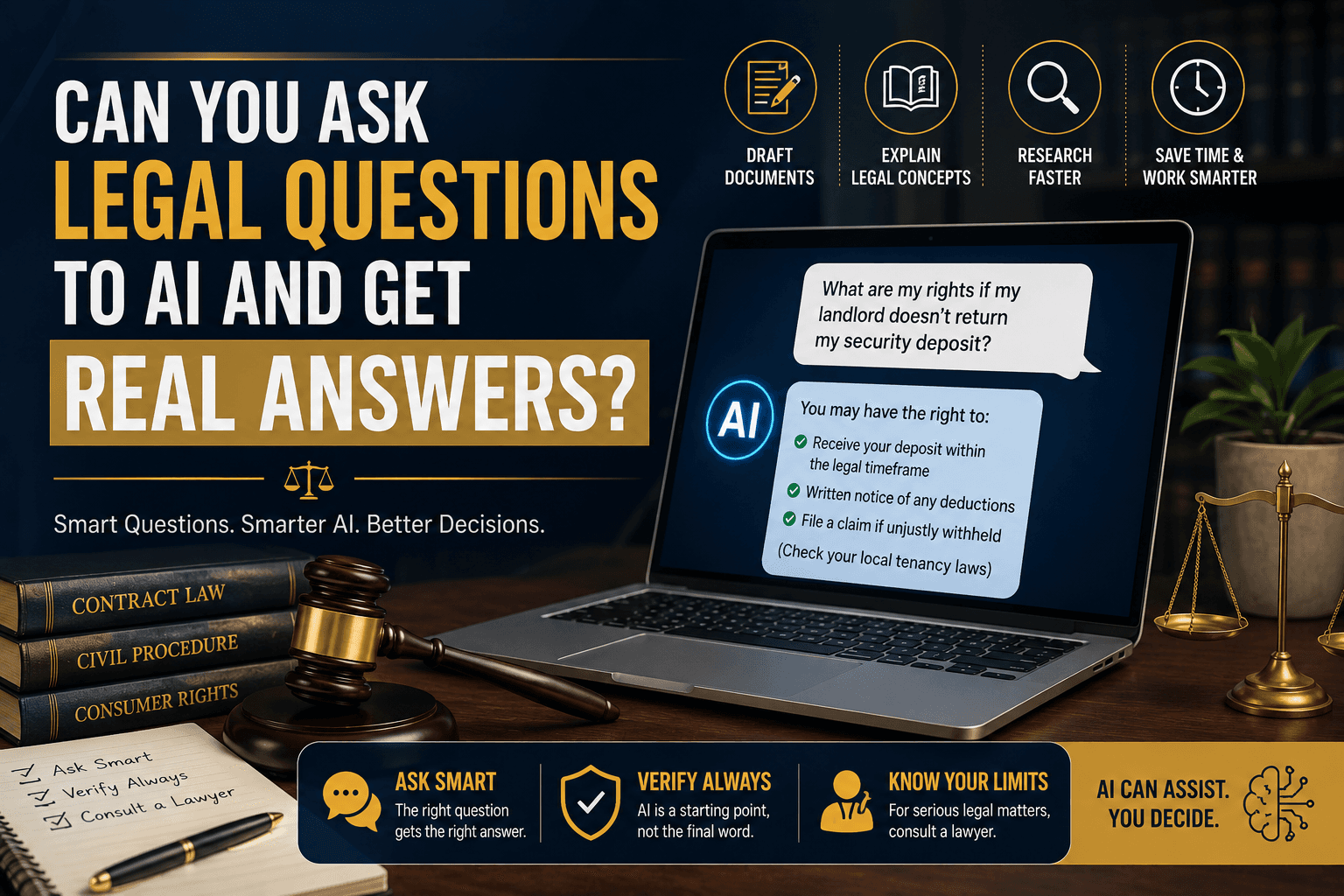
Yes — you can ask legal questions to AI and get useful, real-world answers for orientation, plain-English explanations, issue spotting, and first drafts. But AI should not be treated as your final legal authority. It can miss jurisdiction-specific rules, misunderstand facts, or confidently produce wrong citations, so the safest approach is to use it as a starting point, verify the underlying sources, and involve a qualified lawyer whenever the stakes are high.
What AI is actually good at for legal questions
Used properly, AI is valuable for early-stage legal work. It helps people understand unfamiliar issues faster and helps lawyers move through repetitive tasks more efficiently.
- Explaining legal concepts in plain English: If a clause, notice, or procedure is confusing, AI can usually translate it into simpler language.
- Giving initial orientation: It can help you understand the broad framework around issues like tenancy, employment, consumer protection, contracts, or intellectual property in many jurisdictions.
- Creating first drafts: For simple documents, checklists, emails, or issue summaries, AI can provide a workable starting point.
- Summarizing long material: It can pull out themes, obligations, dates, and questions from contracts, pleadings, or judgments.
- Saving time on repetitive work: Legal teams use AI to reduce routine workload so more time goes to judgment, strategy, and client communication. In practice, teams using Lexi report 10+ hours saved per lawyer per week, and some firms handle 45% more cases per attorney.
That is why AI is increasingly useful across law firms, corporate legal teams, litigation practices, and in-house teams.
Where AI becomes risky
The problem is not that AI is always bad at legal work. The problem is that it can be persuasive even when it is wrong.
It can fabricate or misstate authorities
This risk is well documented. In Mata v. Avianca (S.D.N.Y. 2023), lawyers were sanctioned after submitting non-existent cases generated through AI-assisted research. That case is now a cautionary example across the profession: if an AI tool provides a citation, you must verify that the case, quote, and proposition are real and current.
It can flatten nuance
Legal answers often turn on details such as timing, venue, the governing law clause, procedural posture, later appellate history, exceptions, or whether a statement came from the majority opinion rather than a dissent or concurrence. AI can miss those distinctions.
It does not know your full facts unless you give them
Most legal questions are not abstract. They depend on relationships, documents, deadlines, local rules, and commercial context. AI can give general information, but general information is not the same as legal advice tailored to your exact situation.
What counts as a "real answer" from AI?
A real answer from AI is not necessarily a final answer. In legal work, a useful AI response usually does one or more of the following:
- Helps you understand the issue in plain language
- Surfaces the right questions to ask next
- Identifies the documents or facts you need
- Provides a first-pass structure for research or drafting
- Flags possible risks, missing clauses, deadlines, or ambiguities
That is different from saying the AI has resolved your legal problem. Think of it as a fast, structured first pass that still requires source-checking and human judgment.
If you want a deeper look at reliability, see is AI-generated legal work reliable and is AI legal advice safe.
Why the quality of your question changes the quality of the answer
One of the biggest reasons people get poor results is that they ask vague questions. Legal AI performs much better when the prompt includes facts, documents, dates, parties, and jurisdiction.
Weak question
"What are my rights against my landlord?"
Better question
"I rented an apartment in [city/jurisdiction]. I moved out on [date]. My landlord has not returned my security deposit and has not given written reasons. The lease says deductions must be itemized. What issues should I check, what documents matter, and what general next steps are common in many jurisdictions?"
The second version gives the model something concrete to work with while still recognizing that the final answer depends on local law and your actual documents.
For practical prompting guidance, see how to get started with legal AI and how lawyers can use AI safely.
How to ask legal questions to AI safely
If you want better answers with less risk, follow a disciplined workflow.
- State the jurisdiction if you know it: Many legal rules vary by country, state, province, or court system.
- Give the facts chronologically: Dates and sequence often matter.
- Paste the exact clause or text: Summaries can hide the issue.
- Ask for issues, not certainty: Ask "what should I check" or "what are the possible issues" before asking for conclusions.
- Request sources: Ask the system to identify the statute, regulation, case, or rule it relied on.
- Verify every authority independently: Read the actual text before relying on it.
- Remove or protect sensitive information: Do not share confidential or privileged material casually; check your organization's policies and local professional rules.
This is also why many professionals prefer legal-specific tools over general chatbots. A legal workflow should support document review, redlining, source verification, and structured matter organization rather than just conversation. Lexi has processed 5,000,000+ documents across 200,000+ cases for 200+ organizations, which reflects the kind of scale legal teams look for when they need a real operational tool rather than a novelty.
When you should stop asking AI and call a lawyer
Some matters are too important to treat as self-service, even if AI gives a plausible answer.
- Court filings, hearings, or disputes with procedural deadlines
- High-value contracts, indemnities, limitation-of-liability clauses, or regulated transactions
- Employment terminations, investigations, or compliance issues
- Criminal exposure, fraud concerns, or allegations of misconduct
- Family, immigration, tax, or insolvency matters with life-changing consequences
- Any situation where being wrong will cost you money, rights, leverage, or credibility
In those situations, AI can still help you organize facts, summarize documents, or prepare questions for counsel. But it should not replace a lawyer's analysis. Related reading: will AI replace my lawyer and can AI replace a lawyer for my legal documents.
How lawyers use AI without outsourcing judgment
For lawyers, the best use of AI is not blind delegation. It is supervised acceleration.
That means using AI to summarize a file, compare contract versions, draft a first-pass email, build a chronology, extract obligations, or suggest research paths — then checking the output against the record, the governing authorities, and client objectives. If you want examples from practice, see how lawyers actually use AI in practice and how accurate AI legal document review is.
This distinction matters. AI can improve speed and consistency, but the lawyer remains responsible for judgment, ethics, and final work product. Bar guidance in many jurisdictions has moved in this direction: competence now increasingly includes understanding the benefits and risks of technology, including AI-assisted work.
So, can you ask legal questions to AI and get real answers?
Yes — if you define "real answers" correctly.
AI is good at giving you a useful starting point: explaining legal language, identifying issues, structuring research, summarizing documents, and generating first drafts. It is not automatically reliable enough to be your final legal answer, especially where facts, sources, or jurisdiction-specific rules matter.
The practical rule is simple:
- Ask specific questions
- Provide the relevant facts and jurisdiction
- Request sources
- Verify everything important
- Use a qualified lawyer for high-stakes decisions
That is the balanced way to use legal AI. Not blind trust. Not total rejection. Smart use, careful verification, and human judgment where it counts.
FAQ
Can AI answer legal questions accurately?
Sometimes, especially for general explanations, document summaries, and first-pass issue spotting. But accuracy depends on the prompt, the jurisdiction, and the tool. You should verify sources and not rely on AI alone for high-stakes matters.
Is it safe to ask AI legal questions about my case?
It can be safe for general orientation, but be careful with confidential facts and privileged documents. Follow your organization's privacy rules, use trusted tools, and avoid sharing sensitive information unless you understand how the system handles data.
Can AI give legal advice instead of a lawyer?
AI can provide legal information and a useful starting point, but it does not replace a lawyer's role in applying law to your exact facts, strategy, risk tolerance, and jurisdiction. For serious matters, check your local bar rules and speak to qualified counsel.