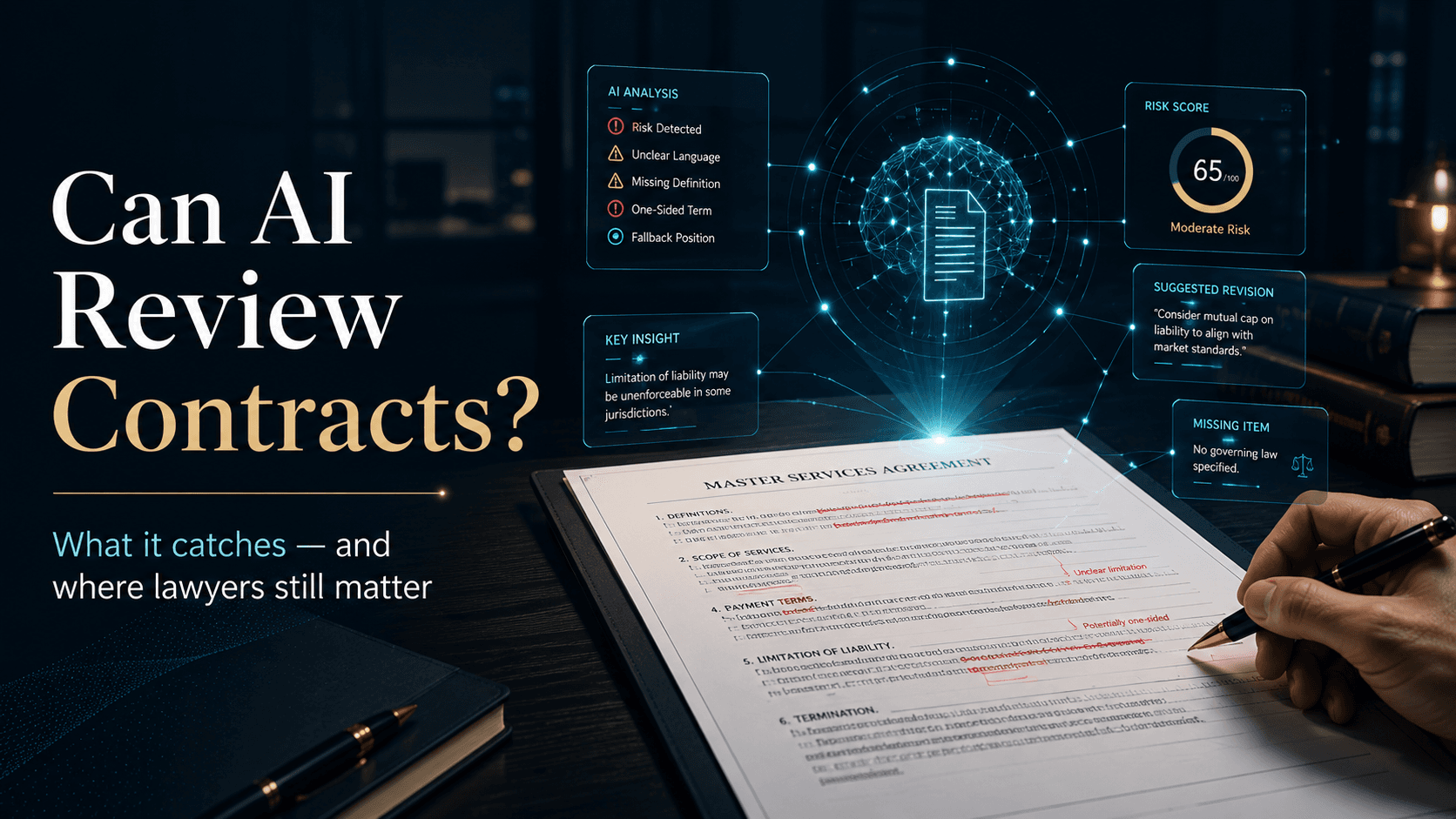
AI legal advice is safest when it helps with legal information, document summaries, issue-spotting, and preparation for a lawyer. It is not safe to treat AI as a substitute for legal judgment on filings, negotiations, contracts, rights, deadlines, or strategy without qualified human review. In many jurisdictions, the practical rule is simple: use AI to get oriented, but involve a lawyer before taking action.
Why the answer is not simply yes or no
When people ask whether AI legal advice is safe, they often treat all legal use cases as if they carry the same risk. They do not. Asking AI to explain a legal term is very different from asking it what to file tomorrow, what to sign, or whether to settle a dispute.
The safer way to evaluate AI legal advice is to ask three questions:
- Who is using it: a lawyer, an in-house legal team, a business user, or an individual under stress?
- What is the task: learning, summarizing, researching, drafting, reviewing, or deciding what action to take?
- What happens next: is the answer only for orientation, or will someone rely on it without verification?
That last question matters most. AI can produce a polished answer that sounds complete even when it is missing jurisdictional detail, procedural nuance, factual context, or source support. Safety is not just about whether the answer is right in the abstract. It is about whether someone is tempted to act on it too quickly.
When AI legal advice is generally safer
AI can be genuinely useful in lower-risk legal workflows, especially when the goal is understanding rather than action. This is where it often helps clients ask better questions and helps legal teams move faster without giving up control.
- Explaining legal concepts in plain language
- Summarizing contracts, pleadings, judgments, or policies
- Organizing facts into a chronology before a lawyer call
- Spotting issues that need deeper review
- Preparing a checklist of documents or information to gather
- Creating a first draft that will be reviewed by counsel
These uses are closer to preparation and support than final advice. If you want a practical framework for this distinction, see can you ask legal questions to AI and get real answers and how to get started with legal AI.
When AI legal advice becomes risky
The risk rises quickly when AI output moves from explanation to direction. Legal matters often turn on local procedure, exceptions, deadlines, privilege, evidence, negotiating leverage, and facts that a user may not realize are important. In those situations, even a mostly correct answer can still be dangerous.
Do not rely on AI alone to do any of the following without professional review:
- File court forms, pleadings, motions, or responses
- Send legal notices, demand letters, or settlement proposals
- Accept, terminate, amend, or negotiate a contract
- Assess litigation strategy or likely outcomes
- Interpret high-stakes employment, tax, family, criminal, regulatory, or governance issues
- Rely on case citations or statutes without checking the source and current validity
- Share confidential legal information through tools that are not approved for legal use
These are the moments where the right answer depends on judgment, not just language generation. That is also why many readers ask related questions like is it safe to use AI for legal documents without a lawyer review and how reliable is AI for creating legal contracts.
Why lawyers and non-lawyers face different levels of risk
A lawyer using AI is not doing the same thing as a member of the public using AI on a stressful legal problem. Lawyers usually bring training, issue-framing, source checking, procedural awareness, and professional duties to the workflow. Non-lawyers may understandably assume that a confident answer is a reliable one.
Lawyers know how to frame the problem
A broad question like “Can I sue my landlord?” leaves out facts that may control the answer. A lawyer is more likely to ask about the contract, notices, dates, payment history, evidence, remedies, and local procedure. Better framing usually produces a better output.
Lawyers know what must be verified
Legal work depends on authority, facts, and jurisdiction. Even a useful AI answer still needs source checking and legal review. That is one reason professional guidance across many jurisdictions focuses on competence, confidentiality, supervision, and communication when lawyers use generative AI.
For example, the American Bar Association's Formal Opinion 512 discusses lawyers' duties when using generative AI tools, including competence and confidentiality. Courts have also shown what goes wrong when verification is skipped. In Mata v. Avianca (S.D.N.Y. 2023), lawyers were sanctioned after submitting AI-fabricated citations. The lesson is not that AI must never be used. The lesson is that unsupported output must never be treated as verified legal authority.
If you want a deeper look at that verification problem, see is AI-generated legal work reliable and how accurate is AI legal document review.
Emotional pressure makes bad AI legal decisions more likely
Some of the highest-risk legal prompts are written in moments of stress: a dismissal, a family dispute, a landlord conflict, a consumer complaint, or a business relationship that has broken down. In those moments, people often ask AI to validate a position they already want to take.
That creates a hidden problem. AI responds to the facts and framing it is given. If the prompt is one-sided, emotionally loaded, or missing adverse facts, the output may sound decisive while resting on an incomplete record. The danger is not only hallucination. It is false confidence built on incomplete inputs.
This is why AI should help people prepare for legal conversations, not replace them. It can organize facts and sharpen questions, but it cannot independently assess everything a lawyer would notice from context, evidence, procedure, and strategy.
A safer rule: start with AI, end with a lawyer
The most practical rule for both lawyers and clients is straightforward: start with AI, end with a lawyer. Use AI to understand terminology, summarize documents, identify missing information, and prepare for a more productive legal discussion. Then have a qualified professional review anything that affects rights, obligations, deadlines, money, negotiation posture, or formal action.
That model is also consistent with how legal teams adopt AI responsibly. The best systems are built to support professional workflows, not bypass them. For example, firms and in-house teams often use AI to accelerate first drafts, document review, and research, then apply lawyer judgment before anything is sent externally. You can explore those workflows on Lexi's pages for law firms, corporate legal teams, litigation teams, and in-house counsel.
What safer legal AI workflows look like in practice
Safer legal AI is less about one perfect answer and more about a controlled process. Legal teams reduce risk when they use tools and policies that support review, traceability, and confidentiality.
- Use AI for first-pass analysis, not final sign-off
- Check whether cited authorities are real, relevant, and current
- Confirm the jurisdiction and procedural posture before acting
- Keep a human lawyer responsible for client-facing judgment
- Use approved platforms and internal policies for sensitive information
- Document review steps for higher-risk matters
Lexi is designed around that kind of workflow. It helps legal teams draft in the firm's style, review and redline contracts, and work with verified citations so lawyers can evaluate the source behind the answer. Across 200+ organizations, Lexi has helped teams process 5,000,000+ documents and 200,000+ cases, while users report outcomes such as 45% more cases per attorney and 10+ hours saved per lawyer per week. Those gains matter because they create room for more of the work that should stay human: judgment, strategy, communication, and accountability.
For a more hands-on view of legal AI use, see how lawyers actually use AI in practice and how lawyers can use AI safely.
Final takeaway
So, is AI legal advice safe? Sometimes, yes, but only within limits. It is generally safe for legal information, summaries, issue-spotting, and preparation. It is not safe to rely on as the final word for contracts, disputes, filings, negotiations, or any decision with legal consequences unless a qualified lawyer reviews the work.
The most reliable model is not AI instead of legal judgment. It is AI inside a legal workflow where human professionals remain responsible for accuracy, confidentiality, and strategy. In many jurisdictions, that is the difference between efficient assistance and avoidable legal risk.
FAQ
Can I use AI to answer legal questions before talking to a lawyer?
Yes, for basic orientation. AI can help you understand terms, summarize documents, and prepare questions. But if the answer will affect what you file, sign, send, or argue, have a lawyer review it first.
Is AI legal advice safe for contracts?
It can be useful for summarizing clauses, spotting issues, and preparing a first draft. It is not safe to rely on AI alone to approve, negotiate, or sign important contracts without legal review.
Why does AI legal advice sound right even when it is wrong?
Generative systems are built to produce fluent answers. That fluency can hide missing facts, weak authority, or fabricated citations. In legal work, confidence is not proof. Verification is.