By Lexi Team
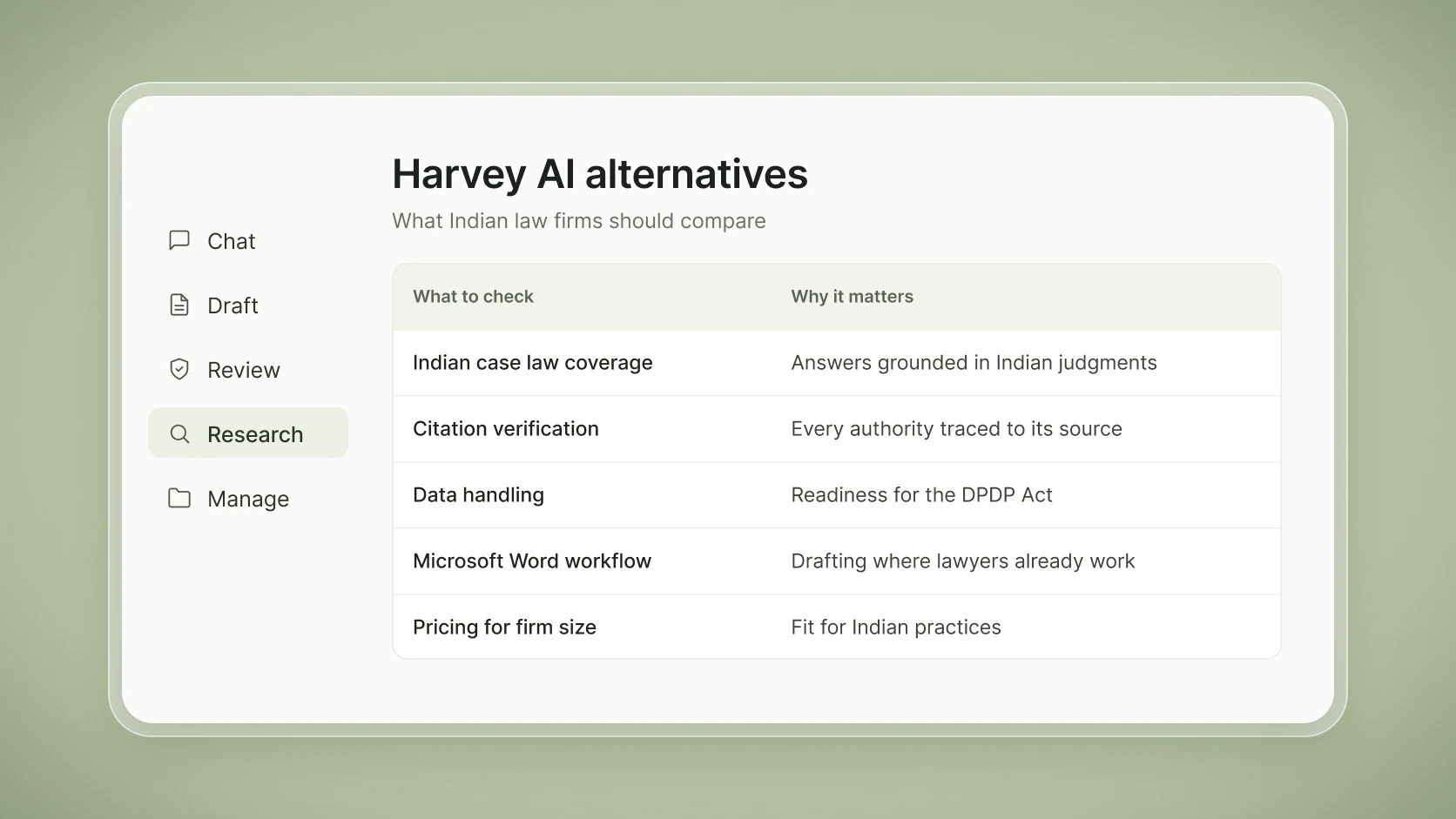
For partners and knowledge leads evaluating Harvey AI alternatives, the useful starting point is the firm’s work: Indian-law research, drafting and review; Word and email workflows; and the handling of client and matter information.
A product description is not proof of suitability for a particular firm. It does not establish the Indian authorities available under a proposed licence, the reliability of citations in a live matter, the terms governing uploaded material or the price the firm will pay. Use written vendor responses and a controlled pilot to make those distinctions.
This framework does not rank products or assume that any provider meets a firm’s accuracy, coverage, security or compliance requirements. Lawyers must still check authorities and material propositions before using an output in advice, pleadings or submissions.
How to compare Harvey AI alternatives for Indian law firms
Legora, Thomson Reuters CoCounsel, Lexis+ AI, vLex Vincent AI and Spellbook may appear on a firm’s shortlist. Their broad product focus can help determine which demonstrations to request, but public descriptions do not establish Indian availability, content or licensing. Request a written proposal for the exact service, modules and deployment being offered. Apply the same questions to Harvey and any other shortlisted provider.
| Product | What it is | Written description to request | Assumption to avoid |
|---|---|---|---|
| Legora | A collaborative legal workspace for research, document review and drafting. | The research sources, review and drafting tasks, collaboration features and integrations included in the proposed service. | That its general workflow description establishes Indian-law coverage or access to the firm’s systems. |
| Thomson Reuters CoCounsel | An AI assistant for legal work tied to Thomson Reuters content and tools; access to Westlaw or Practical Law depends on the market and licence. | The CoCounsel modules, Thomson Reuters materials and geographic availability included in the Indian proposal. | That content or a module offered in another market is included. |
| Lexis+ AI | LexisNexis’s generative AI service for research and related legal workflows using licensed LexisNexis content. | The service configuration, research and drafting functions, and Indian content collections in the proposed licence. | That the product name establishes access to particular Indian sources. |
| vLex Vincent AI | A research and analysis assistant associated with the vLex and Fastcase multi-jurisdiction library. | The functions offered and a list of included courts, tribunals, jurisdictions, languages and source collections. | That a jurisdiction or source in the wider library is available under the firm’s licence. |
| Spellbook | A Microsoft Word add-in focused on contract drafting and review. | The contract workflows, supported Word environments and document permissions in the proposed service. | That Word integration establishes suitability for Indian-law research or the firm’s contract and data-handling requirements. |
For demonstrations, prioritise products against the work they emphasise: collaborative research and review, licensed-content research, multi-jurisdiction analysis or Word-based contract drafting. Those distinctions are a starting point, not evidence that a provider meets the firm’s requirements. For a separate discussion of two names on this shortlist, see Harvey vs Legora; assess either product against the firm’s own requirements and current vendor terms.
The comparison checklist
Use one written questionnaire, a common set of test materials and scoring criteria agreed before demonstrations. Keep the responses and pilot findings in a decision record.
1. Indian-law coverage and citation verification
Ask each vendor to identify the Indian materials included in the proposed service: courts, tribunals, legislation, delegated legislation, regulations and Indian-language sources, where relevant. Request update practices, source-link access and known exclusions. Specify the courts, time periods and practice areas the firm actually needs.
Public availability of a judgment online does not mean it is in a vendor’s licensed corpus; ask for the list.
For each research answer in the pilot, a lawyer should:
- confirm that every cited judgment or provision exists in an authoritative or firm-approved source;
- read the cited passage and check that it supports the proposition stated;
- assess relevance to the facts, forum and issue; and
- check currency, subsequent treatment and material contrary or limiting authority.
Record fabricated or missing citations, inaccurate quotations, unsupported propositions and inaccessible links separately. An answer can be a useful research starting point without being ready for use in client advice or a court filing.
2. Data handling and contractual controls
Send each vendor a data-handling schedule. Ask where prompts, uploaded files, outputs, metadata, backups and support logs are processed and stored; how long each is retained; how deletion works; whether customer content is used for model training; and which subprocessors are involved. Request the proposed contract and data-processing terms, including access controls, audit records, incident procedures and the allocation of responsibilities.
Require answers for the proposed plan and deployment, not just the vendor’s general privacy statement. Terms may need to be specified separately for particular features, models, regions and support channels.
3. Confidentiality, privilege and client restrictions
Assess the arrangements against the firm’s duties of confidentiality to clients under the Bar Council of India Rules and its engagement terms, not only data-protection law. Professional communications privilege is governed by sections 132 to 134 of the Bharatiya Sakshya Adhiniyam, 2023. Matter material may be privileged, confidential or restricted by client instructions even if it contains no personal data. Identify client- and engagement-specific limits on disclosure, storage and third-party processing, and obtain client approval where required before uploading material.
Ask who at the provider and among its support staff and subprocessors can access matter content, for what purposes and under what contractual confidentiality obligations. Test matter-level access controls within the firm and the provider’s service. Where privilege could be affected by sharing material, obtain advice on the proposed arrangement rather than treating data-protection compliance as sufficient.
4. Word, email and matter workflow
Test the versions of Word, document-management systems and email tools the firm uses. Include permissions, version control, redlines, tracked changes, templates, document comparison, file-size limits and matter-access restrictions. Map when content leaves a firm-controlled environment and request a written description of the route it takes.
For email, use a non-sensitive sample to test drafting a response, extracting actions, attaching a source document and preserving a review record. Do not introduce client-confidential material into a pilot before the firm approves the information-handling arrangements.
5. Security evidence and operational accountability
Request current security documentation and the scope of any audit evidence. Examine identity and access controls, encryption, vulnerability management, incident notification and the division of responsibilities between the firm and provider. The evidence should cover the service being purchased, not merely the vendor group.
Name the firm’s security-review owner, the vendor contact responsible for written answers and the conditions that would pause or end the pilot.
6. India-firm pricing and total cost
Obtain a quote based on the proposed users and usage. Separate implementation, onboarding, seats, usage limits, overages, integrations, support, taxes, minimum commitments, renewal pricing and termination terms. A headline price alone is not a total-cost assessment.
DPDP Act and Rules in procurement
For an Indian deployment, assess how the Digital Personal Data Protection Act, 2023 and the Digital Personal Data Protection Rules, 2025 apply to the firm’s proposed processing of digital personal data. Their provisions have a phased commencement: do not assume that every duty is already in force, or that a later commencement removes the need to prepare the workflow and contract. Assess the provisions applicable when the service will be used.
Map what personal data users may enter, the firm’s and provider’s roles, the instructions governing processing, access and retention controls, deletion, incident response and subprocessors. Indian privacy counsel should assess those arrangements in light of the firm’s matters, its obligations and the applicable commencement position. A vendor’s general compliance statement is not a substitute for that assessment. Address confidentiality, privilege and client restrictions separately, including for material without personal data.
Where Lexi fits
Lexi is AI-native legal technology for law firms, litigators and in-house teams. It offers Indian-law research with linked sources, drafting tools and a Word add-in. Firms should apply the same questionnaire, representative tasks and lawyer-review criteria used for every provider, including permissions and version-control tests for the proposed Word workflow.
A short pilot plan
Set acceptance criteria before users see outputs. Keep the vendor’s written responses with the pilot record so the decision reflects both task performance and procurement requirements.
- Define the work. Select representative Indian-law tasks: locating authorities on a defined issue, preparing a research note from approved sources, reviewing a clause against a firm playbook and drafting from approved facts.
- Control the materials. Use firm-approved test materials. Record what is uploaded, by whom and under which permissions.
- Apply common tasks. Give shortlisted products the same instructions, materials and time window where practical.
- Require lawyer verification. Check authorities, quotations and material propositions, and assess whether each draft follows the approved facts and instructions.
- Measure the record. Log completion, review effort, citation failures, workflow friction, security, confidentiality and data-handling responses, and projected total cost. Do not assume time savings or accuracy outcomes in advance.
- Decide against preset thresholds. Expand, revise controls, run a further limited pilot or stop. Assign partner, knowledge, IT/security, privacy and procurement owners to the decision.
Questions to resolve before procurement
- Does the proposed licence provide written evidence of the Indian-law coverage the firm needs?
- Can lawyers verify authorities, quotations, relevance and currency within the proposed workflow?
- Do the contract and written responses address data handling, retention, deletion, training use, subprocessors and incidents?
- Do client and engagement terms permit the proposed processing, and are privilege, provider access, contractual confidentiality and matter-level permissions addressed?
- Has the firm tested its actual Word and email workflows, permissions and document routes?
- Has the security team reviewed evidence scoped to the proposed service and assigned an operational owner?
- Does the written quote cover India-specific total cost, including taxes, limits, implementation and renewal?
- Who is accountable for approval, ongoing review and escalation?
Shortlist providers that meet the firm’s minimum requirements, then use a controlled pilot to test representative Indian-law work. Require written answers on coverage, information handling, security, integrations and price before committing to a service.
Legal-information disclaimer: This article is general information for Indian law-firm procurement, not legal advice. Statutory commencement and application should be assessed for the firm’s circumstances at the time of deployment.
Next step: Explore Lexi as one option for your firm’s evaluation.