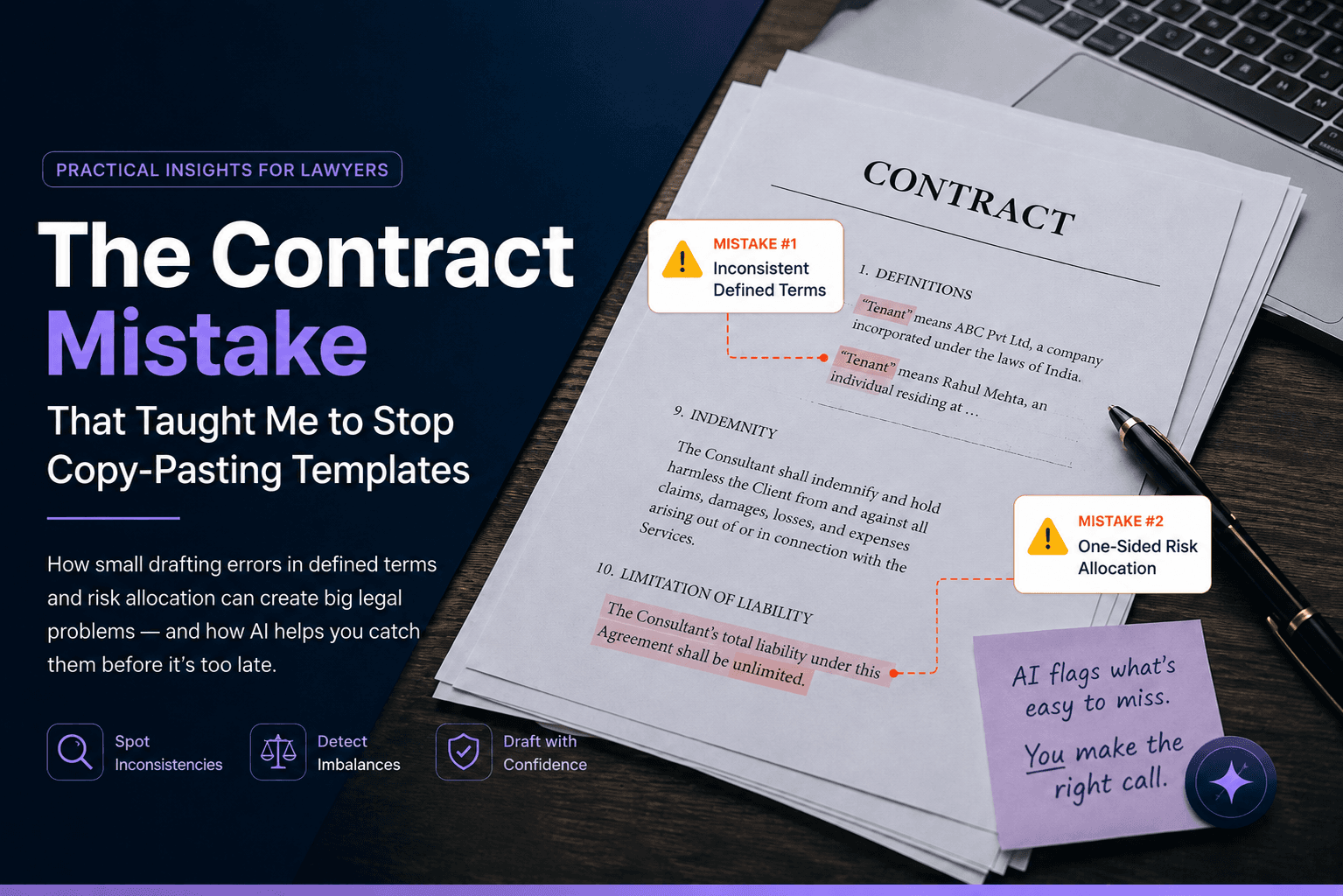
The biggest risks of copy-pasting contract clauses are hidden inconsistencies, outdated assumptions, and risk allocation that no longer fits the deal. Reusing language can save time, but it can also import mismatched definitions, one-sided liability terms, and boilerplate that conflicts with the current transaction. The safest approach is to treat every reused clause as a starting point, then review it against the present parties, scope, and jurisdiction before the draft goes out.
Templates save time. They also carry old assumptions into new deals.
You open the last similar agreement, change the party names, update the dates, tweak a few commercial points, and keep moving. In many matters, that is efficient. It is also one of the easiest ways for drafting risk to slip into a new contract without much resistance.
A clause that worked perfectly in one matter can create ambiguity in the next if nobody checks whether the old language still fits the new relationship. The real question is not whether a clause looks familiar. It is whether the clause still makes sense for this deal.
Why copy-pasting contract clauses creates legal risk
Templates are not the problem. Good precedent is one of the most valuable tools lawyers have. The problem is untested reuse.
When a clause is copied from an older matter, it brings more than wording. It brings assumptions about bargaining power, liability allocation, service scope, remedies, payment timing, operational roles, and commercial intent. If those assumptions are left untouched, they quietly become part of the new agreement.
That is why copy-paste errors often survive early review. The language reads smoothly because it has already been negotiated once. Familiarity makes it easier to miss the fact that the clause now sits in a different deal structure.
Many legal teams reduce that risk by using a repeatable review workflow instead of relying only on memory. For practical next steps, see how to get started with legal AI and how lawyers actually use AI in practice.
Risk 1: defined terms drift across the agreement
Small wording changes can alter legal meaning
One of the most common risks of copy-pasting contract clauses is definition drift. A contract may define one term, then use a similar but different term elsewhere, or apply the same label to two slightly different concepts.
For example, an agreement may define “Customer” but later refer to “Client,” “Purchaser,” or the legal entity name in key operative clauses. That may feel harmless during drafting. In a dispute or compliance review, it can create uncertainty about who owes what to whom.
This problem also appears with terms such as affiliates, services, deliverables, acceptance criteria, confidential information, business day, change request, and cause. Once defined terms become unstable, obligations often become unstable too.
What to check before the draft leaves your desk
- Whether every defined term is used consistently throughout the agreement
- Whether any capitalized term appears without a definition
- Whether multiple terms are being used for the same party, document, or obligation
- Whether schedules, exhibits, and order forms use the same language as the main body
- Whether cross-references still point to the right clause after edits
A first-pass review tool can help surface these issues quickly. For example, Lexi for law firms can help flag inconsistent party references, undefined terms, and drafting drift so a lawyer can correct them early. That kind of review does not replace legal judgment. It simply makes hidden ambiguity easier to spot. For a related discussion, read how accurate AI legal document review is.
Risk 2: liability and indemnity language gets inherited from a different deal
Familiar clauses can be commercially wrong
The most serious copy-paste mistakes are often not grammatical. They are economic. A limitation-of-liability clause, indemnity provision, warranty package, or remedy structure may have been reasonable in the prior matter but inappropriate in the current one.
A long-term outsourcing arrangement may justify a very different liability structure from a short pilot, a one-time consulting engagement, or a software subscription. A clause designed for one pricing model may overprotect or underprotect a party in another. A broad indemnity may make sense where one party controls sensitive systems, but not where responsibility is shared or limited.
These mismatches matter because they often survive until late-stage negotiation, when the other side spots them and treats them as aggressive drafting rather than accidental carryover.
Questions lawyers should ask about inherited risk clauses
- Does the liability cap reflect the value and structure of this specific deal?
- Are carve-outs from the cap intentional and balanced?
- Does the indemnity map to the actual scope of services, products, or data handling?
- Are warranties tied to the current delivery model rather than a prior one?
- Do termination rights align with payment, cure periods, transition support, and survival language?
- Would the proposed remedy structure still look reasonable if a dispute arose tomorrow?
These are not questions software can answer on its own. They are legal and commercial judgment calls. But tools can help identify which clauses deserve the closest review. If you want a practical view of that boundary, see can AI review contracts.
Risk 3: boilerplate stops being boilerplate
Lawyers often reuse notice clauses, governing law provisions, dispute-resolution language, assignment terms, amendment mechanics, force majeure wording, entire-agreement clauses, and order-of-precedence rules with minimal editing. That is understandable, but risky.
Boilerplate clauses can create real problems when the transaction context changes. A copied notice clause may list obsolete addresses or delivery methods. A dispute-resolution clause may conflict with the parties’ chosen forum or preferred process. Assignment language may create obstacles in a corporate reorganization. A force majeure clause may be too broad or too narrow for the supply chain or operating model involved.
Even a survival clause can distort the deal if confidentiality, audit, payment, or intellectual-property obligations are not aligned with what should actually continue after termination.
In many jurisdictions, the practical effect of these provisions depends heavily on local law, court practice, and market norms. That is why lawyers should check the rules and guidance relevant to the governing law and forum instead of assuming one standard clause works everywhere.
Risk 4: copied clauses can break the contract’s internal logic
Some copy-paste mistakes do not sit inside a single clause. They arise because one imported clause conflicts with the rest of the document.
A services agreement may include acceptance language drafted for deliverables that no longer exist. A data-processing schedule may impose security obligations inconsistent with the main body. A payment clause may still assume milestone billing even though the commercial team switched to a subscription model. A statement of work may promise deliverables on timelines the termination clause does not support.
These errors are easy to miss because each clause may look fine on its own. The problem appears only when the agreement is read as a complete system of obligations.
Where internal logic usually breaks first
- Main agreement and schedules using different commercial assumptions
- Definitions section not matching operative clauses
- Termination rights that conflict with renewal mechanics
- Service levels or acceptance criteria inconsistent with remedies
- Privacy, security, or IP clauses that do not match the stated scope of work
This is one reason contract review should test coherence, not just wording. The better question is not “Have we used this clause before?” but “Does this clause fit everything else this contract is trying to do?”
How lawyers reduce the risks of copy-pasting contract clauses
The safest drafting habit is simple: separate precedent value from precedent authority. A prior clause may be a useful starting point without being the right answer for the next deal.
In practice, lawyers reduce copy-paste risk by reviewing reused language in layers:
- First, confirm the clause fits the transaction type and commercial structure.
- Second, test whether the clause uses the same terms, parties, and assumptions as the rest of the agreement.
- Third, check whether governing law, dispute process, notice mechanics, and compliance issues still fit the relevant jurisdiction.
- Fourth, compare the clause against the client’s actual risk tolerance, not the prior deal’s negotiation outcome.
- Finally, read the contract end to end to see whether imported language creates downstream conflicts.
That layered review is what turns templates into efficient tools rather than hidden liabilities. For a drafting-focused companion piece, see common drafting mistakes lawyers can catch with AI.
Where technology helps and where lawyers still decide
Technology is most useful in this area as a first-pass reviewer. It can help flag inconsistent definitions, missing cross-references, unusual redlines, duplicated obligations, and clauses that look out of place in the current draft. That can be especially valuable for high-volume teams working under time pressure.
What technology cannot do by itself is determine the correct legal or commercial position. A one-sided indemnity may be an error, or it may be a deliberate concession tied to pricing, exclusivity, insurance, data sensitivity, or service scope. A broad confidentiality clause may be overreaching, or it may be justified by the information at stake.
That distinction matters for professional responsibility. In many jurisdictions, professional-conduct guidance makes the same basic point: lawyers may use AI tools, but they still remain responsible for competence, confidentiality, supervision, and the accuracy of the final work product. Check the bar or regulator guidance that applies to your practice before adopting any workflow. If you are evaluating practical safeguards, see how lawyers can use AI safely and whether AI-generated legal work is reliable.
Why this matters for law firms and in-house teams
Copy-paste risk is not limited to junior lawyers. It affects solo practitioners without a second reviewer, specialist teams under deadline pressure, law firms managing large precedent banks, and in-house legal departments handling constant contract flow.
The shared challenge is speed. Reusing language helps teams move faster, but speed increases the chance that old assumptions will pass into a new document without enough scrutiny.
That is why many teams build review systems around repeatable workflows, not reusable text alone. For teams handling high contract volume, a first-pass review tool can help flag inconsistent definitions, unusual liability language, missing cross-references, and clauses that do not match the current deal. Lexi supports those workflows across law firms, corporate legal teams, and in-house teams, helping lawyers draft in the firm’s style, review and redline contracts, and run legal research with verified citations.
A practical checklist before you reuse any contract clause
- Does the clause match the parties’ actual roles in this transaction?
- Do the definitions and cross-references still work everywhere they appear?
- Was the liability or indemnity language negotiated for a different deal type?
- Are payment terms, termination mechanics, and remedies aligned with the commercial model?
- Do schedules, annexes, and order forms use the same assumptions as the main agreement?
- Does the governing law and dispute process make sense for the relevant jurisdictions?
- Would you be comfortable explaining the clause to the client or a court if it were challenged later?
If any answer is unclear, the clause needs another pass.
The safest way to use templates
The lesson is not to stop using templates. It is to stop treating them as self-validating.
Good templates accelerate drafting. Careful review keeps old language from silently rewriting a new deal. When lawyers test reused clauses for internal consistency, commercial fit, and jurisdictional appropriateness, they preserve the efficiency of precedent without inheriting risk by accident.
That is the drafting habit that reduces the risks of copy-pasting contract clauses: use precedent to start faster, then review deliberately before you rely on it.
FAQ
What are the main risks of copy-pasting contract clauses?
The main risks of copy-pasting contract clauses are inconsistent definitions, liability or indemnity terms inherited from a different transaction, and boilerplate that no longer fits the deal. Reused wording can also break the contract’s internal logic if schedules, payment terms, remedies, or dispute clauses no longer align.
Is it safe to reuse contract templates?
Yes, if the template is treated as a starting point rather than a final answer. Lawyers usually reduce risk by checking whether each reused clause fits the current parties, scope, commercial structure, and governing jurisdiction.
Can AI catch copy-paste mistakes in contracts?
AI can help catch many copy-paste mistakes in contracts, especially inconsistent definitions, missing cross-references, drafting drift, and unusual risk allocation. It is most useful as a first-pass reviewer, not a substitute for legal judgment. Lawyers still need to verify the output, apply local legal and professional-responsibility rules, and decide whether the clause reflects the commercial deal.