بقلم Lexi Team
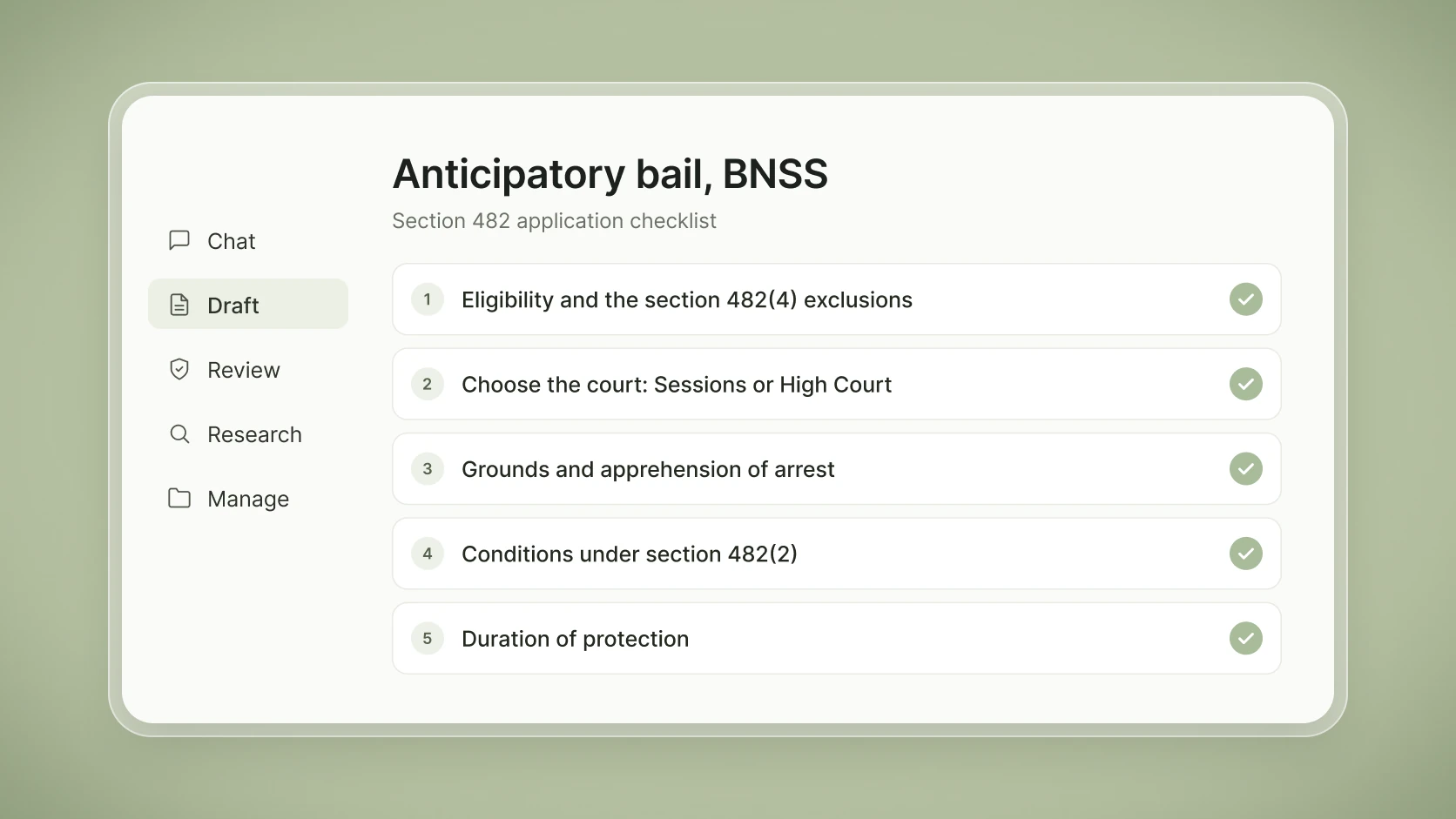
Anticipatory bail in BNSS is governed by section 482 of the Bharatiya Nagarik Suraksha Sanhita, 2023. Before drafting an application, resolve three threshold questions: does section 482(4) exclude the accusation, does a special statute restrict pre-arrest bail, and does the BNSS govern the application or does a saved Code of Criminal Procedure, 1973 (CrPC) provision apply?
Section 482 permits a person who has reason to believe they may be arrested on an accusation of a non-bailable offence to apply to the High Court or Court of Session for a direction that they be released on bail in the event of arrest. The court may grant that direction if it thinks fit. Bharatiya Nagarik Suraksha Sanhita, 2023, section 482(1)
For practitioners, the immediate task is to identify the accusation, procedural stage and relief needed. That analysis informs forum selection, the supporting record, proposed conditions and any request for interim protection.
Anticipatory bail in BNSS: resolve exclusions and transition first
1. Is the accusation excluded by section 482(4)?
Section 482(4) excludes cases involving arrest on an accusation of an offence under section 65 or section 70(2) of the Bharatiya Nyaya Sanhita, 2023 (BNS). Identify every provision invoked in the FIR, complaint and other relevant case papers, then examine the accusation against the statutory exclusion. Bharatiya Nagarik Suraksha Sanhita, 2023, section 482(4)
This is not a general exclusion for serious offences. Where excluded and other offences appear together, do not assume that the additional charges remove the bar. Analyse the allegations and frame the proposed relief with the statutory wording in view.
2. Does a special statute restrict pre-arrest bail?
Section 482(4) is not the complete eligibility analysis. Check every applicable special statute, particularly sections 18 and 18A of the Scheduled Castes and the Scheduled Tribes (Prevention of Atrocities) Act, 1989, which restrict pre-arrest bail for accusations under that Act. The bar does not apply where the allegations do not disclose a prima facie offence under the Act: Prathvi Raj Chauhan v Union of India (2020) 4 SCC 727. Address that question by reference to the allegations; invoking section 482 BNSS does not, by itself, avoid a special-law restriction.
3. Does the BNSS govern the application?
The BNSS came into force on 1 July 2024. Section 531 repeals the CrPC but saves an investigation, inquiry, trial, appeal or application pending immediately before commencement: the specified pending matter is to continue under the CrPC. The date of an alleged offence alone does not answer which procedural provision governs a later bail application. Bharatiya Nagarik Suraksha Sanhita, 2023, section 531(2)(a)
Identify what was pending immediately before 1 July 2024 and when the proposed application is being filed. An application filed after commencement was not itself an application pending before commencement, even if the FIR is older. Where an investigation or another proceeding was already pending, assess the effect of section 531 and the binding decisions applicable in the forum before invoking section 482 BNSS or section 438 CrPC. Record the procedural basis in the application rather than treating the FIR date as conclusive.
Section 482 BNSS and section 438 CrPC
Section 482 BNSS is headed “Direction for grant of bail to person apprehending arrest”. The Allahabad High Court in Asheesh Kumar v State of U.P. (1 August 2025, 2025:AHC:128977) treated it as corresponding to section 438 CrPC. The central route is recognisable: an applicant apprehending arrest on a non-bailable accusation may seek a pre-arrest bail direction from the High Court or Court of Session.
Correspondence is not a substitute for reading the provision that governs the case. Section 482(2), (3) and (4) of the Bharatiya Nagarik Suraksha Sanhita, 2023 address conditions, the effect of a direction following arrest, and excluded accusations respectively. Also account for any applicable special-law restriction and section 531 if a transitional issue arises. In a saved matter, identify the applicable CrPC provision rather than using the BNSS section number interchangeably.
Who may apply, and before which court?
The applicant must have reason to believe they may be arrested on an accusation of a non-bailable offence. Set out the factual basis for that apprehension: for example, the FIR or complaint, communications from investigators, or other relevant events. Distinguish a concrete apprehension from speculation that a complaint might be made.
Section 482(1) permits an application to the High Court or the Court of Session; it does not itself require an applicant to approach the Court of Session first. Forum choice must also account for territorial jurisdiction, applicable court rules, binding decisions and prior proceedings. If applying directly to the High Court, explain why that forum has been chosen and disclose any earlier bail applications. Do not treat a provisional observation made while a court is considering the forum question as a settled rule requiring a Sessions Court application first.
Preparing the application: facts, grounds and supporting material
A section 482 application should be tailored to the arrest apprehension and the investigation, not treated as a generic merits brief.
A practical drafting checklist
- Identify the accusation: state the FIR, complaint or case details; alleged provisions; police station or court; and procedural stage.
- Address availability: explain the section 482(4) exclusion and any special-statute restriction, including a relevant prima facie-offence question; address section 531 where necessary.
- Explain the apprehension: give the dates, communications and events supporting the applicant’s belief that arrest may follow.
- Present the applicant’s account: provide a clear chronology, identify the defence position and distinguish assertions from supporting documents.
- Address conduct: deal candidly with relevant antecedents, prior proceedings, attendance and cooperation offered or provided.
- Annex relied-on material: prepare legible, indexed documents and any translations required by the forum.
- Frame relief precisely: distinguish a request for interim protection pending hearing from the final direction and proposed conditions.
This is a working checklist, not a statutory form. Follow the chosen court’s requirements for affidavits, annexures, filing and urgent listing.
Conditions the court may impose
When granting a direction under section 482(1), the High Court or Court of Session may include the conditions described in section 482(2): availability for interrogation by a police officer when required; no inducement, threat or promise to a person acquainted with the case facts; no departure from India without the court’s prior permission; and such other conditions as may be imposed under section 480(3), as if bail had been granted under that provision. Bharatiya Nagarik Suraksha Sanhita, 2023, section 482(2)
Draft proposed conditions that are specific and workable. If cooperation, witnesses, travel or attendance may be contested, address the concern directly. Once an order is made, record every obligation and assign responsibility for compliance; do not assume that the court adopted the conditions proposed in the application.
Duration, arrest and the operative order
In Sushila Aggarwal v State (NCT of Delhi) (2020) 5 SCC 1, a Constitution Bench held that anticipatory bail under section 438 CrPC need not ordinarily be limited to a fixed period and does not automatically end when a charge-sheet is filed or summons issued; protection may continue through trial. A court may nevertheless limit it where the facts call for that. Section 482 BNSS corresponds to section 438 CrPC, so this is the relevant baseline when seeking a final direction under section 482. Interim protection pending a hearing is distinct from that final direction.
The operative order controls the protection granted. Check whether it is interim or final, which accusation it covers, whether it specifies an end date or event, and which conditions apply. Do not assume that a final order expires at a procedural milestone or that protection continues contrary to an express limit.
Section 482(3) addresses the effect of a direction if the person is subsequently arrested without a warrant on the covered accusation and is prepared to give bail. It also addresses the form of warrant if a Magistrate taking cognizance decides to issue one in the first instance. Read that provision with the operative order when advising on the steps to take if arrest is attempted. Bharatiya Nagarik Suraksha Sanhita, 2023, section 482(3)
Maintain an order note for the client and litigation team: date, court, case number, covered accusation, operative relief, conditions, next listing and compliance owner. Keep a copy available for prompt production to the investigating agency or relevant court.
Practical filing and hearing workflow
- Confirm the provision: assess section 482(4), restrictions under any applicable special statute and, where relevant, section 531 before settling on section 482 BNSS or section 438 CrPC.
- Choose the forum: account for territorial jurisdiction, binding decisions, previous applications, urgency and filing procedure; explain the choice if applying directly to the High Court.
- Build the record: collect the initiating documents, chronology, communications, prior orders and material supporting the apprehension and defence account.
- Draft the application: separate statutory availability, facts, grounds, proposed conditions and interim relief.
- Prepare for the hearing: be ready to address the accusation, any contention about custodial interrogation, the applicant’s conduct and proposed safeguards.
- Review the order immediately: confirm the exact protection granted and every condition.
- Implement compliance: communicate the order through appropriate channels, preserve proof of compliance and monitor future dates.
For a document-heavy matter, a chronology, document index and condition tracker can help the team keep the application and subsequent obligations organised.
Practitioner checklist
- Have you identified every alleged offence and assessed the section 482(4) exclusion and any applicable special-statute restriction?
- If the SC/ST Act is invoked, have you considered whether the allegations disclose a prima facie offence under it?
- Have you determined whether section 482 BNSS or a saved CrPC provision governs the application?
- Is the apprehension of arrest on a non-bailable accusation supported by specific facts?
- Have you selected the forum with regard to jurisdiction, binding decisions, prior proceedings and court rules, and explained any direct High Court filing?
- Does the record address the applicant’s account, relevant antecedents and cooperation?
- Do the proposed conditions take account of sections 482(2) and 480(3)?
- Are the requests for interim and final relief distinct and precise?
- Has someone been assigned to review the order and monitor compliance?
Legal information only: This guide describes Indian law as at 8 November 2026 and is not advice on any particular case. Apply the governing statute, court rules and terms of the relevant order to the facts before filing.
Next step: Explore Lexi’s AI-native legal technology for law firms, litigators and in-house teams.