بقلم Lexi Team
The phrase “statutory demand Singapore” covers two distinct insolvency tracks. A demand addressed to a company may support a winding-up application; one addressed to an individual or firm may precede a bankruptcy application. The distinction affects how the demand is prepared and served, the time available to respond, and the court proceedings that may follow.
A creditor should therefore identify the debtor and the intended insolvency route before issuing a demand. Neither non-payment nor the expiry of a demand automatically produces a winding-up or bankruptcy order. This guide addresses Singapore law as at 10 November 2026.
Statutory demand Singapore: why the two tracks differ
Under section 125 of the Insolvency, Restructuring and Dissolution Act 2018 (IRDA), a company’s inability to pay its debts is one ground on which the court may order its winding up. An uncomplied statutory demand is one way of establishing that inability to pay; it is not the only way. A creditor seeking compulsory winding up must apply to the General Division of the High Court. See the Singapore Courts’ company winding-up guidance.
Personal bankruptcy is a separate process. The Singapore Courts describe a statutory demand as a notice stating the debt, the purpose of the demand, the time for compliance and the possible consequence of bankruptcy proceedings. Their guidance on serving a personal statutory demand also notes that a demand is not the only way to establish inability to pay.
Company demands: the winding-up route
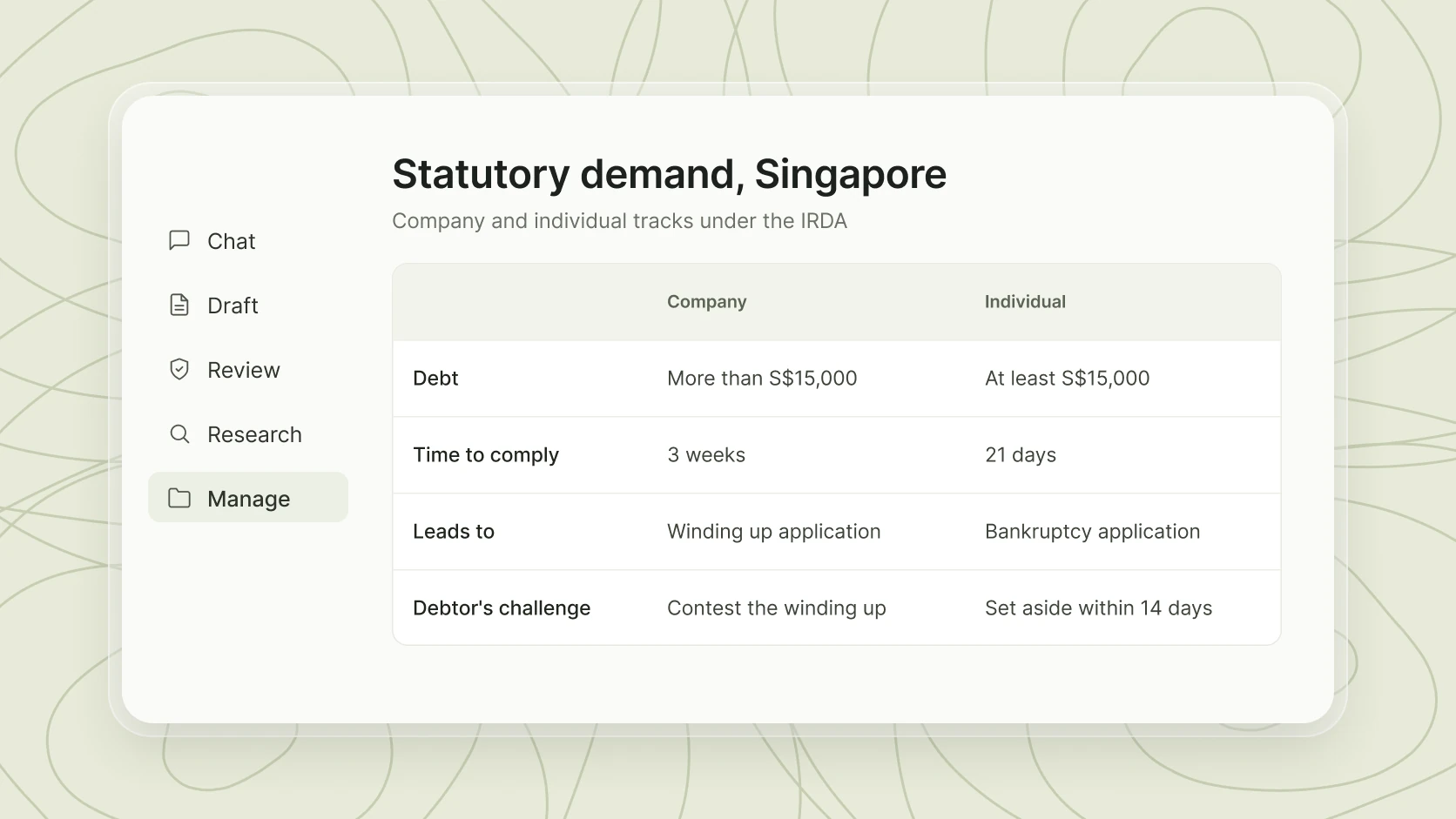
Section 125(2)(a) of the IRDA provides a specific route to deeming a company unable to pay its debts. It applies where a creditor is owed more than S$15,000 that is then due, leaves a demand under the creditor’s hand at the company’s registered office, and the company neglects for three weeks thereafter to pay, secure or compound the sum to the creditor’s reasonable satisfaction. The court must still decide any subsequent winding-up application; the demand does not wind up the company.
Before issuing the statutory demand letter, identify the company by its correct legal name and UEN. Reconcile the sum presently due against the agreement, invoices, payment history, credits, interest calculation and any security. A demand should not obscure a genuine dispute about liability or amount.
Serving and documenting a company demand
For the section 125(2)(a) route, the statutory method is to leave the demand at the company’s registered office. Record the address used, the date and manner of service, and who effected it. Retain the signed demand, service instructions, delivery or process-server records, and any correspondence about receipt. These records matter if the creditor later relies on the three-week period or the company contests service.
How a company can respond
A company should not treat a corporate demand as though it were a personal bankruptcy demand with the same set-aside procedure. If the sum is due, it can address payment, security or an arrangement acceptable to the creditor. If liability or quantum is genuinely disputed on substantial grounds, it should assemble the evidence promptly and take advice on opposing a winding-up application or, where appropriate, seeking to restrain a threatened application. The Court of Appeal in Pacific Recreation Pte Ltd v S Y Technology Inc [2008] SGCA 1 held that a company need only show a triable issue, the same standard as resisting summary judgment, to restrain a winding-up application based on a disputed debt. Insolvency proceedings are not a substitute for ordinary proceedings to determine a genuinely disputed debt.
The immediate evidence file should include the governing agreement, invoices, statements of account, payment records, credit notes, correspondence about the dispute and documents concerning security. The appropriate court response depends on what the creditor has done and the basis on which the company disputes the debt.
Individual demands: the bankruptcy route
A creditor’s application to make an individual or firm bankrupt falls under the personal insolvency provisions of the IRDA. The Singapore Courts’ bankruptcy filing guidance states that, generally, the debtor must owe at least S$15,000 and be unable to repay it, subject to the other statutory conditions.
A personal statutory demand ordinarily gives the debtor 21 days after service to comply. If it is not complied with or set aside, the creditor may be able to apply for bankruptcy; it must still make the application and obtain a court order. If the creditor relies on the demand, the bankruptcy application can be filed once 21 days have passed since service without compliance or a set-aside application, and must be filed within four months of service of the demand. See the Singapore Courts’ filing guidance. The Singapore Courts’ debtor guidance explains the possible responses to a demand.
Where a creditor relies on an uncomplied demand, the official filing guidance identifies the creditor’s bankruptcy application, an affidavit in support and an affidavit of service of the demand among the documents to prepare. It also refers to rule 78 of the Insolvency, Restructuring and Dissolution (Personal Insolvency) Rules 2020 for the affidavit of service.
Serving and setting aside a personal bankruptcy demand
Start with personal service on the debtor, following the Singapore Courts’ service guidance. If personal service cannot be effected despite reasonable attempts, check the permitted alternative methods and any conditions or court approval applicable to the proposed method; do not assume that simply posting or emailing the demand will suffice. Retain the dates, times, addresses and outcomes of personal-service attempts, any enquiries into the debtor’s whereabouts, the basis for alternative service and proof of how and when it was effected. These records will support the affidavit of service and the calculation of deadlines. Do not borrow the registered-office method or the three-week company rule for an individual debtor.
A debtor who disputes a personal demand may apply to set it aside. For a demand served in Singapore, the deadline is 14 days after service, shorter than the 21-day compliance period. If the demand was served outside Singapore, the deadline is 21 days. The General Division of the High Court can extend time, and the request can be included in the set-aside application. The Supreme Court’s practice directions for bankruptcy and winding-up matters address applications to set aside statutory demands and to extend time.
A debtor should retain the demand and its envelope or electronic delivery record, note when and how it was received, and collate evidence of payments, credits, security and any dispute over liability or quantum. The creditor should keep a complete service record and ensure that the demand and later court papers use a consistent debt calculation and chronology.
Drafting and evidence checklist for both tracks
These file-management steps support, but do not replace, the requirements of the applicable insolvency regime.
- Identify the debtor. Confirm whether the liable party is a company, individual or firm, and use its correct legal name and identifiers.
- Choose the right route. Apply the corporate winding-up requirements to a company and the personal bankruptcy requirements to an individual or firm. Do not reuse a demand across tracks without revising it.
- Reconcile the debt. Match each component to the agreement, invoices, judgment or other source documents; account for payments, credits, interest and security.
- Check authority. Confirm the creditor’s entitlement, any assignment and the authority of the person signing or instructing service.
- Calculate the dates. Record the date and method of service before calculating the applicable compliance period or a debtor’s set-aside deadline. For a personal demand served in Singapore, diarise day 14 for a set-aside application, day 21 for compliance and the four-month limit for filing a bankruptcy application that relies on the demand.
- Build a service bundle. Preserve the final demand, address checks, service instructions, delivery records, acknowledgements and material needed for an affidavit of service.
- Map the dispute. Review correspondence on liability, payment arrangements, credits and security alongside the proposed demand.
- Check court papers for consistency. Compare debtor identity, dates, amounts and supporting documents across the demand, affidavits and proposed application.
Inherited precedents deserve particular care: see The Template Trap: Risks of Copy-Pasting Contract Clauses and How to Reduce Them. For a broader document-review workflow, see How Lawyers Can Use AI Safely: A 5-Step Checklist.
At-a-glance comparison: company winding up and personal bankruptcy
| Issue | Company winding up | Personal bankruptcy |
|---|---|---|
| Debtor | Company. | Individual or firm, subject to the statutory conditions. |
| Governing route | Corporate winding up under section 125 of the IRDA. | Personal insolvency under the IRDA and the Personal Insolvency Rules 2020. |
| Role of demand | May establish a statutory basis for deeming the company unable to pay its debts under section 125(2)(a). | May support a creditor’s bankruptcy application if not complied with or set aside. |
| Debt amount | More than S$15,000 then due for the section 125(2)(a) demand route. | Generally at least S$15,000 for a creditor’s bankruptcy application, subject to other conditions. |
| Compliance period | Three weeks after the demand is left at the registered office. | Ordinarily 21 days after service of the demand; a bankruptcy application relying on it must be filed within four months of service. |
| Service | Leave the demand at the company’s registered office for the section 125(2)(a) route. | Start with personal service; if it cannot be effected, follow the conditions for a permitted alternative method and retain proof. |
| Debtor response | Pay, secure or compound the debt, or contest the winding-up route where there is a proper basis. | Comply or promptly apply to set aside the demand; the set-aside deadline is 14 days for service in Singapore or 21 days for service outside Singapore, subject to any extension. |
| Evidential focus | Debt, company identity, registered-office service, payment and dispute records. | Debt, service and receipt, compliance or set-aside evidence, and bankruptcy application papers. |
Conclusion: choose the route before issuing or challenging a demand
A statutory demand has different requirements and consequences depending on whether the debtor is a company or an individual or firm. Identify the correct route, establish the debt, document service and calculate the relevant dates before taking the next step. The demand itself is not a winding-up or bankruptcy order.
Explore Lexi for AI-native legal technology for law firms, litigators and in-house teams managing legal documents and case materials.
Legal information disclaimer: This is general information about Singapore law as at 10 November 2026, not legal advice. Insolvency rules and thresholds may change; obtain advice on the law applicable to a particular matter.