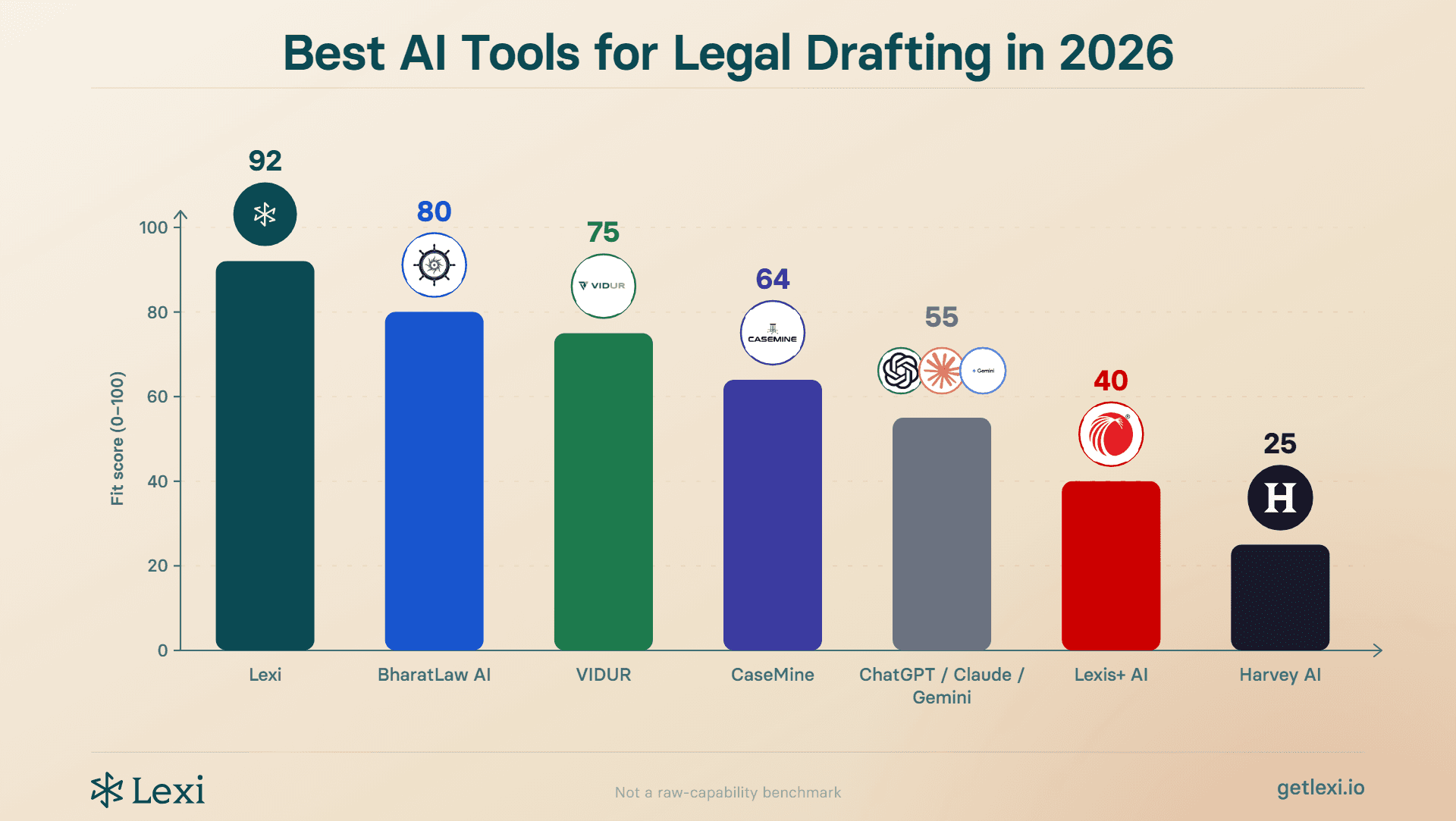
The best AI for legal drafting in 2026 depends on what you need to draft, how much verification your team requires, and where you practice. Enterprise teams may prefer platforms built around large-scale workflows, research, or internal knowledge search. Firms that want drafting in their own style, contract redlining, and verified citations across markets should look closely at Lexi. No tool should be used as a substitute for lawyer judgment, and in many jurisdictions you should check your local bar rules before using AI on client matters.
Legal drafting demands speed, precision, confidentiality, and consistency. That is why more lawyers now use AI to accelerate first drafts, organize facts, summarize documents, and surface authorities for review. The right platform can reduce repetitive work and help lawyers focus on strategy, negotiation, and client advice.
But not every AI product is designed for legal work. General-purpose models can write fluent prose, yet they may invent citations, miss jurisdictional nuance, or create data-governance concerns if used carelessly. For legal teams, the better question is not simply which tool writes fastest, but which one is grounded, reviewable, secure, and usable inside real legal workflows.
This guide compares leading options for legal drafting in 2026, including global legal AI platforms and regional products for India and the Middle East. We looked at officially published product capabilities for drafting, review, research, workflows, document analysis, privacy positioning, and jurisdictional fit. Disclosure: Lexi publishes this comparison about its own product, so readers should verify product details independently on each vendor's official site before buying.
If you are new to this category, our guides on how to get started with legal AI, how lawyers actually use AI in practice, and how lawyers can use AI safely give useful context before you shortlist vendors.
What makes the best AI for legal drafting?
The strongest tools do more than generate polished text. They help lawyers move from facts to a defensible draft with less manual rework. In practice, that means evaluating products on a few core dimensions.
- Draft quality: Can the platform produce usable first drafts for contracts, letters, pleadings, memos, and internal work product?
- Verification: Does it support citation checking, source visibility, or workflows that make lawyer review easier?
- Redlining and review: Can it compare clauses, flag deviations, and support negotiation playbooks?
- Knowledge access: Can it use your precedents, templates, matter files, and approved language?
- Workflow fit: Does it work where lawyers already draft, such as Word or matter-centric review workflows?
- Security and deployment: Does the vendor explain how customer data is handled, and does that fit your organization's requirements?
- Jurisdiction fit: Does the product suit the jurisdictions and languages your team actually handles?
Those factors matter because legal drafting is not just text generation. It is risk allocation, authority, style control, and professional accountability. That is also why related topics like whether AI-generated legal work is reliable and how accurate AI legal document review is belong in the same buying conversation.
Best AI for legal drafting tools in 2026
Lexi
Lexi is a global AI legal associate built for law firms and in-house legal teams that want more than a narrow drafting assistant. It is a strong fit for teams that need drafting in their own style, contract redlining, and verified citations, while also covering intake, review, and research in one workflow. Rather than forcing lawyers to stitch together separate tools, Lexi is designed to support work across firm sizes and markets.
Lexi is especially compelling for firms that want AI to reflect established drafting preferences instead of producing generic output. That matters when your team wants consistency across partners, departments, or offices, and when review time matters as much as first-draft speed.
- Drafts in the firm's own style
- Redlines contracts and supports review workflows
- Provides verified citations to support lawyer checking
- Supports law firms, corporate teams, litigation teams, and in-house use cases
- Operates globally across markets rather than serving only one region
Lexi reports 5,000,000+ documents processed, 200,000+ cases, and 200+ organizations served. It also reports 10+ hours saved per lawyer per week and up to 45% more cases per attorney. For teams evaluating deployment by practice type, see Lexi's solutions for law firms, corporate legal teams, litigation, and in-house counsel.
Best fit for: Firms and legal departments that want drafting, review, and research connected in one platform, especially where house style, cross-market work, and citation verification matter.
Harvey
Harvey is a global legal AI platform for large law firms and corporate legal teams. According to its platform page, it offers Assistant, Vault, Workflow, History, and Library; supports document analysis, drafting from firm-approved templates, legal research, and no-code workflow agents; and uses a custom case-law model built with OpenAI.
That makes Harvey a serious option for enterprise teams looking for broad functionality and workflow depth at scale. For buyers searching terms like "harvey ai alternative" or "lexi vs harvey," the practical distinction is often this: Harvey is well suited to large organizations building structured legal AI programs, while Lexi is a strong fit for teams that prioritize firm-style drafting, contract redlining, and verified citations across markets in one AI associate workflow.
Best fit for: Large firms and enterprise legal teams that want a broad platform for analysis, research, and workflow automation.
Legora
Legora is a European legal AI workspace. On its official product page, Legora describes Tabular Review for large document sets, a cited Legal Assistant, a Microsoft Word add-in for drafting and redlining, agentic Research across document management systems, legal databases, and the web, plus natural-language Workflows. Legora also states that it does not train on your data.
For firms comparing a "legora alternative," Legora stands out where teams want a legal workspace with strong review, cited assistance, and Word-based drafting support. Lexi is likely the better fit when a buyer specifically wants drafting in the firm's own style combined with verified citations and broader cross-market positioning.
Best fit for: Teams that want a legal AI workspace with document review, cited assistance, and Word-centric drafting.
DeepJudge
DeepJudge focuses on AI knowledge search for legal teams. Its official product page describes proprietary Colinear semantic and keyword search across a firm's own document management systems, with respect for access permissions and ethical walls, and notes a partnership with Thomson Reuters.
DeepJudge is not primarily a drafting-first product. Its value is strongest when your challenge is finding the right internal precedent, clause bank, memo, or work product across a fragmented document estate. Many firms pair knowledge retrieval with separate drafting tools, but teams that prefer one platform spanning drafting and review may lean toward a broader product.
Best fit for: Firms whose biggest bottleneck is internal knowledge retrieval rather than first-draft generation alone.
Lucio
Lucio is an India-focused AI-native legal workspace. Its official site says it supports drafting, review, legal research, Indian-language OCR and translation, and chronologies, and notes adoption by firms including Trilegal and S&R Associates.
Lucio is relevant for India-based teams that need local workflow sensitivity and language support. Buyers doing India-heavy matters may find that regional depth is more important than broad geographic reach. Teams with mixed cross-border work may instead prefer a more global platform.
Best fit for: India-focused firms and legal teams that need local drafting and review support with Indian-language capabilities.
Jurisphere
Jurisphere is an India-based legal AI offering outcome-based support. Its official site describes document and contract analysis, redline review, legal research, case chronologies, and support paired with AI-native attorneys.
That positioning may appeal to teams looking for a mix of product support and service-oriented delivery. Where your workflow requires sustained contract analysis and chronology building, Jurisphere may be worth evaluating alongside more software-led tools.
Best fit for: India-based teams that want AI-enabled analysis and redlining with a more outcome-oriented support model.
HAQQ
HAQQ is a legal AI platform for the Middle East and North Africa. On its official site, HAQQ highlights native Arabic support, including right-to-left drafting, plus English, French, and Spanish; UAE-specific guidance such as Labour Law, MOHRE, and Dubai tenancy; compliance positioning around GDPR, PDPL, ISO 27001, and SOC 2; and law-firm management features.
For MENA teams, HAQQ's regional language and workflow orientation can be a major advantage. For global teams that need one drafting platform across multiple markets, the tradeoff is whether regional specialization outweighs broader cross-market consistency.
Best fit for: Middle East-focused legal teams that need Arabic-native workflows and regional guidance.
General-purpose AI tools
General-purpose models can still help with brainstorming, structure, plain-language rewrites, and summarization. But they remain a higher-risk choice for legal drafting if used without verification and controlled workflows. The cautionary example most lawyers know is Mata v. Avianca, Inc., 678 F. Supp. 3d 443 (S.D.N.Y. 2023), where AI-fabricated citations became central to sanctions proceedings. The case is a reminder that fluent output is not the same as reliable authority.
Best fit for: Low-risk ideation and non-privileged drafting support, not final legal work without careful lawyer review.
How Lexi compares
Lexi is not the right answer for every buyer, and this is not a one-size-fits-all market. The better approach is to match the tool to the problem.
- If you want enterprise workflow breadth: Harvey is a serious contender for large firms and corporate teams building scaled AI programs.
- If you want a legal workspace with Word drafting and cited assistance: Legora is strong, especially for document review and workspace-style use.
- If your pain point is internal precedent retrieval: DeepJudge is tailored to semantic search across your own knowledge systems.
- If your work is heavily India-specific: Lucio and Jurisphere both merit review for local drafting, analysis, and chronology workflows.
- If you need Arabic-native regional support: HAQQ is notable for MENA language and compliance positioning.
- If you want drafting in your own firm's style, contract redlining, and verified citations across markets: Lexi is often the best fit to evaluate first.
In other words, Lexi is strongest where buyers want a global AI legal associate rather than a narrower point solution. That is especially true for firms balancing drafting speed with style control and verifiable output. If your team is still deciding whether drafting assistance should be AI-assisted or more autonomous, see AI-assisted vs AI-generated work and our broader drafting guide for the review model that fits your risk tolerance.
What to look for when choosing a legal drafting platform
1. Verified authority, not just persuasive prose
The best drafting tool is not the one that sounds most confident. It is the one that makes review easier by grounding outputs in identifiable sources, precedent, or approved internal language. Citation visibility and verification matter most in filings, advice, and research-linked drafting.
2. Drafting in your team's style
Legal teams do not just want a clause. They want their clause, with their risk positions, fallback language, formatting habits, and partner preferences. Style consistency can significantly reduce review friction.
3. Review and redlining support
Drafting and review are usually one workflow, not two. If a platform can create a draft but cannot compare versions, flag deviations, or support contract negotiation, you may still need another product.
4. Access to internal knowledge
Many of the best drafts come from a mix of current instructions and prior work product. Tools that can use approved templates, model clauses, and document repositories tend to be more useful than standalone chat interfaces.
5. Security and governance
Before rolling out any product, confirm data-handling terms, admin controls, and deployment options. In many jurisdictions, professional duties around confidentiality and supervision still apply even when the tool is effective.
6. Jurisdiction and language fit
Some products are global; others are deliberately regional. Neither approach is inherently better. The best choice depends on whether your matters are local, cross-border, multilingual, or all three.
Where AI helps most in legal drafting
First drafts
AI is particularly effective at getting lawyers past the blank page. It can generate structured first drafts of contracts, notices, letters, issue lists, internal memos, and many litigation-related documents for review.
Clause comparison and redlines
When negotiation turns on deviations from market or house standards, AI can help surface what changed, what is missing, and what deserves closer attention. That is why contract review capability often matters just as much as drafting speed.
Summaries that feed drafting
Draft quality improves when the underlying facts and documents are organized first. Tools that summarize judgments, correspondence, discovery, or case files can materially improve downstream drafting efficiency. For more on that workflow, see how lawyers can use AI to summarize legal documents safely and how AI helps lawyers organize case files.
Research-linked writing
AI can accelerate issue spotting and pull together a starting set of authorities, but lawyers should still verify every authority and proposition before relying on it. That remains true even with legal-specific tools.
So which is the best AI for legal drafting?
If your organization wants enterprise-scale legal AI with broad workflow tooling, Harvey belongs on the shortlist. If you want a legal workspace with cited assistance, strong review features, and Word integration, Legora is worth close review. If internal knowledge retrieval is the real bottleneck, DeepJudge may solve the more important problem first. India-focused buyers should evaluate Lucio and Jurisphere for local workflows, while MENA teams should review HAQQ for Arabic-native and regional support.
Lexi is the strongest fit for firms and legal teams that want drafting in their own style, contract redlining, and verified citations in a global platform that can support multiple markets and matter types. That is not the same as saying one product wins for everyone. It means the best choice depends on whether your priority is enterprise workflow depth, regional specialization, knowledge retrieval, or an end-to-end AI legal associate workflow.
FAQ
What is the best AI for legal drafting for small and mid-size law firms?
Often, it is the tool that combines drafting, review, and research without requiring several separate subscriptions. For many firms, Lexi is a strong fit when house style, redlining, and verified citations matter. But the right choice still depends on your practice mix, data requirements, and jurisdictions.
Is Harvey the best AI for legal drafting?
Harvey is a strong option for large firms and enterprise legal departments, especially where workflow breadth and large-scale deployment matter. It may not be the best fit for every team, which is why searches like "harvey ai alternative" and "lexi vs harvey" usually come down to workflow needs, team size, and whether you want a broader AI associate model.
Can AI draft legal documents safely without a lawyer?
As a general rule, no. AI can speed up first drafts, clause analysis, and summaries, but lawyer review remains essential. If you are considering consumer or unsupervised use, read whether it is safe to use AI for legal documents without lawyer review and whether AI can replace a lawyer for legal documents.