بقلم Lexi Team
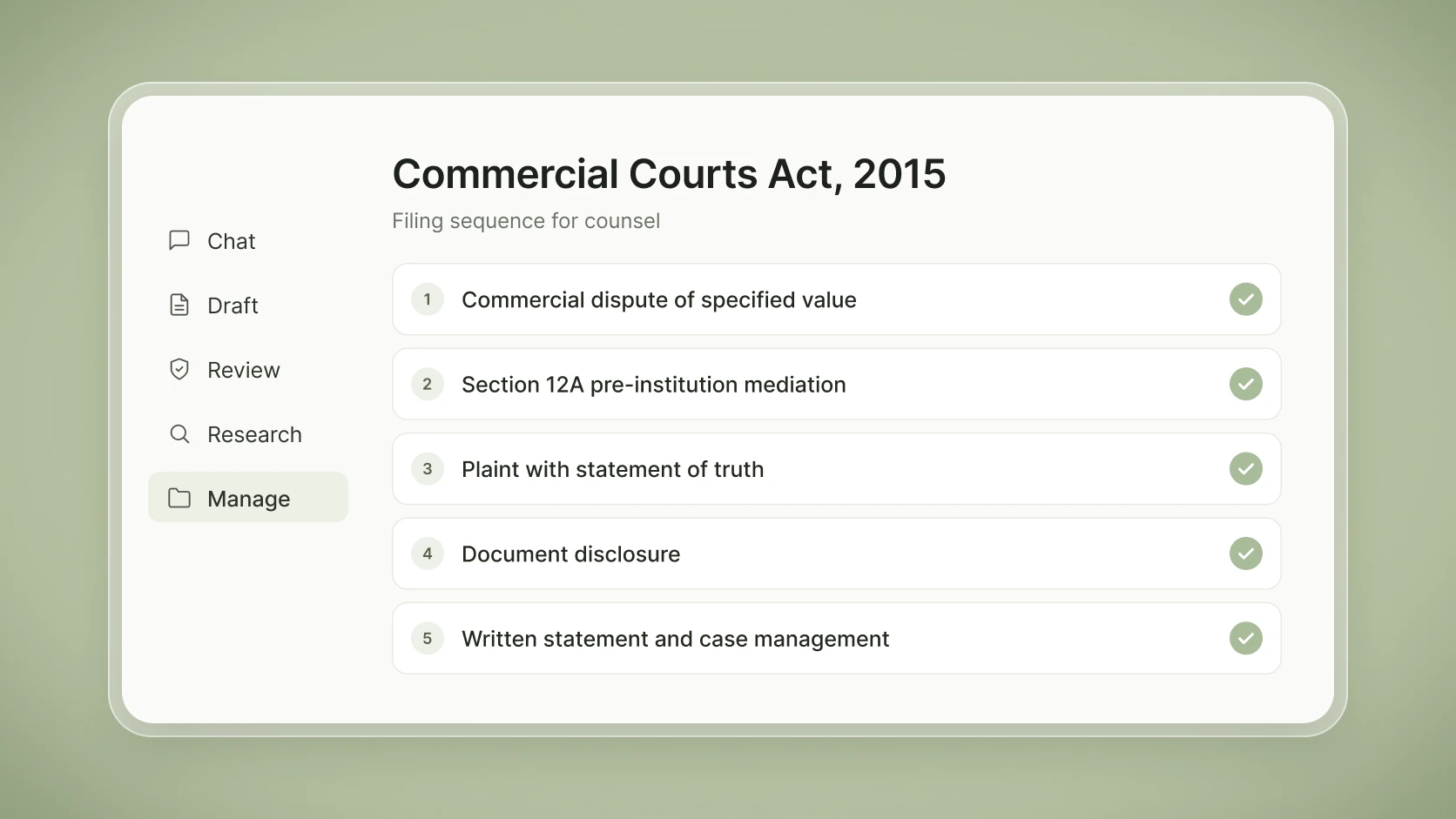
Under the Commercial Courts Act, 2015, an Indian commercial suit requires more than a well-drafted claim. Counsel should classify the dispute, establish its specified value, identify the proper court and address pre-institution mediation before filing. This checklist sets out that sequence for disputes lawyers and in-house counsel.
Commercial Courts Act, 2015: confirm coverage and specified value
Start with the pleaded cause of action. Section 2(1)(c) of the Commercial Courts Act, 2015 defines “commercial dispute” by reference to specified categories of transactions and agreements. These include ordinary transactions of merchants, bankers and financiers; export or import of merchandise or services; construction and infrastructure contracts; agreements relating to immovable property used exclusively in trade or commerce; franchising, distribution and licensing agreements; intellectual property rights; and partnership, joint venture and shareholder agreements. Match the material facts to an applicable category: the fact that the parties are businesses, or that a claim has a substantial value, is not enough on its own.
Then calculate specified value separately. Section 12 sets out the valuation approach for different reliefs. For a money claim, include interest computed up to the filing date. For immovable or movable property, or a right in either, use the property’s market value at filing; for another intangible right, use the market value of that right as estimated by the plaintiff. Retain the material supporting the figure. The statutory floor is ₹3 lakh, but the applicable threshold and allocation of courts must be read with the relevant notifications.
- Identify the statutory commercial-dispute category and the facts supporting it.
- List each relief and apply the corresponding specified-value rule.
- Reconcile the valuation, court-fee position and jurisdictional averments in the plaint.
- Preserve contracts, invoices, account statements and other documents supporting the classification and value.
Identify the court with jurisdiction
Establish territorial and pecuniary jurisdiction before choosing a filing venue. Record the material events, defendant’s location and any contractual jurisdiction clause. Then determine whether the suit belongs in a Commercial Court or, where the High Court exercises ordinary original civil jurisdiction, its Commercial Division. The Act provides the framework; notifications, applicable High Court rules and local filing directions govern the practical allocation and filing process.
Forum file to complete before drafting
- Cause-of-action chronology and the location of material events.
- Contractual jurisdiction clause, defendant address and service details.
- Applicable pecuniary threshold and commercial-court allocation notification.
- Registry requirements for fees, copies, pagination and electronic filing.
Decide whether Section 12A mediation is required
Section 12A of the Commercial Courts Act, 2015 requires pre-institution mediation before a suit is instituted if the suit does not contemplate urgent interim relief. In Patil Automation Pvt. Ltd. v. Rakheja Engineers Pvt. Ltd., the Supreme Court held the requirement mandatory and made that declaration effective from 20 August 2022. A plaint filed on or after that date without Section 12A compliance, where the suit does not genuinely contemplate urgent interim relief, is liable to rejection under Order VII Rule 11 of the Code of Civil Procedure, 1908.
As at 4 November 2026, the Mediation Act, 2023 substitution of Section 12A had not taken effect. The existing Section 12A and the Commercial Courts (Pre-Institution Mediation and Settlement) Rules, 2018 govern this filing step. For a later filing, recheck whether the substitution has commenced.
Assess urgency from the relief actually sought and the facts supporting it. In Yamini Manohar v. T.K.D. Keerthi, the Supreme Court explained that the court examines the plaint, the cause of action and the request for interim relief; an urgency prayer cannot be a device to bypass mediation. If filing without mediation, plead the immediate harm, identify the interim order needed and assemble the supporting record. Follow any application or filing requirements of the proposed court.
Apply to the mediation authority and retain the outcome
Under the 2018 Rules, submit Form 1 to the Authority authorised under the Legal Services Authorities Act, 1987. In practice, this may be the State or District Legal Services Authority, or the High Court Legal Services Committee where the High Court has original jurisdiction. The Form 1 mediation application calls for party and contact details, the nature of the commercial dispute, the quantum of the claim, the territorial jurisdiction of the competent court and a brief synopsis. Use the filing method applicable to the authority handling the dispute.
Section 12A requires the mediation process to be completed within three months of the plaintiff’s application; the period may be extended by a further two months with the parties’ consent. Keep the application, acknowledgement and procedural notices. If the opposite party does not participate, retain the Authority’s non-starter report; if mediation proceeds without a settlement, retain its failure report. If the parties settle, retain the written settlement agreement signed by the parties and the mediator. Preserve mediation communications and negotiation material separately, subject to applicable confidentiality rules; do not treat them as routine court-facing annexures.
Account for limitation during mediation
Section 12A provides that the period during which the parties remained occupied with pre-institution mediation is not computed for limitation under the Limitation Act, 1963. Do not replace a date-by-date limitation calculation with an assumption that every interval surrounding an application is excluded.
Prepare a limitation worksheet at case-opening. Record the cause-of-action dates, contractual notice events, mediation application and acknowledgement dates, the authority’s outcome date and the intended institution date. Keep the underlying documents beside the calculation, particularly where a deadline is close or a filing may need to be corrected.
Prepare the plaint and disclosure record
The Act applies commercial-suit amendments to the Code of Civil Procedure, 1908. Prepare the plaint, statement of truth and document disclosures as a single consistent record. The commercial-suit disclosure regime requires attention to relevant documents in a party’s possession, power, custody or control, including documents adverse to its case. Apply the governing rules to the specific filing and preserve electronic source material where it matters.
Practical pre-filing document controls
- Number the source documents and connect each material pleading assertion to a document or identified witness.
- Distinguish material held by the client from records that must be obtained from another source.
- Preserve native electronic files and relevant metadata where authenticity or chronology may be contested.
- Reconcile the prayer, valuation, interim-relief application, statement of truth and disclosure schedule before filing.
Calendar the written statement and case-management steps
For a covered commercial suit, the amended Code of Civil Procedure allows a defendant 30 days from service of summons to file a written statement. The court may allow filing up to 120 days from service, for reasons recorded in writing and on payment of such costs as the court deems fit, but after 120 days the defendant forfeits the right to file it and the court cannot take it on record. Record the service date and calculate the deadline immediately.
Also calendar the court’s directions for admission and denial of documents, inspection, evidence and hearings. Commercial-suit case management is most useful when each direction has an owner, a due date and a record of the order that set it.
Consider summary judgment at the proper stage
Order XIII-A of the Code of Civil Procedure, as applied to commercial disputes by the Act, permits a summary-judgment application after summons has been served but before issues are framed. The test includes whether a party has no real prospect of succeeding on or defending the claim and whether there is no other compelling reason for a trial. It is not a substitute for identifying genuinely disputed facts.
Before applying or responding, separate the documentary facts that are not in dispute from issues requiring evidence. Consider the application’s timing, supporting material and effect on the wider case-management plan.
Pre-filing checklist for counsel
- Classify the pleaded dispute under the Act’s commercial-dispute definition.
- Calculate specified value for each relief and support the calculation.
- Establish territorial and pecuniary jurisdiction and identify the allocated court.
- Decide whether Section 12A mediation is required or the suit genuinely contemplates urgent interim relief.
- If mediation is required, apply through the appropriate Authority and retain the outcome record.
- Calculate limitation using the relevant dates and the statutory treatment of mediation time.
- Complete the plaint, statement of truth, disclosures and electronic-document record.
- Calendar service, written-statement and early case-management deadlines.
Legal information disclaimer: This is general information, not legal advice. Applicable commencement notifications, court rules and later legal developments may affect a particular filing; consult qualified Indian counsel.
Next step: Explore Lexi for legal research, document review and drafting workflows for law firms, litigators and in-house teams.