By Lexi Team
A due diligence checklist for acquisition is useful only if it answers the deal questions: which facts could change the structure, price, conditions, indemnities, closing steps or decision to proceed? Each finding should point to a source document or an identified gap.
This framework is for lawyers and in-house M&A teams reviewing a private company in India. Tailor its scope to the target, the transaction and the specialists involved.
Due diligence checklist for acquisition: start with the deal question
Start with the transaction, not the folder structure. Is the buyer acquiring shares, selected assets or a business? Is the target regulated? Will the buyer assume financing, retain key people, rely on particular customer contracts or integrate data and technology systems immediately after closing? The answers determine the legal diligence scope.
Jurisdictions, group entities, funding arrangements and the timetable matter too. A short signing-to-closing period may make consent sequencing and conditions precedent central. A competitor transaction may require controlled access to commercially sensitive information. The Competition Commission of India discusses this risk in its compliance manual. Where a transaction may be a combination under sections 5 and 6 of the Competition Act, 2002, involve competition counsel in assessing notification and completion requirements. Since 10 September 2024, section 5(d) can also bring a transaction within the combination rules where its value exceeds Rs 2,000 crore and the target has substantial business operations in India, even if the asset and turnover thresholds are not met.
Define the boundary between legal, financial, tax, commercial, technical, environmental and operational workstreams. Each should state what it will review, its assumptions and its escalation route. No single workstream covers the whole transaction.
Set up the review before opening the data room
An organised data room reduces duplicated review and makes gaps visible early. Ask the seller for an indexed room organised by entity, document type and time period. Establish a naming convention and preserve version history. If a document is replaced, record the superseded version and the reason for replacement.
- Agree workstreams, review leads and an escalation contact for each workstream.
- Create an index showing document name, date, entity, category, source location, version, reviewer and review status.
- Record unavailable, restricted, illegible or incomplete materials as gaps, not as negative findings or evidence of compliance.
- Maintain a questions log with the question, supporting document reference, date raised, seller response, owner, deadline and status.
- Set access rules for privileged, competitively sensitive and personal-data-containing materials, including clean-team arrangements where appropriate.
- Agree when findings move from working notes to the red-flag report and who validates that move.
Use references another reviewer can find: data-room path, file name, date, page or clause, and version. This is especially important where records conflict. Lexi’s legal research workflow for India offers a companion approach to tracing conclusions to sources. For intake and access planning, see Lexi’s law firm client onboarding checklist for India and Singapore.
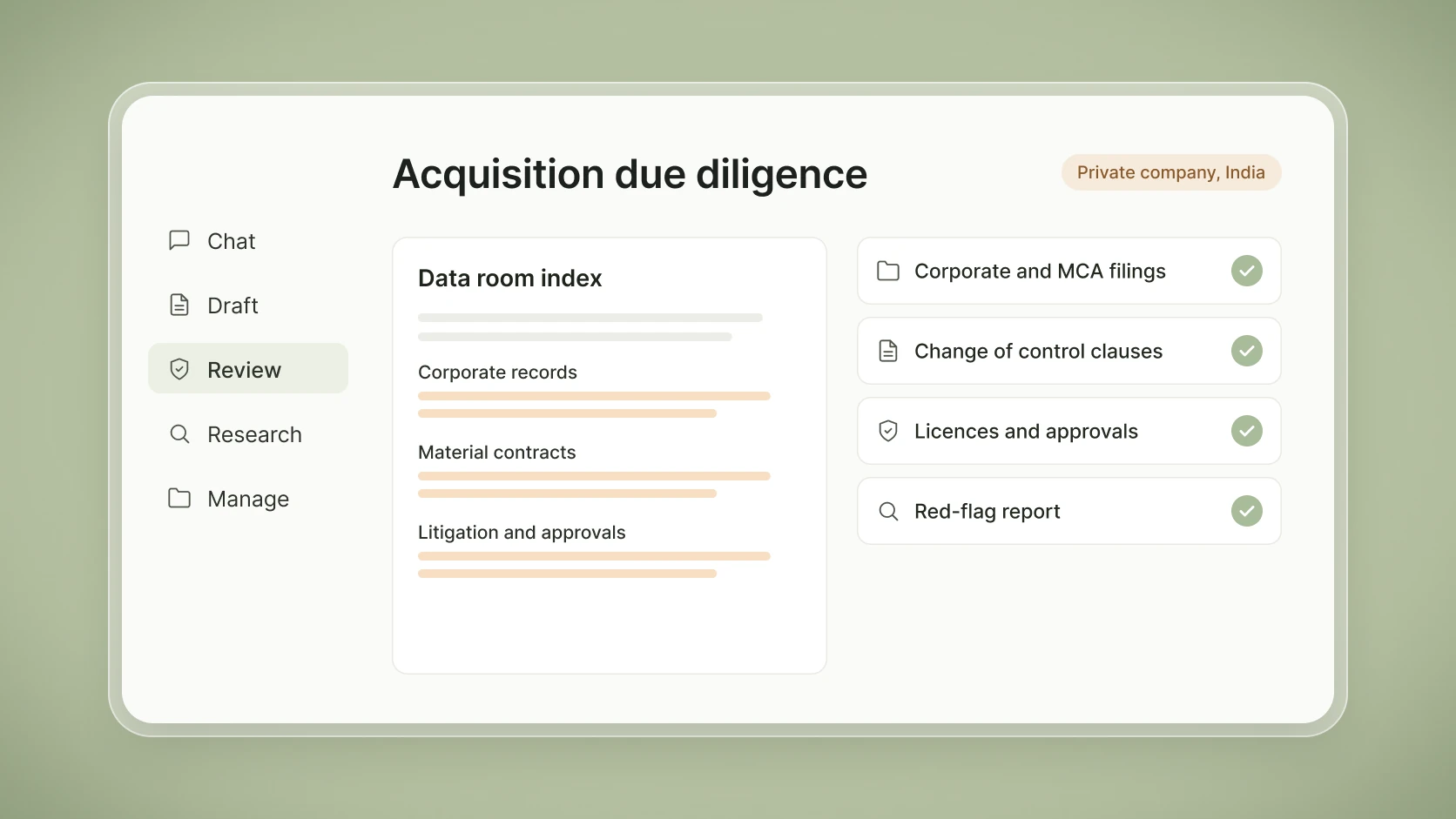
Corporate records and MCA filings
Review the constitutional documents and amendments, incorporation records, governance records, board and shareholder minutes or resolutions, statutory registers, annual returns and other relevant Ministry of Corporate Affairs (MCA) filings. Build a group chart identifying each entity, its jurisdiction, ownership, directors and role in the business. Relevant records under the Companies Act, 2013 include the register of members and other security holders, annual returns and resolutions or agreements filed with the MCA where applicable.
Test consistency between the records and the proposed transaction. Were the necessary approvals obtained for past issuances, transfers, borrowing, asset dealings or related arrangements? Do registers align with minutes and filings? Does the group chart capture relevant subsidiaries and joint ventures?
Do not treat an MCA search result, a management schedule or a data-room copy as conclusive in isolation. Record the underlying document, the filing checked, any discrepancy, the explanation sought and the evidence needed to resolve it. The available MCA filing and the company’s own records serve different purposes; reconcile them before reaching a conclusion.
Shareholding, securities and charges
Prepare a capitalisation table from the underlying records. Review issued and proposed capital; recorded shareholder and beneficial ownership information; historical issuances and transfers; options, warrants and conversion rights; and other rights affecting economics or control.
Identify transfer restrictions, pre-emption rights, tag or drag rights, consent rights, pledges and other encumbrances. Compare registers and transaction documents with available MCA filings, including charge filings under section 77 of the Companies Act, 2013. For a potential release, waiver, board action or third-party consent, record the documentary basis and the proposed deal response.
For a private-company share transfer, determine whether rule 9B of the Companies (Prospectus and Allotment of Securities) Rules, 2014 applies to the target or an exemption applies. If the rule applies, check whether the relevant target securities and the selling shareholders’ holdings have been dematerialised before transfer. Plan any required ISIN, depository, demat-account and transfer steps as closing deliverables.
Regulated targets need a separate ownership analysis. For a banking company, check applicable RBI ownership and approval requirements with sector counsel. Do not apply banking requirements to another private-company target without a basis for doing so.
Foreign investment and FEMA
Where the buyer or an existing investor is a non-resident, review each relevant foreign issuance or transfer against the Foreign Exchange Management (Non-debt Instruments) Rules, 2019. Check the applicable sectoral cap, entry route and conditions, any required government approval, pricing guidelines and timely reporting through the RBI FIRMS portal, including Form FC-GPR for issues and Form FC-TRS for relevant transfers. Identify late filings, compounding or other regularisation history, and assess how the proposed acquisition affects compliance and closing.
Distinguish a direct investor that is an entity of, or a citizen of, a country sharing a land border with India from an investor based elsewhere whose investment has a beneficial owner connected to such a country. A direct land-border investor must be assessed for the government approval route under the proviso to rule 6(a) of the Foreign Exchange Management (Non-debt Instruments) Rules, 2019. For an indirect beneficial owner, the policy revised in 2026 permits a qualifying non-controlling minority interest to use the automatic route, subject to the applicable limit, sectoral conditions and reporting; beneficial ownership outside that exception may require government approval. Trace ownership at the investor-entity level and check the Rules as amended and the current Consolidated FDI Policy before settling the structure or closing requirements.
Material contracts and change-of-control risk
Identify material customer, supplier, financing, distribution, technology, outsourcing and other operational agreements. Materiality should reflect revenue dependence, spend, strategic importance, exclusivity, financing exposure, replacement difficulty and transaction relevance, not just contract value.
- Change-of-control, assignment and subcontracting provisions;
- Consent, notice, approval and timing requirements;
- Termination rights, cure periods and consequences of default;
- Term, renewal, exclusivity, minimum commitments and pricing mechanics;
- Indemnities, liability limits, security and insurance obligations; and
- Restrictions affecting post-closing integration or value.
For financing, review facility documents, amounts outstanding, covenant compliance and defaults, and guarantees and security given by the target or its group. Identify lender consents, change-of-control terms and mandatory prepayment triggers. If debt will be repaid at closing, obtain the payoff information and specify the evidence needed for repayment and release of guarantees and security, including applicable charge satisfaction filings.
State what the contract says before stating what it may mean. A transaction does not trigger a clause merely because a summary labels it “change of control”. Test the trigger against the defined terms, transaction structure and related agreements, then track any required consent or notice to a responsible owner.
If you are buying assets or a business
Identify the assets and liabilities included in the transfer and those expressly excluded. Check title and encumbrances for material assets, and identify the conveyances and other transfer documents needed at closing. For each material contract, determine whether assignment, novation or a third-party consent is required. Check whether licences and registrations can transfer with the business; many require a fresh application or approval. Assess which employees are expected to move, how their transfer will be documented and how accrued dues will be addressed. Ask tax counsel to review applicable indirect taxes, and assess stamp duty on conveyances under the law of the relevant state.
Employment and people-related documents
Review employment and consultancy agreements for key personnel, incentive and equity plans, confidentiality obligations, invention or IP-assignment provisions, relevant restrictive covenants, and material policies or benefits commitments. Identify dependencies on founders, executives, technical leads, sales leaders and holders of critical licences or customer relationships.
Review wage, provident fund, employees’ state insurance, gratuity, contract-labour and workplace sexual-harassment compliance as applicable to the target’s locations and workforce. Request registrations, returns, contribution and payment records, inspection correspondence, complaints records and outstanding demands. The Code on Wages, 2019, the Industrial Relations Code, 2020, the Code on Social Security, 2020, and the Occupational Safety, Health and Working Conditions Code, 2020 took effect from 21 November 2025, replacing 29 central labour laws. Check wage structures, gratuity provisions, fixed-term employment terms and standing orders against the provisions and rules applicable to the target.
Capture disclosed employment disputes, claims, investigations, exits and settlements. Record missing signed agreements, unclear assignment chains and inconsistent incentive records as evidence gaps. Route questions about Indian employment-law consequences, enforceability and continuity to the appropriate specialist.
Real estate and property interests
For owned property, obtain available title documents, encumbrance information, plans and material transaction records. For leased or licensed premises, review the parties, tenure, permitted use, rent and escalation terms, renewal rights, deposits, assignment provisions and change-of-control terms.
A data-room copy is not conclusive proof of title, encumbrance status or local compliance. Match the property and parties to the relevant official records and use local counsel where the location or transaction requires it. Record the scope of each search and any issue it cannot resolve.
Licences, approvals and regulatory matters
Map the target’s activities and locations to potentially applicable licences, registrations, permits and approvals. For each item, record the issuing authority, named holder, activity covered, validity period, conditions, renewal position, available inspection history and evidence of compliance.
Then ask the transaction question: does the acquisition require a consent, notification, approval or change to a licence? Answer it by reference to the target’s sector, the licence terms and the deal structure. Keep a separate list of approvals and notices needed before signing, before closing or after closing, with an owner and deadline for each.
Litigation, investigations and claims
Review disclosed and identified litigation, arbitration, notices, investigations, threatened claims, settlements and material orders. For each matter, capture the forum, parties, status, relief sought, exposure described in the record, insurer involvement, key documents and next procedural date.
Where appropriate, cross-check available court, tribunal or regulator records. Separate a verified record from a company representation and from an allegation in correspondence. Do not quantify exposure beyond what the reviewed materials support; refer valuation and accounting consequences to the relevant specialists.
Intellectual property and technology
Identify material IP and technology assets. Review ownership and chain-of-title evidence, registrations and renewals, employee and contractor assignments, inbound and outbound licences, disputes, opposition or infringement matters, and restrictions on transfer or continued use.
For technology-dependent targets, identify material third-party and open-source dependencies, hosting or security dependencies, and questions requiring technical review. Distinguish documentary ownership evidence from technical validation of code, architecture or usage.
Tax and data protection
Review available tax registrations, returns, assessments, audits, notices, disputes and material tax representations. Identify the entity, period, issue, status, amounts described in the records and deadlines. For an asset deal, ask tax counsel to assess whether pending proceedings or outstanding tax demands affect a proposed transfer under section 281 of the Income-tax Act, 1961 for earlier periods, or the corresponding provision of the Income-tax Act, 2025, which applies from 1 April 2026. For a share deal, assess stamp duty on the transfer. Tax advisers should assess exposure and filing or payment requirements; legal diligence should not present an unreviewed tax conclusion as final.
For personal data, map data categories, purposes, systems, vendors, transfers, incident history, notices, internal controls and transaction-related sharing. The core operational requirements under the Digital Personal Data Protection Act, 2023 and the Digital Personal Data Protection Rules, 2025 are scheduled to apply from 13 May 2027. Test readiness for those requirements rather than treating them as past-compliance obligations, and assess privacy and security duties already in force. Plan access to personal data in the data room accordingly and refer compliance questions to privacy counsel.
Turn findings into a usable red-flag report
A red-flag report is a decision tool, not an unranked inventory. Use a consistent entry format:
| Field | What to record |
|---|---|
| Issue and source | Concise finding, document location, date, page or clause. |
| Classification | Verified fact, company representation, reviewer observation, assumption or unresolved question. |
| Deal impact | Potential effect on structure, price, conditions, consents, timing, protections or integration. |
| Priority and owner | Urgency, accountable workstream and escalation point. |
| Next step | Evidence request, specialist review, consent plan, drafting response or closing action. |
Prioritise by transaction impact, evidential strength and time sensitivity. A missing document may be urgent because it blocks a conclusion, even when no breach has been established.
Where AI document review can help and where counsel signs off
AI-native legal technology can support a controlled review workflow: classify documents, identify likely duplicates, extract clauses and dates, compare versions, summarise long agreements and surface possible gaps. These are triage and organisation tasks, not autonomous legal conclusions.
Require source-linked outputs so a reviewer can open the underlying document. Test for omissions, false positives, poor scans, context errors and inconsistent terminology. Counsel must validate sources, assess legal significance, determine whether a clause is triggered and approve transaction advice. Lexi’s guide to the limits of legal AI in India discusses safeguards for legal use.
Before uploading client materials, confirm approved access controls, confidentiality protections, retention settings and handling rules. Limit access by role and matter, and preserve an auditable review trail. Tool output should not replace professional judgment or final lawyer review.
A final acquisition diligence checklist
- Scope and access: Define deal questions, workstreams, materiality, data-room index, permissions and questions log.
- Entity and ownership: Review corporate records, group structure, capitalisation, transfer restrictions and available charge information. Check whether rule 9B applies or an exemption is available, and plan any dematerialisation and depository steps before a share transfer. Where relevant, check past and proposed foreign investment under FEMA, including caps, entry routes, approvals, pricing, reporting, direct land-border investment and any applicable non-controlling minority beneficial-ownership exception.
- Contracts and operations: Review material agreements, change-of-control triggers, consents, notices and operational dependencies. Check outstanding debt, defaults, guarantees and security, lender requirements, and repayment and release evidence needed at closing.
- Asset or business transfer: List assets and liabilities to be transferred or excluded; check title, transfer documents, contract assignments or novations, licence transfers or fresh applications, employee transfers and dues, state-specific stamp duty and applicable indirect taxes.
- People and assets: Assess key personnel, statutory employment compliance, incentives, confidentiality, IP assignments, property interests and technology dependencies.
- Regulatory and disputes: Map licences and approvals; review claims, investigations, orders and procedural dates.
- Tax and data: Route records to specialists, assess tax-related transfer risks and stamp duty, and identify current data duties and future readiness requirements.
- Findings and follow-up: Distinguish facts from representations and assumptions; assign owners and deadlines to open points.
- Sign-off: Confirm source validation, specialist input, transaction-document responses and closing conditions before signing or closing.
Adapt this legal due diligence checklist for acquisition to the target’s sector, footprint and deal structure. Explore Lexi’s AI-native legal technology for document review and matter workflows, with counsel responsible for transaction advice.
Legal information only. This India-focused workflow is not legal, tax, financial or technical advice. Obtain advice tailored to the transaction and the law applicable at signing and closing.