بقلم Lexi Team
Why contract review needs a repeatable process
A contract review checklist is most useful when the reviewer has the deal context, a clear negotiation position and a defined route for decisions. Without those inputs, review can become an unfocused clause-by-clause exercise, followed by avoidable business questions, unclear redlines and late escalations.
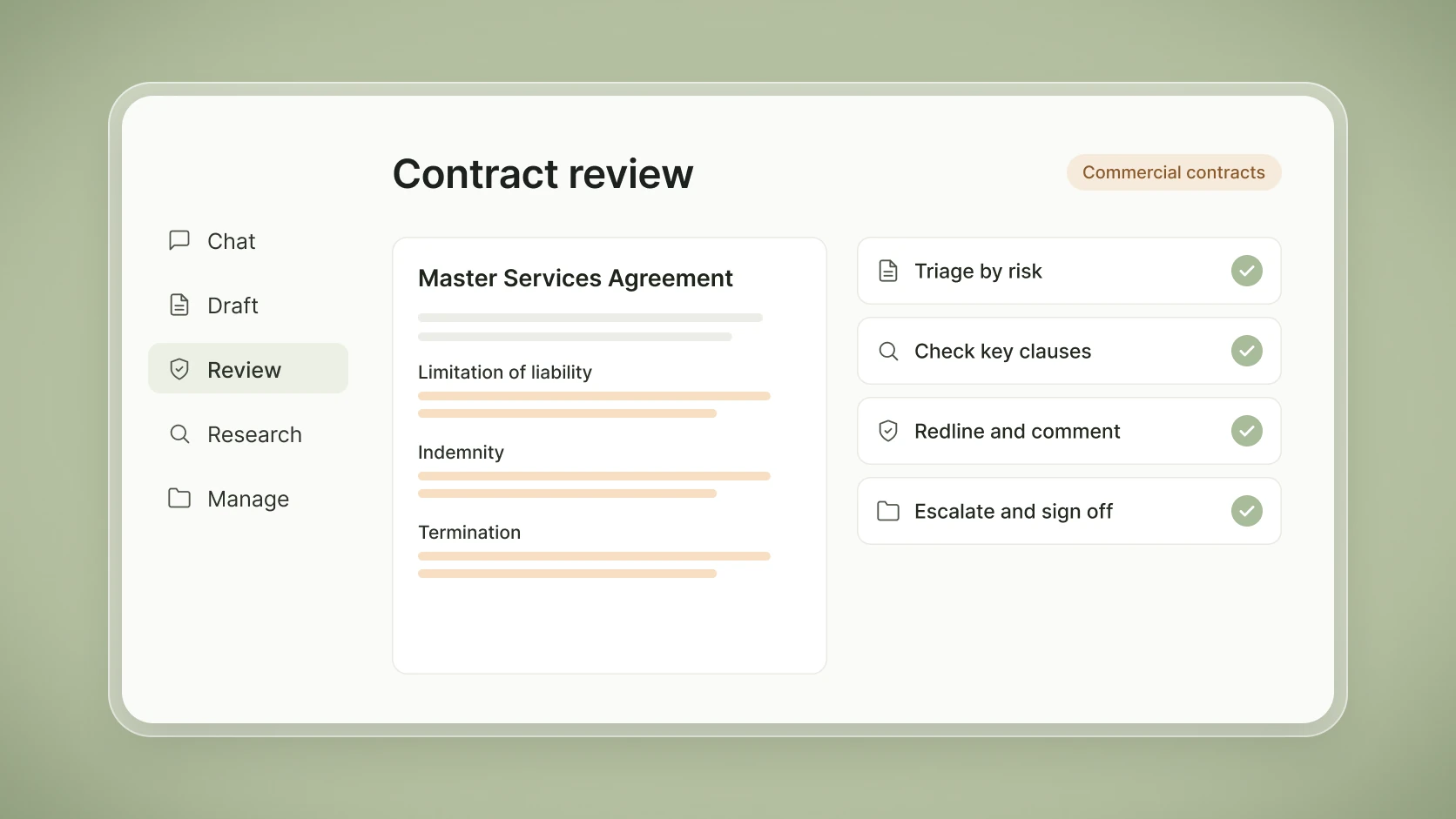
The checklist below has five stages: triage, clause review, risk prioritisation, controlled redlines, and escalation and sign-off.
Contract review checklist at a glance
| Stage | Checklist | Record |
|---|---|---|
| Triage | Identify the parties, business owner, deal purpose, deadline, draft status, related documents and applicable playbook. | Reviewer; version and date; business owner |
| Clause review | Check commercial terms, obligations, remedies, liability, data, intellectual property, disputes, schedules and execution mechanics. | Issue; contract reference |
| Risk prioritisation | Distinguish approval-blocking issues from material and lower-priority points. | Risk classification; reason |
| Controlled redlines | Track changes, explain material edits and check definitions, cross-references and related provisions. | Proposed resolution; negotiation status |
| Escalation and sign-off | Route decisions to the right owner; confirm approvals, accepted deviations, final version and signing authority. | Decision owner; approval; signatory |
A repeatable contract review process changes the sequence. It starts by establishing what the business is trying to achieve and which risks it can accept. It then directs review effort to the clauses and operational commitments that matter to the transaction. Finally, it creates a record of who accepted departures from the organisation’s standard position.
A checklist supports consistency; it does not determine whether a risk is acceptable. That decision depends on the facts, commercial leverage, internal policy, delegated authority and applicable law. Teams should adapt the checklist to their current playbook and approval matrix.
Keep legal review, internal approval and signatory authority distinct. Legal review identifies issues and recommends a position; the organisation’s approval matrix determines who may accept a risk or commercial departure; and the proposed signatory must have authority to bind the contracting entity under the applicable process and law.
Step 1: Triage the contract before reviewing clauses
Do not begin with liability language. Begin with intake. A short, complete intake gives the reviewer a basis for identifying the right priorities and stakeholders.
- Document and transaction: Identify the agreement type, whether it is a new draft or a redline, the contract version and date, the transaction purpose, and the business owner.
- Parties: Confirm each contracting entity, affiliate references, signatory details and the counterparty’s role in the deal.
- Commercial context: Record the value or value basis, procurement or sales model, key deliverables, implementation timetable, renewal expectations and immovable business deadlines.
- Governing framework: Identify the proposed governing-law and forum clauses, related agreements, incorporated terms, statements of work, policies and schedules.
- Starting position: Locate the approved template, playbook, prior negotiated precedent where permitted, and the business’s stated priorities.
- Review route: Identify the reviewers who may be needed: commercial, finance, tax, privacy, information security, regulatory, intellectual-property or senior legal, as well as any internal approval thresholds.
Approval thresholds should be treated as organisation-specific. A transaction’s value alone may not capture risk: a low-value agreement can create meaningful data, intellectual-property, regulatory or operational exposure.
Before progressing, frame the deal in one sentence: “The business needs this agreement to achieve X, by Y, while limiting Z.” That sentence is a useful test for every proposed concession.
Step 2: Review the deal mechanics and key clauses
A practical review asks four questions of each material provision: What does it require? Who bears the risk? Can the business perform it in practice? Does it conflict with another part of the agreement or an incorporated document?
Use the following categories as a review map, not as a universal allocation of risk.
- Scope and deliverables: Are the goods, services, milestones, acceptance criteria, dependencies and change-control process sufficiently clear? Are documents incorporated by reference actually available and consistent?
- Fees, taxes and payment: Is the price model clear? Are invoicing, payment timing, expenses, credits, disputes, currency and tax treatment addressed in a workable way?
- Term, renewal and termination: When does performance begin and end? Is renewal deliberate? What termination rights, notice periods, transition duties, refunds or wind-down obligations apply?
- Service levels and remedies: Are measurable commitments and reporting obligations defined where relevant? Is the remedy commercially and operationally coherent?
- Representations, warranties and indemnities: Is each promise within the giving party’s control? What event triggers indemnity, what loss is covered, and what procedure governs claims?
- Liability, exclusions and insurance: What losses are limited or excluded? Does the liability structure align with the obligations, available insurance and negotiation position?
- Confidentiality, data, security and privacy: What information is covered, who may access it, what security commitments are made, and what return, deletion, incident or assistance obligations apply?
- Intellectual property: Who owns background and newly created materials? What licences, restrictions, feedback rights or infringement arrangements are included?
- Subcontracting and assignment: Can either party transfer rights or delegate performance? Are consent, notice, responsibility and change-of-control provisions aligned?
- Compliance and disputes: Are compliance commitments specific and achievable? Are dispute-resolution, governing-law, forum and notice provisions complete and consistent with the deal?
- Document mechanics: Check precedence, amendment, waiver, severability, entire-agreement language, counterparts, execution blocks and schedules.
This approach is particularly important when a draft arrives with multiple attachments. A well-written main agreement cannot cure a conflicting schedule, a missing service description or an undefined term that changes the commercial outcome.
Step 3: Prioritise issues by risk and business impact
Not every drafting point deserves the same negotiation effort. A useful non-numeric triage separates issues into three working groups:
- Critical: Issues that block approval unless resolved or expressly accepted by the appropriate decision-maker. Examples may include an unperformable obligation, unacceptable data handling, missing authority, or a core commercial term that does not reflect the deal.
- Material: Issues that require negotiation, a documented business decision or specialist review, but may not prevent the transaction from proceeding.
- Lower priority: Drafting, clarification or operational points that should be cleaned up where possible but do not alter the agreed risk position.
The classification is not fixed. It depends on the transaction, the organisation’s risk appetite, its delegated-authority framework and the counterparty relationship. A reviewer should state why an issue is classified as critical or material, rather than relying on a label alone.
Prioritisation also keeps the redline intelligible. Lead with the issues that determine whether the deal can be approved. Do not allow a long list of minor comments to conceal an unresolved point that needs a business decision.
Step 4: Prepare clear, controlled redlines
Redlining is both negotiation and recordkeeping. Use tracked changes, retain a clean version, and maintain a comparison copy so that all material edits remain traceable. Avoid silent changes to substantive language.
- Pair a material amendment with a concise comment stating the issue, the proposed resolution and, where useful, the decision needed.
- Use a consistent comment convention, such as “Legal: open,” “Business input required,” or “Security review required.”
- Check every amended defined term, cross-reference, schedule reference and precedence provision.
- Confirm that a local edit has not created an inconsistency elsewhere, for example between a limitation of liability clause and an indemnity, service credit or data schedule.
- Align the redline to the current playbook and documented negotiation position. If a requested change departs from either, identify it as a deviation.
Where multiple reviewers contribute, designate one person to consolidate comments before the draft is returned. That reduces contradictory asks and ensures the counterparty receives a controlled negotiating position. A clause copied from another agreement still needs to fit this deal; see The Template Trap: Why Copy-Pasting Contract Clauses Creates Hidden Legal Risk.
Step 5: Escalate and obtain sign-off
Escalation is not a sign that review has failed. It is the mechanism for placing a decision with the person who has the relevant expertise or authority.
Escalate issues outside the reviewer’s authority or expertise to the appropriate owner: the business owner for commercial concessions; finance for payment, credit or revenue matters; privacy and security for data and technical commitments; tax for tax treatment; regulatory specialists for sector-specific obligations; and senior legal reviewers for significant departures or strategic risk.
Maintain an open-issues log with the issue, contract reference, risk classification, proposed position, decision owner, deadline, decision and any accepted deviation. Before execution, use the organisation’s approval matrix to confirm that the necessary internal approvals have been obtained. Separately confirm that the final version matches the approved version, all conditions are complete, and the proposed signatory has authority under the applicable law and the organisation’s process.
Where AI-assisted contract review may fit
Contract review AI may be useful as a bounded first-pass aid within an approved workflow. It can help generate an issue list for review, locate clauses, compare language between versions, identify defined terms or cross-references, and compare a draft against an approved playbook.
Those outputs are prompts for lawyer review, not conclusions. The reviewer should verify every material output against the source contract, assess the complete deal context, determine whether an issue matters, and decide the redline or escalation path. For related workflows and guidance, see How Lawyers Can Use AI Safely: A 5-Step Checklist and How Accurate Is AI Legal Document Review?.
Before uploading or processing a contract in any review tool, check confidentiality obligations, client instructions, access controls, user permissions, data location, retention settings, vendor terms, approved-tool status and the organisation’s privacy and security policies. Do not use a tool outside the organisation’s approved process. A tool should support traceable human review, not displace it.
India and Singapore: localise the contract review checklist
India: Check the contracting entity, board authorisation and signing authority, including Companies Act, 2013, section 21 where a company is signing a contract. Assess stamp duty under the Indian Stamp Act, 1899, as applicable in the place of execution or use, including any applicable local amendments or legislation; requirements depend on the instrument and location. Where section 35 of the Indian Stamp Act applies, it restricts admission in evidence and acting on an instrument that is not duly stamped, subject to its provisos and applicable local amendments. Check whether registration is compulsory under the Registration Act, 1908, section 17. For electronic signing, check whether the Information Technology Act, 2000 and other applicable law permit electronic execution of the particular instrument; do not assume that every document can be signed electronically. For personal data, check the Digital Personal Data Protection Act, 2023 and the Digital Personal Data Protection Rules, 2025: their commencement is phased, so confirm which obligations are in force for the transaction.
Singapore: Confirm the contracting entity and signing authority. The Companies Act 1967, sections 41A and 41B, addresses the optional use of a common seal and company execution; check the applicable execution requirements for the document, particularly a deed. Consider the Electronic Transactions Act 2010 and any applicable exceptions before using electronic signatures. Check whether stamp duty arises under the Stamp Duties Act 1929, particularly for property or share instruments. Where personal data is transferred overseas, assess the transfer limitation obligation under the Personal Data Protection Act 2012, section 26. In either jurisdiction, assess cross-border data flows, dispute provisions and the place of performance against the deal’s facts. Seek local advice where a point affects approval or enforceability.
Build the checklist into the team’s workflow
A maintained playbook, clear ownership and a record of approved deviations make contract review more consistent without removing the judgment that commercial agreements require. Review the checklist periodically as the organisation’s products, risk appetite, regulatory environment and contracting patterns change.
Lexi’s AI-native legal technology can support contract review workflows for in-house teams, law firms and litigators, while lawyers retain responsibility for verification, judgment and sign-off. For related drafting controls, read 7 Drafting Mistakes AI Can Catch Before a Contract Goes Out.
Next step: Explore Lexi for lawyer-led legal workflows.
Legal information disclaimer: This article provides general information, not legal advice. Contract requirements and legal effect depend on the applicable jurisdiction, transaction and final agreement. Check current law and commencement dates, and seek qualified legal advice for a specific matter.