By Lexi Team
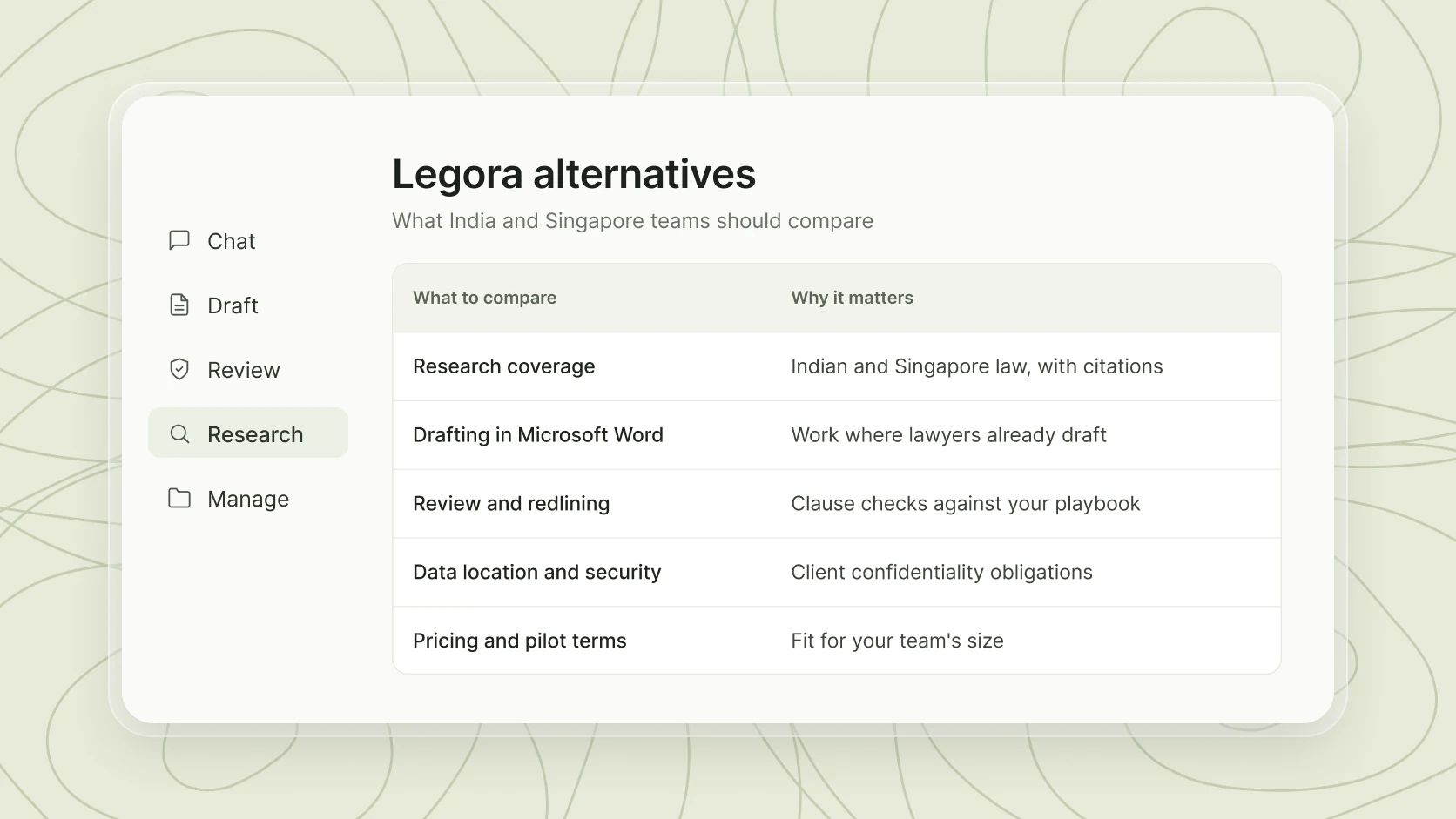
Legora alternatives are worth comparing when a legal team's research, drafting, document review or procurement needs call for a closer look at its options. For partners, knowledge lawyers and in-house legal leads in India and Singapore, the useful question is which offering fits the team's work, review controls, data requirements and budget. This November 2026 comparison uses public product descriptions to identify starting points; they do not establish what a proposed plan includes, its local source coverage, data terms or price.
When to compare Legora alternatives
Start with a defined use case rather than a product demonstration. A corporate legal department may prioritise agreement triage, playbook-based review and business-facing summaries. A disputes practice may prioritise chronology building, source traceability and controlled drafting. A knowledge team may focus on research, reusable work product and access governance.
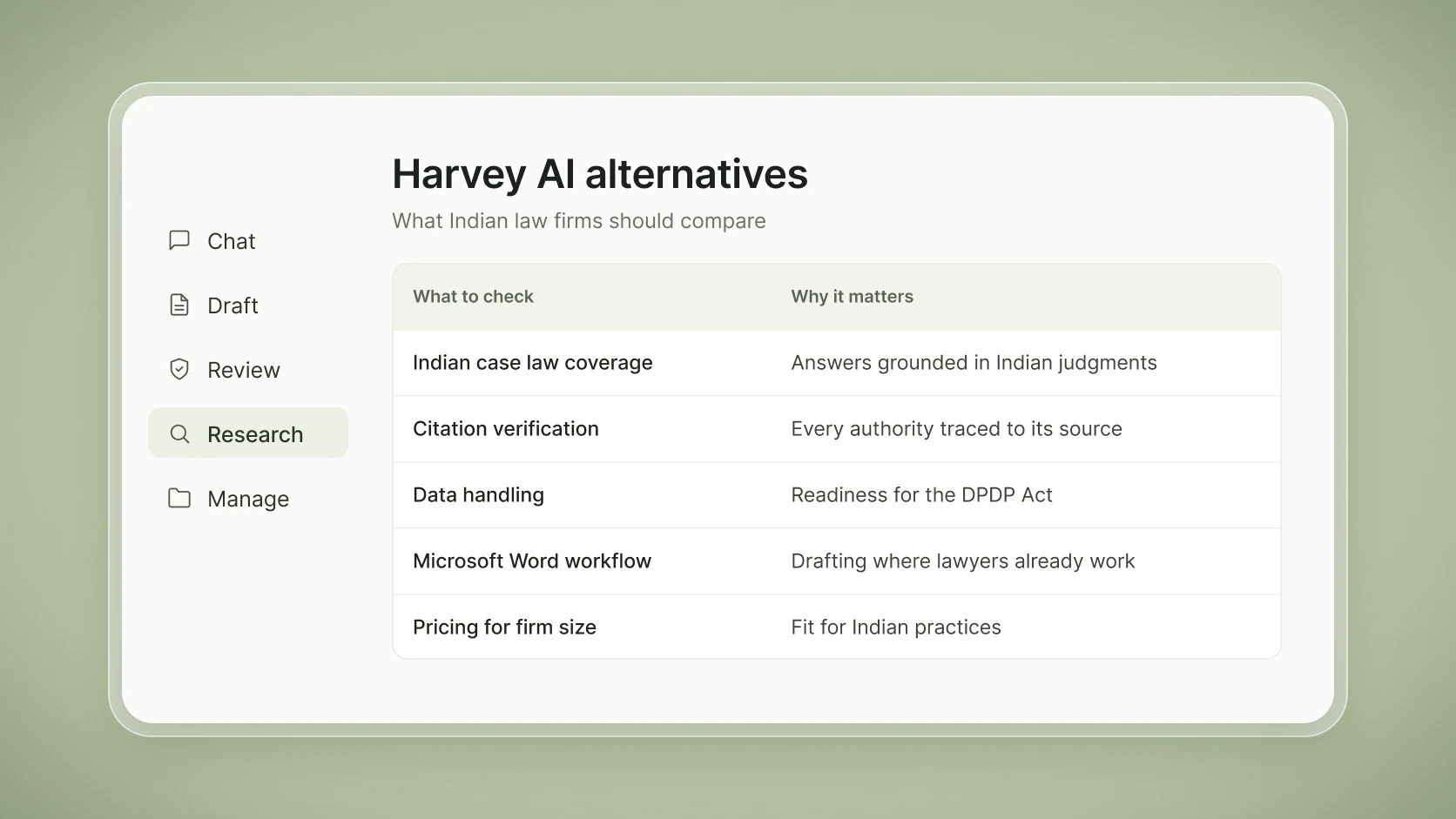
This comparison covers Legora, Harvey, Thomson Reuters CoCounsel, Lexis+ with Protégé and Lexi. Teams considering a wider India-focused shortlist can also use Lexi's guide to Harvey alternatives for Indian law firms.
What to test before shortlisting legal AI tools
Build a small evaluation set from recurring document types, clauses and questions. Use approved, non-sensitive material where possible, and give each product the same instructions and review criteria. Have a lawyer assess legal accuracy, completeness, source use and the work required to make an output usable. A fluent answer is not, by itself, a reliable answer.
Keep two kinds of evidence separate:
- Public information: what a product page expressly describes.
- Deployment-specific information: written answers about the proposed plan's availability, implementation, security, data processing, support, limitations and commercial terms.
A demonstration may use different settings, content or services from those the team would buy. For drafting evaluations, Lexi's legal drafting tool comparison guide offers further criteria for testing the work product.
Products to include on the shortlist
| Product | Publicly described capabilities and likely fit | Questions to confirm |
|---|---|---|
| Legora | Legora describes collaborative AI for reviewing, researching and drafting legal work. It calls Legora aOS an agentic operating system for legal work and names Agent, Monitors and Lists among its products. Worth a look if: lawyers want to test collaborative research and review alongside drafting. | Which of these workflows, review formats and integrations are in the proposed plan? Can users inspect the underlying documents and any India or Singapore authorities? |
| Harvey | Harvey describes a platform for legal and professional services, including Vault for storing and analysing legal documents, Knowledge for legal, regulatory and tax research, and AI agents designed for legal work. Worth a look if: the team wants to evaluate document analysis and research together. | Which services are included in the quote? What can users inspect or export, and how will they verify local authorities? |
| Thomson Reuters CoCounsel | Thomson Reuters describes CoCounsel as AI for high-stakes professional work that draws on Westlaw and Practical Law content. Worth a look if: the team already uses, or is evaluating, those research and practical guidance services. | Which Westlaw or Practical Law materials does the proposed licence permit users to access in India or Singapore? Can users inspect the underlying sources? |
| Lexis+ with Protégé | LexisNexis now offers Lexis+ AI as Lexis+ with Protégé. LexisNexis describes conversational search, summarisation, legal drafting, and document upload and analysis, with answers grounded in LexisNexis content and citations users can check. Worth a look if: the team wants to evaluate research and drafting against its licensed LexisNexis sources. | Which India or Singapore sources and functions are included in the proposed subscription? Can users open the cited material? |
| Lexi | Lexi describes a workspace spanning intake to final draft, with research, documents and matter management, verified citations and drafting within Microsoft Word. It has offices in India and Singapore. Worth a look if: a law firm, litigator or in-house team wants to test those workflows in one workspace. | Which research, drafting, document and matter workflows are in the proposed deployment? Confirm source coverage, Word functionality and implementation details. |
Use the team's approved examples to test each stated fit. For Legora, trace review findings to documents and examine the drafting workflow. For Harvey, test how a document in Vault informs a research or analysis task. For CoCounsel and Lexis+ with Protégé, check whether lawyers can inspect relevant licensed sources. For Lexi, test a matter from research through a draft in Word. Ask every vendor for the applicable service description, permissions, data terms and quote.
A practical scorecard for India and Singapore teams
Use the same rating method for every product: U means untested or unanswered, 0 means a requirement was not met, 1 means it was partly met, and 2 means it was met. Record the test result or written vendor answer, its date and the applicable plan.
| Evaluation area | What to test or obtain | Evidence to record |
|---|---|---|
| Legal research | Ask an India or Singapore question relevant to the team's work. Check any local sources and whether a lawyer can open cited authorities. | Source accessed, answer accuracy and limits of licensed content. |
| Drafting | Revise a representative draft, including in Word where that workflow is required. | Edits needed, source support, export format and lawyer approval. |
| Document review | Find specified clauses or facts in approved documents and trace each finding to its source. | Correct and missed findings, document references and review record. |
| Microsoft Word workflow | Demonstrate the required editing, permissions and version-control steps. | Functions available in the quoted plan and any integration requirements. |
| Data handling | Obtain written terms for processing and storage locations, subprocessors, access, retention, deletion and incidents. | Applicable agreement, security materials and unresolved exceptions. |
| Pricing | Request a quote covering services, content licences, seats, usage, support, implementation and exit terms. | Written quote and assumptions used for the total cost. |
For each research result, record whether a lawyer could open the underlying authority and whether it answered the question. For review and drafting, retain approved test examples, output and the lawyer's assessment. Ask vendors to distinguish standard functionality from paid services or custom implementation.
For Singapore litigation work, distinguish preparing court documents from filing them. The Singapore Judiciary's eLitigation service supports electronic court filing. Ask how a product's output fits the team's filing workflow rather than assuming the product connects to that service.
Jurisdiction and data-handling checks
Run the procurement review against the information the team would actually upload. Identify personal data, confidential client material, access permissions, overseas processing, retention requirements and the contractual terms governing use. A vendor privacy notice does not, on its own, settle a firm's obligations to its clients.
India
Current law matters during a November 2026 pilot. Section 43A of the Information Technology Act, 2000 and the Information Technology (Reasonable Security Practices and Procedures and Sensitive Personal Data or Information) Rules, 2011 may apply, depending on the organisation and whether it handles sensitive personal data or information covered by those provisions. Check the data involved, the applicable security practices and the proposed vendor arrangement; do not treat the future commencement of other obligations as a gap in current requirements.
The Digital Personal Data Protection Rules, 2025 were notified on 13 November 2025, and the Digital Personal Data Protection Act, 2023 is being brought into force in phases. The main obligations under the Digital Personal Data Protection Rules, 2025 apply from 13 May 2027. Check official commencement notifications for any change before relying on that date. Review client confidentiality terms and sector-specific requirements alongside both current law and the proposed vendor terms.
Before using client material in a pilot, obtain terms on processing, subprocessors, overseas access, retention, deletion and incident response. Decide who within the legal and security teams can approve the proposed use.
Singapore
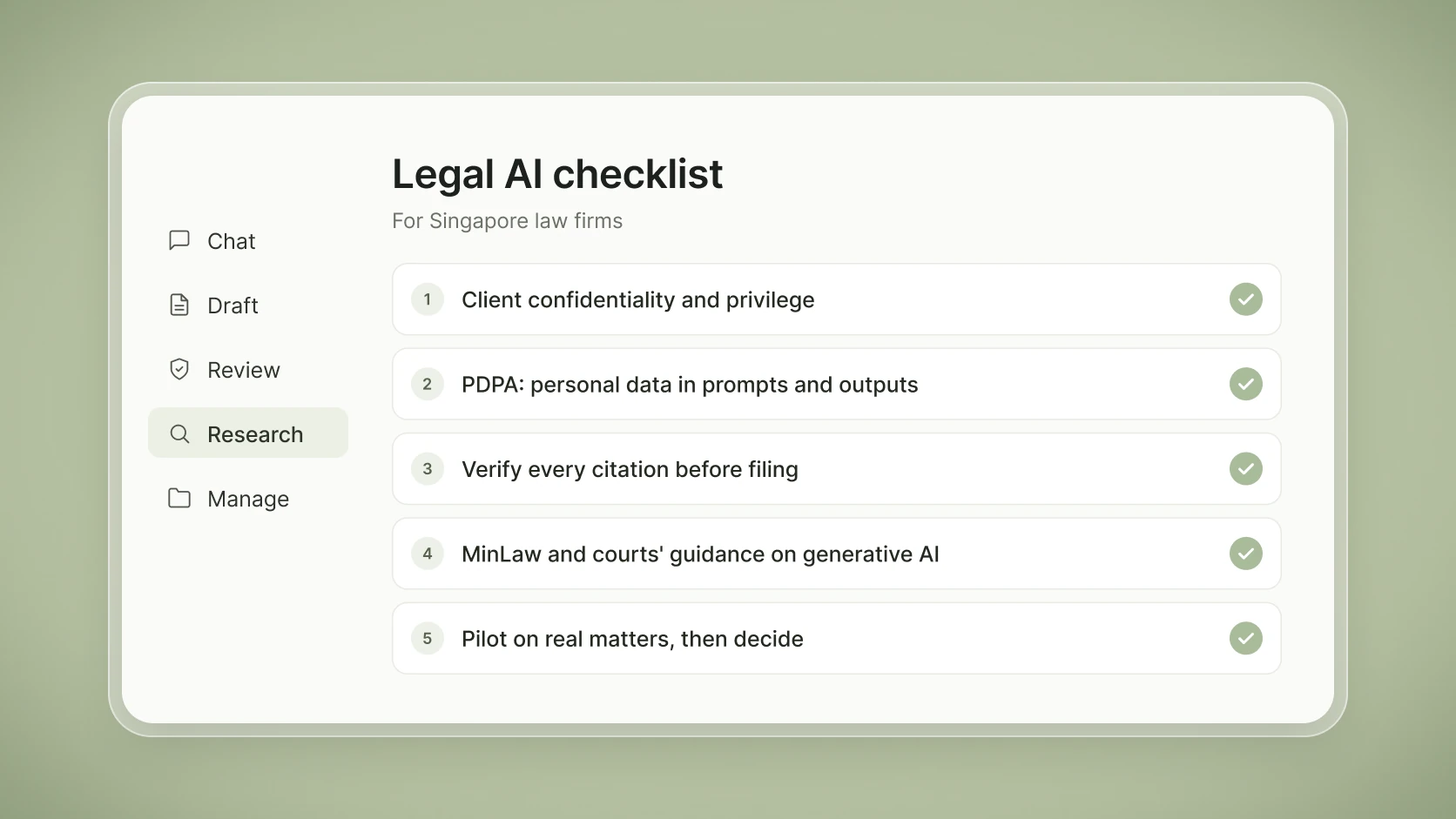
For Singapore teams, the Personal Data Protection Act 2012 addresses protection of personal data in section 24, retention in section 25 and transfers outside Singapore in section 26. Assess how those provisions apply to the proposed arrangement, together with client confidentiality commitments and the vendor's access, transfer and deletion terms. Lexi's PDPA guide for law firms provides a starting point for that review.
Where work concerns Singapore court documents, keep lawyer review and filing responsibilities explicit. For broader selection criteria, see Lexi's Singapore legal AI selection checklist.
How to run the evaluation
- Choose priority workflows. Select recurring tasks and set lawyer-owned acceptance criteria for each.
- Prepare approved material. Use representative examples and protect sensitive information before any upload.
- Review the work, not just the demonstration. Assess factual grounding, legal relevance, completeness, editability and required escalation.
- Send a common vendor questionnaire. Cover security, processing, locations, support, integrations, implementation and pricing.
- Record the decision. Rate each scorecard criterion against the evidence and retain the written answers on which the team relies.
Frequently asked questions
What are the main Legora alternatives to evaluate?
Harvey is a candidate for document analysis and research through its described Vault and Knowledge services. CoCounsel is relevant to teams evaluating Westlaw and Practical Law content; Lexis+ with Protégé is relevant to teams evaluating LexisNexis-grounded research and drafting. Lexi is relevant to teams testing research, documents, matter management and Word drafting in one workspace. Compare each with Legora using the same approved tasks.
Which is the best Legora alternative for a corporate legal department?
That depends on the department's work and the evidence from its evaluation. Teams prioritising an existing research-content licence can start with the relevant CoCounsel or Lexis+ with Protégé workflow. Teams prioritising document analysis can test Harvey's described Vault workflow; those seeking a combined research, drafting and matter workspace can test Lexi. Compare all candidates against agreement-review requirements, information-handling terms and quoted prices.
Can public pages settle data location and pricing questions?
No. Obtain written answers for the proposed deployment, including service components, processing and storage locations, subprocessors, usage limits and negotiated terms.
Legal information: This article provides general information for India and Singapore, not legal advice. Assess applicable law and contractual obligations for the specific deployment.
Next step: Talk to Lexi about your team's evaluation criteria.