By Lexi Team
Section 34 arbitration act limitation is the first issue to resolve when challenging an arbitral award in India. Under section 34 of the Arbitration and Conciliation Act, 1996 (the 1996 Act), a party may apply to set aside an award only on specified grounds and within a strict filing period. A strong argument on the award will not cure a missed statutory deadline.
Start with the award, proof of its receipt and any post-award request to the tribunal. Also confirm the seat of arbitration: section 34 is the Indian setting-aside route for an India-seated award, not ordinarily a route to set aside a foreign-seated award. For a comparison of seat choices, see the Singapore arbitration clause-drafting checklist.
Section 34 arbitration act limitation: establish the trigger
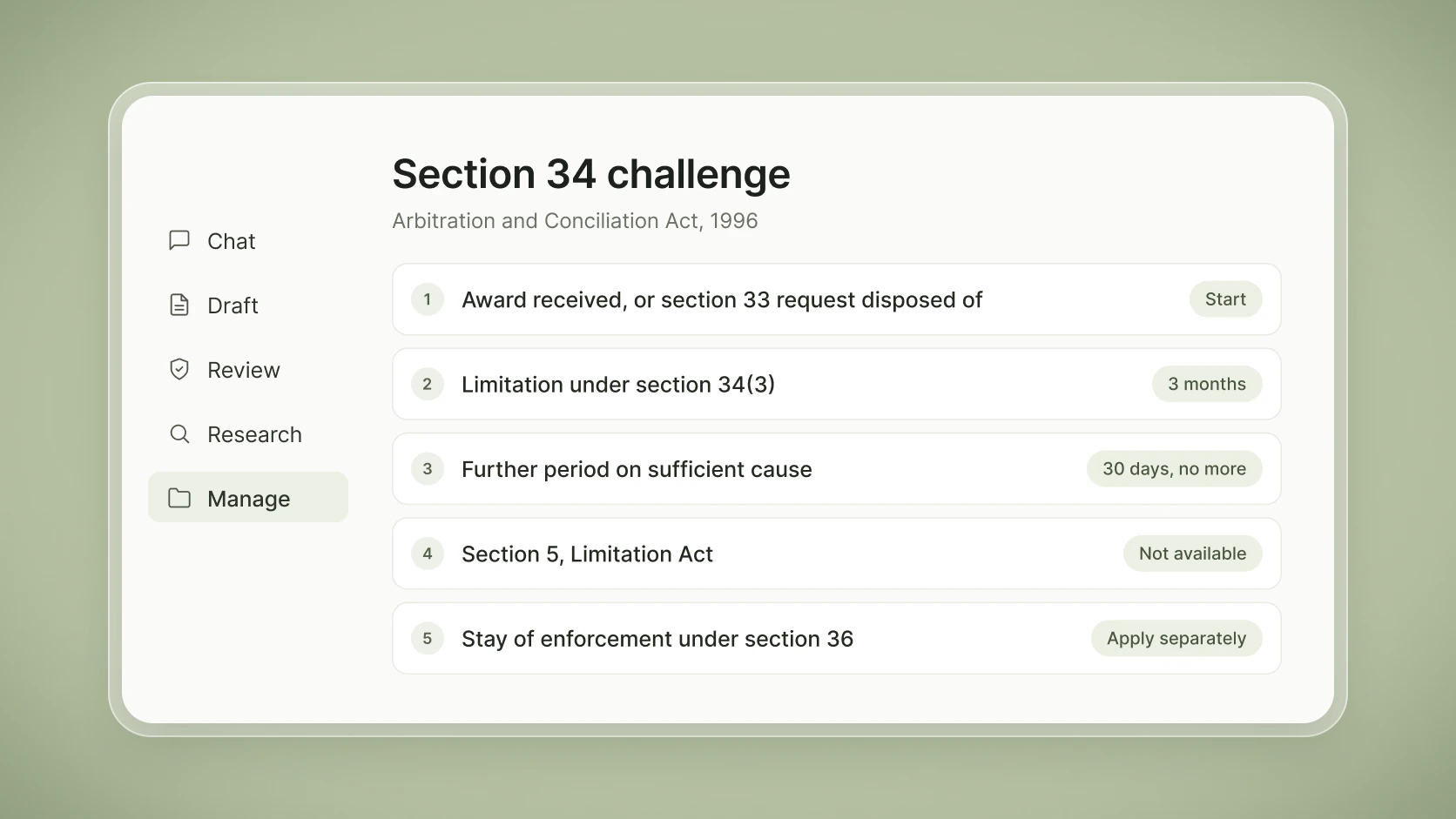
Section 34(1) of the 1996 Act makes an application under section 34 the route for court recourse against an arbitral award. Section 34(3) starts the filing period when the applicant receives the award or, if a qualifying request was made under section 33, when the tribunal disposes of that request. Record both the award date and the date of receipt: they are not necessarily the same.
Build a dated chronology before drafting grounds:
- Identify when and how the signed award was delivered to the party, and retain the covering email, delivery acknowledgement, courier record or portal record.
- Preserve any section 33 request, proof of its submission and the tribunal's disposition. Check that it concerned a permitted correction, an interpretation agreed to by the parties, or an additional award on an omitted claim, and that it was made within the applicable period, ordinarily 30 days from receipt of the award unless the parties agreed otherwise. Do not use the disposal date of a late or unrelated letter as the section 34(3) trigger.
- Record the proposed filing date and the court in which the application will be made.
In Facility Plus Estate Management v Innovision Ltd, the Delhi High Court held that time ran from when the party collected the signed award, not when a scanned copy was emailed to its counsel.
Calculate the three-month period and outer limit
Under section 34(3) of the 1996 Act, the ordinary filing period is three months from the relevant trigger. Exclude the trigger day when calculating that period. The court may entertain an application within a further period of up to 30 days if satisfied that sufficient cause prevented filing within the initial three months, but not thereafter. Do not substitute 90 days for the statutory expression 'three months', and do not treat the further 30 days as an automatic extension.
For example, if the applicant receives the signed award on 15 January 2026 and makes no section 33 request, the ordinary period ends on 15 April 2026; assuming the court is open, the further 30 days end on 15 May 2026. Section 5 of the Limitation Act, 1963 cannot extend a section 34 filing beyond that outer limit. If the applicant needs the permitted additional period, explain the delay with dated, supporting material and file within that period. An application for condonation does not make a later challenge curable.
In My Preferred Transformation & Hospitality Pvt Ltd v Faridabad Implements Pvt Ltd, the Supreme Court held that section 4 of the Limitation Act, 1963 permits filing when the court reopens if the ordinary three-month period ends during a court closure, but gives no such benefit when the further 30 days end during a closure. Check the court calendar and filing rules early, preserve electronic filing acknowledgements and records of corrections, and plan to file before the last possible day.
Grounds for setting aside an arbitral award in India
Section 34(2) of the 1996 Act provides limited grounds for setting aside an award; it does not create a general appeal on the merits. For the grounds under section 34(2)(a), the applicant must establish its case on the basis of the record of the arbitral tribunal:
- Incapacity or invalid agreement: a party was under an incapacity, or the arbitration agreement was invalid under the law chosen by the parties or, absent a choice, the law in force.
- Notice or opportunity to present the case: the applicant lacked proper notice of the arbitrator's appointment or the proceedings, or was otherwise unable to present its case.
- Excess of submission: the award decides a dispute outside the submission to arbitration. Section 34(2) permits separation of decisions within the submission from those beyond it where they can be separated.
- Tribunal composition or procedure: it departed from the parties' agreement, subject to provisions of the 1996 Act from which the parties cannot derogate, or, absent agreement, from the Act's requirements.
Under section 34(2)(b), the court may also set aside an award if it finds:
- Non-arbitrability: the subject matter cannot be settled by arbitration under Indian law.
- Public policy of India: the award falls within the statutory public-policy categories, including specified fraud or corruption, contravention of the fundamental policy of Indian law, or conflict with the most basic notions of morality or justice. The statutory test for fundamental policy does not permit a review on the merits.
Section 34(2A) of the 1996 Act adds patent illegality appearing on the face of an award arising from an arbitration other than an international commercial arbitration. An erroneous application of law or a request to reappreciate evidence, by itself, does not satisfy that ground.
For each proposed ground, identify the award passage, relevant pleading, procedural order, evidence or correspondence, and the precise relief sought. Labels such as 'public policy' or 'patent illegality' are not substitutes for explaining how the statutory test is met.
Section 36 enforcement: a challenge is not a stay
Filing a section 34 application does not, by itself, make the award unenforceable. Under section 36 of the 1996 Act, a party seeking to pause enforcement must make a separate stay application and obtain a court order. The court may impose conditions; applications concerning awards for payment of money also engage the statutory approach to staying a money decree. The proviso to section 36(3), inserted by the Arbitration and Conciliation (Amendment) Act, 2021, requires an unconditional stay pending the section 34 challenge if the court is satisfied that a prima facie case exists that the arbitration agreement or underlying contract, or the making of the award, was induced or effected by fraud or corruption.
Address these questions separately in client advice. The section 34 application asks whether the award should be set aside. The stay application addresses enforcement while that challenge is pending. Assess enforcement exposure as soon as the award is received, rather than waiting for the setting-aside grounds to be finalised.
Section 34 filing checklist for counsel
- Secure the award and receipt evidence. Keep the signed award, transmission records and proof showing when the applicant received it.
- Identify section 33 events. Obtain the request and the tribunal's response. Confirm that the request qualified under section 33, was made within the applicable period, including any period agreed by the parties, and determine when it was disposed of.
- Calculate and independently review limitation. Exclude the trigger day and record the ordinary three-month deadline and the last date of the permitted further 30 days separately.
- Build a ground-to-record matrix. Match each section 34 ground to the relevant award paragraph, submission, procedural event and supporting document.
- Confirm the competent court. Check the seat, jurisdiction and any applicable commercial-court allocation. The Commercial Courts Act section 12A filing guide concerns pre-institution mediation for suits; section 12A does not apply to a section 34 application.
- Prepare the filing record. Assemble the arbitration agreement, award, relevant pleadings, orders and evidence. Plan prior notice to the other party and an affidavit of compliance under section 34(5) of the 1996 Act. The Supreme Court has treated section 34(5) as directory: do not miss a limitation deadline while resolving notice formalities, and check the applicable court's filing and service rules.
- Assess a separate stay request. If enforcement presents an immediate risk, prepare the section 36 application alongside the challenge.
- Check filing mechanics. Confirm current court requirements for court fees, signatures, affidavits, electronic filing, service and record certification, and ensure the award is included. A filing so defective that it is non est does not stop time running (Union of India v Gr-Gawar (J.V.), Delhi High Court, 2025).
The filing sequence is straightforward: prove the limitation trigger, calculate the deadline, identify a recognised ground, support it from the record and deal separately with enforcement. Build in time to correct filing defects without relying on the statutory outer limit.
Legal information disclaimer: This is general information about Indian law, not advice on a particular award. Statutory amendments, transitional questions and court rules may affect a filing; confirm the law and requirements applicable to the matter.
Next step: organise the award and arbitration record for review at Lexi.