بقلم Lexi Team
Current as of 29 October 2026. For arbitration in Singapore, a clause that names Singapore and SIAC may still leave essential questions unanswered. It must work across the transaction documents and distinguish the juridical seat from the hearing venue, the administering institution, the applicable rules and the law governing the contract.
For Indian and Singapore counsel, those choices matter before a dispute arises. A clear clause should identify the intended disputes and provide a workable route to appointing a tribunal, while accounting for related agreements, parties and interim-relief needs.
Arbitration in Singapore: start with the seat
The seat is the arbitration’s juridical home, not simply the place where witnesses attend a hearing. In Medipas LLC v Erdenet Mining Corp SOE [2026] SGHC 97, the General Division of the Singapore High Court described the law of the seat as governing arbitral procedure and, on the facts before it, as having the most real and substantial connection to the arbitration agreement. State “Singapore” expressly as the seat if that is the parties’ choice; do not rely on a reference to SIAC, a hearing venue or the contract’s governing law to convey it.
Hearings may be planned for another location without treating that location as the seat. Keep logistical arrangements separate from the seat provision, particularly when witnesses or experts are in India or elsewhere.
A Singapore seat also raises a distinct question about which Singapore arbitration statute applies. It does not, by itself, answer which law governs the underlying commercial contract or every question concerning the arbitration agreement.
International Arbitration Act (Singapore) or Arbitration Act: which statute applies
Singapore’s principal statutes are the International Arbitration Act 1994 (IAA) and the Arbitration Act 2001 (AA). Section 5 of the International Arbitration Act 1994 addresses when an arbitration is international and the circumstances in which parties may agree to apply the IAA to a non-international arbitration. Counsel should apply that test to the parties and transaction rather than assume that an Indian counterparty, a Singapore seat or a chosen contract law settles the classification.
The distinction matters when planning applications for interim measures or challenges to an award. Record the intended seat and statutory analysis with the clause review so that the dispute team can identify the relevant route promptly.
SIAC and the SIAC Rules 2025
SIAC administration, the applicable SIAC Rules and a Singapore seat are separate drafting choices. Say expressly whether disputes are to be administered by SIAC. The SIAC Rules 2025 took effect on 1 January 2025 and apply, unless the parties agree otherwise, to arbitrations commenced on or after that date. A reference to the SIAC Rules “for the time being in force” points to the rules applicable when arbitration begins, not necessarily the edition in force when the contract is signed. Consider whether that approach or an express edition reference fits the transaction.
The 2025 Rules provide a Streamlined Procedure that applies by default where the amount in dispute does not exceed S$1 million, subject to the Rules’ exceptions. Party agreement provides another route. A party may apply for the Expedited Procedure where the amount in dispute does not exceed S$10 million, where the parties have agreed to that procedure, or in cases of exceptional urgency. The Rules also address coordinated proceedings, joinder, preliminary determination and disclosure of third-party funding. These provisions warrant particular attention where the transaction spans several agreements or parties; they do not, by themselves, make every related dispute capable of being heard together.
In Jurong Engineering Ltd v Black & Veatch Singapore Pte Ltd [2003] SGHC 292, a dispute arose over which SIAC rules applied after a different ruleset came into existence between the contract and the arbitration. That historical dispute does not determine the interpretation of a present-day clause; it illustrates why rules wording deserves attention. ST Group Co Ltd v Sanum Investments Ltd [2019] SGCA 65 also discusses wording referring to arbitration at SIAC in Singapore and to SIAC rules. Neither reference should substitute for an express choice of seat.
Emergency and expedited procedures
If urgent relief is important, check the SIAC Rules 2025 requirements for an emergency arbitrator application, including the material and payment required, its timing relative to tribunal constitution and any subsequent Notice of Arbitration. An application may be made before filing the Notice of Arbitration. The Rules also provide for protective preliminary orders; counsel should assess the requirements for seeking one without prior notice and the ensuing notice obligations, rather than assume that relief will be granted.
For a faster merits process, distinguish the Streamlined Procedure’s S$1 million default threshold from the Expedited Procedure’s S$10 million application threshold. Check any party agreement or other applicable eligibility route and whether exceptional urgency is relied on for expedited treatment. The Streamlined Procedure may apply without a separate request; expedited treatment requires an application and SIAC’s decision. Neither threshold promises a particular outcome.
Emergency arbitral relief is not identical to court relief. In a 2023 Singapore Judiciary speech, Justice Judith Prakash explained that, although courts and arbitral tribunals have similar interim-measure powers, non-compliance with an emergency arbitrator’s award or order does not carry the contempt consequences described for a court order. Preserve access to appropriate interim measures without suggesting that the two routes have identical effects.
Court support and setting aside
Choosing arbitration does not exclude every court application. Section 12A of Singapore’s International Arbitration Act 1994 provides for court-ordered interim measures in connection with arbitration, subject to its conditions. The Singapore Judiciary and SIAC have also published a jurisdiction model-clause initiative for parties seeking to have the Singapore International Commercial Court hear IAA-related court matters. Consider that optional clause only if it suits the intended court route.
For an arbitration governed by the IAA, Article 34 of the UNCITRAL Model Law on International Commercial Arbitration, given force of law in Singapore by section 3 of the International Arbitration Act 1994, provides grounds for setting aside an award. Section 24 of that Act provides additional grounds, including fraud or corruption affecting the award and a prejudicial breach of natural justice. Article 34(3) of the Model Law generally requires a setting-aside application within three months after the applicant receives the award or, if a request under Article 33 has been made, after the tribunal disposes of that request.
Do not read “final and binding” in a clause as eliminating statutory court supervision. The applicable statute and the nature of the proposed application determine the available route.
If a party or assets are in India
A Singapore-seated award that qualifies as a New York Convention foreign award may be enforced in India under Part II, Chapter I, of the Arbitration and Conciliation Act, 1996 (India). Singapore is a notified Convention territory. Sections 44 to 49 of that Act address the definition of a foreign award, the enforcement application, grounds for refusing enforcement and the effect of an enforceable award as a decree.
Part I of the Arbitration and Conciliation Act, 1996 (India), generally does not govern a foreign-seated arbitration. The proviso to section 2(2) nevertheless allows an Indian court to grant section 9 interim relief in a qualifying foreign-seated international commercial arbitration, unless the parties have agreed otherwise. If Indian assets or evidence may require protection, decide deliberately whether the clause should preserve or exclude that route; a Singapore seat alone does not answer the question.
Singapore arbitration clause: a drafting checklist
SIAC’s model arbitration clause covers disputes arising out of or in connection with the contract, including questions about its existence, validity or termination. It provides for arbitration administered by SIAC under the SIAC Rules for the time being in force. Use that referral structure as a starting point, then complete the clause for the transaction.
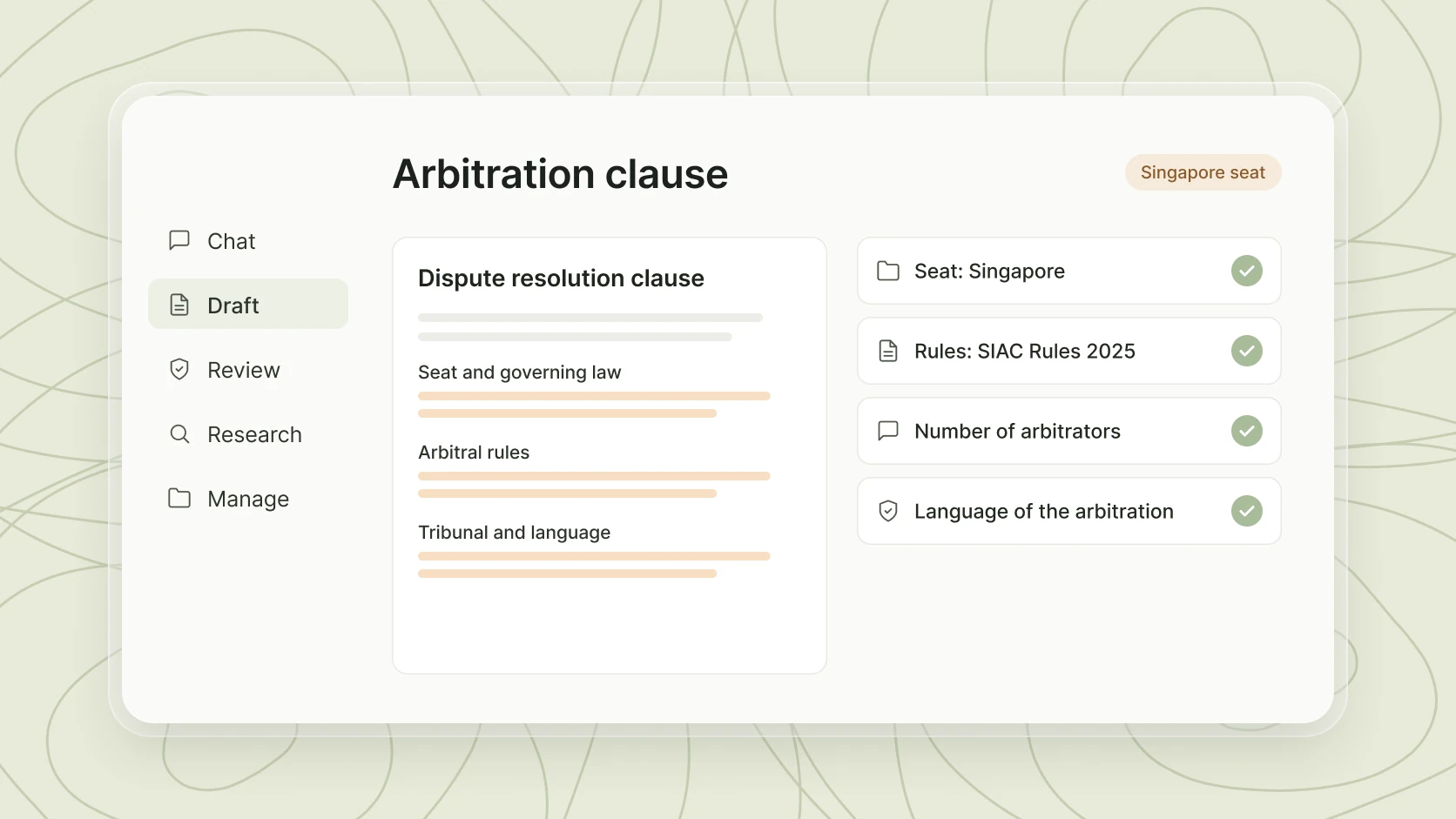
Specify Singapore as the seat if intended, the number of arbitrators, the language of the arbitration and the law governing the arbitration agreement. State the law governing the underlying contract as well; do not assume those two governing-law choices are interchangeable. Review the resulting wording alongside the whole agreement:
- Seat: State Singapore expressly as the juridical seat. Address a different hearing location separately.
- Institution and rules: Identify SIAC administration and decide whether the rules for the time being in force or a specified edition should apply.
- Dispute scope: Cover the contractual and related disputes the parties mean to arbitrate, including questions of existence, validity or termination.
- Tribunal constitution and language: Specify the number of arbitrators and procedural language; check that appointment wording works with the rules.
- Interim and special procedures: Assess the emergency, Streamlined and Expedited Procedure requirements without promising eligibility or a result. Consider separately whether Indian court interim relief should remain available.
- Multiple contracts and parties: Map guarantees, affiliates and related agreements; align clauses where the parties want connected disputes handled together.
- Notices and court wording: Reconcile escalation steps and notice provisions with the arbitration clause. If the parties want the SICC to hear IAA-related applications, consider the optional jurisdiction model clause discussed above.
For more on reviewing reused contract language, see The Template Trap: Risks of Copy-Pasting Contract Clauses and How to Reduce Them.
Before signing: read the clause across the transaction
Compare the final clause with the main agreement, schedules, guarantees, side letters, purchase orders and any framework agreement. Inconsistent seats, institutions, court clauses or escalation steps can undermine an otherwise careful arbitration provision. Match the wording to the intended SIAC Rules approach and the statutory routes relevant to the transaction.
Legal information disclaimer: This article provides general information as of 29 October 2026, not legal advice. Obtain advice on the applicable Singapore and Indian law, institutional rules and transaction facts before signing or acting on a clause.
Next step: Explore Lexi’s legal technology for law firms, litigators and in-house teams.