بقلم Lexi Team
Legal research in India starts before the first search
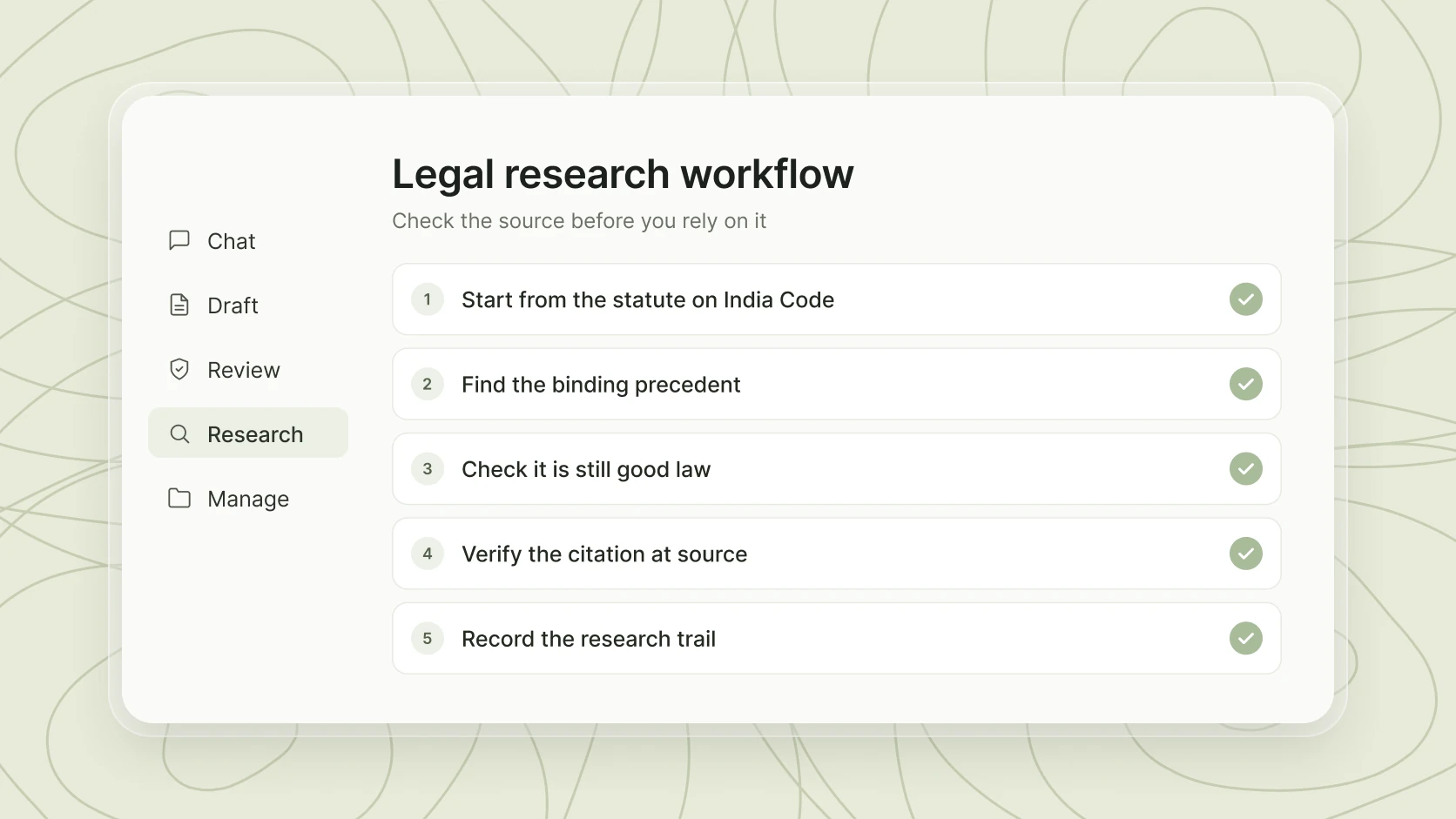
Legal research in India starts with a question, not a case name, a familiar section number or a favourable headnote. Before an authority is used in advice, a pleading, a written submission or an internal note, the researcher must establish a narrower proposition: what legal question is being answered, which text governed on the relevant date, which court will decide the matter, and whether the authority supports the proposition on the material facts.
This workflow shows how to do legal research in India for litigators, associates and in-house counsel who need research that can be reviewed, updated and defended. It treats statutory text, judgments and procedural status as separate checks. It also creates a record that lets another lawyer repeat the work without reconstructing it from browser history.
Start with the question, not the search box
Assignments like “find the law on termination,” “can this order be challenged?” and “is this clause enforceable?” are not yet search instructions. Convert them into issue statements before collecting authorities.
Capture the following in a short research brief:
- Material facts: facts that may affect the rule, exception, limitation period, remedy or factual analogy.
- Legal question: the precise proposition to establish, framed neutrally rather than as the desired outcome.
- Forum: the court, tribunal, regulator or decision-maker that will receive the argument.
- Procedural posture: for example, an interim application, appeal, review, enforcement step, investigation or merits hearing.
- Relevant date: the date of the transaction, cause of action, proceeding, decision or proposed action, as the issue requires.
- Decision or relief at stake: what the court or decision-maker is being asked to decide or grant.
Separate known facts from working assumptions. Then list the propositions that need authority. A useful question is: “What must be true, legally and factually, for the requested result to follow?” That question often reveals hidden sub-issues: jurisdiction, commencement, limitation, notice, delegated legislation, maintainability or the scope of an exception.
A legal research methodology: build a plan before collecting authorities
Turn the issue statement into a small issue tree. For each branch, identify the likely source of law and the test to be resolved. This avoids accumulating authorities without knowing which proposition each one proves.
| Issue branch | Likely source to verify | Research question |
|---|---|---|
| Primary rule | Act, regulation, rule or notification | What is the operative text on the relevant date? |
| Meaning and scope | Definitions, schedules and precedent | How has the relevant language been applied? |
| Procedure and remedy | Procedural rule, court rule or statute | What filing, forum, threshold or relief requirement applies? |
| Application to facts | Precedent and record | Which factual distinctions matter? |
For every proposition, note whether the answer is likely to turn on a statute, delegated legislation, a procedural rule, binding precedent or a factual distinction. Prepare search terms in plain language and statutory language. Include synonyms, alternate spellings, defined terms, remedy terms, older terminology and the names of relevant forums. Search results are leads; they are not the research record.
Verify the statute from the official text
For Indian legislation, begin by locating the relevant Act through India Code. Its database covers central enactments and subordinate legislation, as well as legislation enacted by states and Union Territory administrations. It is a starting point for locating the text, not a substitute for establishing what applied in the relevant jurisdiction on the relevant date.
Read the provision in context. Do not lift a subsection without checking:
- the long title, definitions and linked provisions;
- provisos, explanations, schedules and cross-references;
- rules, regulations, orders or other delegated legislation;
- amendments and any replacement or repeal;
- commencement notifications or Gazette material where commencement matters; and
- state-specific amendments, state rules or local variations where relevant.
The operative text may differ from the current consolidated text if the dispute concerns an earlier date. Identify the version in force on the legally relevant date, check the instruments that brought material provisions or amendments into force, and preserve a copy or stable reference to the text reviewed. Recheck that position when the research is used.
Map the precedent hierarchy for the court you are in
Precedent is not a single nationwide list sorted by relevance. The court, territorial jurisdiction and bench strength affect the weight of a judgment. In India, Article 141 of the Constitution of India provides that the law declared by the Supreme Court is binding on all courts within the territory of India.
For High Court and subordinate-court litigation, identify the court before which the matter will proceed. A ruling of the jurisdictional High Court binds subordinate courts within its jurisdiction, subject to binding Supreme Court law. A decision of another High Court may be persuasive, but it does not acquire binding force merely because it addresses the same provision. Record the court and territorial jurisdiction rather than treating every search result as interchangeable.
Bench strength is equally important. Record whether the decision came from a larger, coordinate or smaller bench. Within the same court, a larger-bench ruling binds a smaller bench; a coordinate bench that doubts an earlier coordinate-bench ruling should refer the question to a larger bench rather than depart from it. See Central Board of Dawoodi Bohra Community v State of Maharashtra (2005) 2 SCC 673. Investigate the actual treatment of any apparent conflict rather than inferring it from a digest label or database summary.
Where available, obtain the judgment from an official court source. The Supreme Court’s ready reckoner provides guidance on finding judgments, orders and case information through its site. For Supreme Court judgments, the Digital SCR portal (digiscr.sci.gov.in) provides the official reported text. Recording a neutral citation, where assigned (for example, 2024 INSC 123), alongside any report citation makes the research log easier to verify. For matters covered by eCourts, its app guide explains how a CNR-number search can return case details, status, hearing history and orders.
Read the judgment, not just the headnote
A headnote, search snippet or citation trail can identify a promising decision. It cannot establish what the court actually decided. Read the full judgment and isolate four things: the material facts, the issues framed, the reasoning and the operative conclusion.
For each authority, write a one-sentence proposition in your own words, followed by the paragraphs that support it. Identify the rule necessary to decide the issue on the material facts, and distinguish it from observations that were not necessary to the outcome. If the distinction is disputed, record the competing readings and rely only on the proposition the judgment clearly supports.
Compare the judgment’s material facts to the present record. A case may state a favourable rule but turn on a notice, document, admission, procedural stage, statutory wording or remedy that is absent here. Confirm the text against an official court source where one is available, especially before quoting, characterising the procedural posture or relying on the dispositive portion.
Check whether the authority remains good law
“Good law” is a conclusion earned by a later-treatment check, not a label copied from a database. Search for subsequent decisions that follow, distinguish, question or overrule the proposition, or refer the issue to a larger bench. Check Supreme Court decisions and decisions of the relevant High Court, then examine the court, date, bench strength and precise proposition addressed in each later judgment.
Also recheck the governing Indian legislation. An amendment, repeal, replacement, commencement event or change in delegated legislation may alter the relevance of an otherwise sound decision. Pending references, appeals and later procedural developments may matter in particular contexts; examine authoritative court records and orders where relevant. Record the date through which you checked later treatment, and repeat the check before relying on the authority.
Database tools can accelerate discovery. Indian Kanoon can help locate Indian judgments, orders and laws. Use a database as a research-access tool, but treat summaries and extracted passages as leads to be tested against the full text and primary materials.
Keep a research trail another lawyer can reproduce
A reliable legal research workflow is dated, proposition-led and explicit about uncertainty. Create a research log for each issue. It can be a matter workspace, spreadsheet or structured note, provided it follows the team’s file-management and confidentiality practices.
- Issue statement and material assumptions.
- Search terms, databases and official sources consulted.
- Access date and, for legislation, the version and legally relevant date checked.
- Full case citation, court, bench and procedural posture.
- Relevant paragraphs and the exact proposition they support.
- Later-treatment, amendment and commencement checks performed.
- Authorities rejected and why.
- Unresolved questions, factual gaps and follow-up tasks.
Preserve permissible copies or stable references to the materials reviewed. A dated trail makes handover easier, supports partner or client review, and tells the team what must be rechecked when a hearing date moves or new authority appears.
Where AI research tools fit, and where verification remains essential
AI-native legal technology can assist with issue exploration, search-term generation, source discovery, document organisation and first-pass comparison. It does not replace examination of the applicable statutory text and full judgment. Before relying on an output, verify quotations, citations, procedural posture, court, bench strength, relevant paragraphs and subsequent treatment against primary sources.
For a focused workflow on using these tools while reducing citation risk, read AI for Legal Research: How Lawyers Find Case Law Faster Without Risking Bad Citations.
A final pre-reliance check
Before an authority enters advice or submissions, ask:
- Does it answer the framed issue, on materially comparable facts and at the relevant procedural stage?
- Is it binding on the Indian forum hearing the matter, or persuasive only?
- Have the court, territorial jurisdiction and bench strength been checked?
- Have the full text, supporting paragraphs and operative conclusion been read?
- Have later decisions, larger-bench treatment, statutory amendments, delegated legislation and commencement been checked to the reliance date?
- Does the research log identify the source, date, version and unresolved points?
If any answer is incomplete, flag the point rather than smoothing it over. That discipline is the difference between finding an authority and being ready to rely on it.
Legal information disclaimer: This article provides general information about legal research methodology in India, not legal advice. Applicable law, procedure and authority status depend on the facts, forum and relevant date. Seek advice from appropriately qualified counsel for a specific matter.
Next step: Explore Lexi for legal research and matter workflows for law firms, litigators and in-house teams.