بقلم Lexi Team
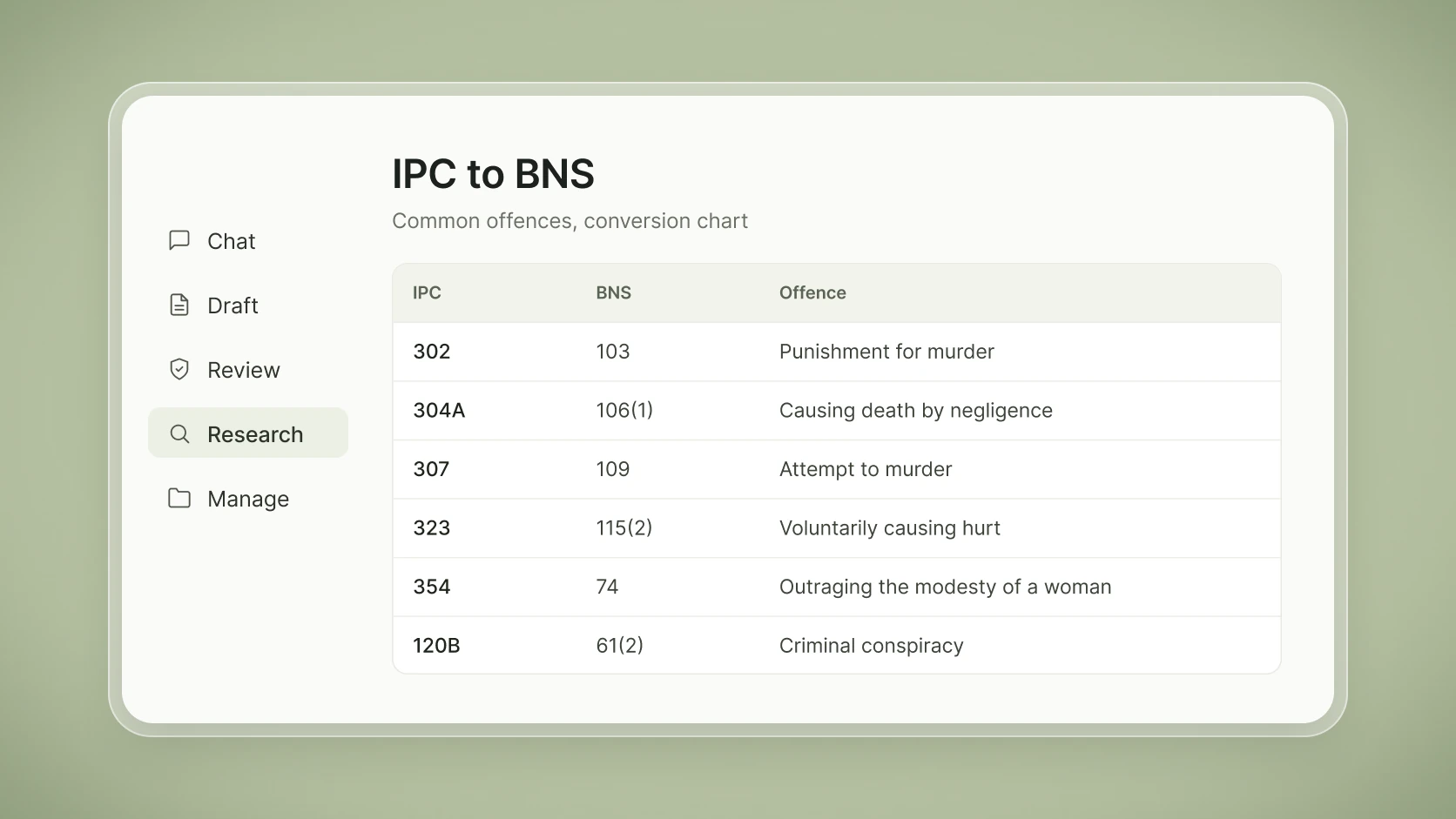
The Bharatiya Nyaya Sanhita, 2023 (BNS) generally replaced the Indian Penal Code, 1860 (IPC) from 1 July 2024. Use this IPC to BNS chart to locate a corresponding provision, then check its ingredients, subsection, punishment and the date of the alleged conduct.
IPC to BNS: use a conversion chart as a starting point
An IPC to BNS conversion chart can speed up criminal-law research. It can also produce a drafting error if a familiar offence label obscures a different subsection, ingredient, exception or punishment provision.
The BNS retains many familiar offences while reorganising provisions and making substantive changes. PRS Legislative Research’s overview explains the transition. A corresponding section number, however, is not a charging conclusion.
For an FIR review, complaint, opinion or charge, start with the alleged conduct and its date. Then identify the full offence definition, the applicable punishment subsection, any proviso or exception, and the enactment in force for that conduct. Use the chart below to locate provisions, not to decide whether their ingredients are established.
How to read the BNS alongside procedural classifications
The India Code record for the Bharatiya Nyaya Sanhita, 2023 identifies it as Act 45 of 2023. When researching an offence, record the relevant BNS section and subsection separately: one may define the conduct while another specifies its punishment.
For cognizability, bail and trial classification, consult the First Schedule to the Bharatiya Nagarik Suraksha Sanhita, 2023. Its explanatory note makes clear that the schedule’s offence and punishment entries indicate the substance of provisions; they do not replace the statutory definitions or prescribed punishments. Read the First Schedule.
A useful research note records:
- the section and subsection containing the offence ingredients;
- the applicable punishment provision, including any aggravated form;
- relevant explanations, provisos and exceptions;
- the procedural classification of the precise offence; and
- the conduct date, commencement position and any savings issue.
IPC to BNS conversion chart for common offences
These are provision-level starting points, not one-to-one substitutes for the statutory text. Read the relevant BNS provisions in full before choosing a subsection; an accessible text of the Act can also help locate the surrounding provisions.
| Offence | IPC provisions | BNS provisions | What to compare |
|---|---|---|---|
| Common intention | Indian Penal Code, 1860, section 34 (acts done by several persons in furtherance of common intention). | Bharatiya Nyaya Sanhita, 2023, section 3(5). | Check the alleged common intention and each person’s participation; neither provision creates a standalone offence. |
| Criminal conspiracy | Section 120A defines conspiracy; section 120B prescribes punishment. | Section 61(1) defines conspiracy; section 61(2) prescribes punishment. | Identify the agreement and the applicable punishment limb. |
| Unlawful assembly | Section 141 defines unlawful assembly. | Section 189(1) defines unlawful assembly. | Check the number of persons and the alleged common object. |
| Rioting | Section 146 defines rioting; section 147 prescribes punishment. | Section 191(1) defines rioting; section 191(2) prescribes punishment. | Check the use of force or violence by an unlawful assembly in prosecution of its common object. |
| Offence committed in prosecution of an unlawful assembly’s common object | Section 149. | Section 190. | Test the common-object and membership requirements; do not treat assembly membership alone as sufficient. |
| Murder | Section 300 defines murder; section 302 prescribes punishment. | Section 101 defines murder; section 103 prescribes punishment. | Test the ingredients and exceptions under section 101 before selecting the applicable punishment provision under section 103. |
| Culpable homicide not amounting to murder | Section 304 prescribes punishment. | Section 105 prescribes punishment. | Distinguish the applicable punishment limb and read it with the provisions defining culpable homicide and murder. |
| Causing death by negligence | Section 304A. | Section 106(1). | Check that the alleged act does not amount to culpable homicide. Do not assume the separately numbered section 106(2) commenced with section 106(1). |
| Dowry death | Section 304B. | Section 80. | Check the statutory time period, circumstances of death, and alleged cruelty or harassment connected with a dowry demand. |
| Attempt to murder | Section 307. | Section 109. | Assess the required intention or knowledge, the act alleged and whether hurt was caused. |
| Voluntarily causing hurt | Section 323 prescribes punishment. | Section 115(2) prescribes punishment. | Read the definition in section 115(1) and distinguish hurt from grievous hurt. |
| Voluntarily causing grievous hurt | Section 325 prescribes punishment. | Section 117(2) prescribes punishment. | Identify the alleged form of grievous hurt and check whether another aggravated provision applies. |
| Wrongful restraint | Section 341 prescribes punishment. | Section 126(2) prescribes punishment. | Read the definition in section 126(1); distinguish restraint from confinement. |
| Wrongful confinement | Section 342 prescribes punishment. | Section 127(2) prescribes punishment. | Read the definition in section 127(1) and check whether an aggravated form applies. |
| Assault or criminal force to a woman with intent to outrage her modesty | Section 354. | Section 74. | Check the alleged assault or criminal force and the required intent or knowledge. |
| Rape | Section 375 defines rape; section 376 and other applicable provisions prescribe punishment. | Section 63 defines rape; section 64 is the general punishment starting point. | Apply the full definition and identify the applicable punishment provision. Check sections 65, 66, 70 and 71 where the facts require. |
| Kidnapping | Section 363 prescribes punishment. | Section 137(2) prescribes punishment. | Read the forms of kidnapping in section 137(1) and identify which is alleged. |
| Theft | Section 378 defines theft; section 379 prescribes punishment. | Section 303(1) defines theft; section 303(2) prescribes punishment. | Read section 303(2) in full, including its first-conviction proviso concerning low-value property and return or restoration. |
| Theft in a dwelling house and other specified thefts | Section 380 addresses theft in a dwelling house and certain other premises. | Section 305 covers theft in a dwelling house, of a means of transport, of articles or goods from a means of transport, of an idol or icon in a place of worship, or of government or local-authority property. | Check the applicable clause of section 305 against the location, property and transport involved; IPC section 380 (theft in a dwelling house, building, tent or vessel used for human dwelling or custody of property) corresponds to clause (a) of section 305, not to every category in it. |
| Robbery | Section 392 prescribes punishment. | Section 309(4) prescribes punishment. | Read the definition of robbery in section 309 and check the circumstances relevant to punishment. |
| Dacoity | Section 395 prescribes punishment. | Section 310(2) prescribes punishment. | Check the number of persons and the elements of dacoity under section 310. |
| Cheating | Section 415 defines cheating; sections 417, 418 and 420 address different punishable forms. | Section 318(1) defines cheating; sections 318(2), 318(3) and 318(4) address different punishable forms. | Identify the alleged deception and inducement. Distinguish ordinary cheating, the protected-interest form and the property-delivery or valuable-security form. |
| Criminal breach of trust | Section 405 defines the offence; sections 406-409 address punishment, including particular capacities. | Section 316(1) defines the offence; sections 316(2)-(5) address punishment and particular capacities. | Check entrustment or dominion over property, alleged dishonest use or disposal, and whether a specified capacity changes the punishment subsection. |
| Mischief causing damage | Section 427 addresses mischief causing damage at its specified threshold. | Section 324 addresses mischief and its punishment. | Read the applicable BNS punishment subsection; do not carry over the IPC section 427 damage threshold. |
| Forgery of a valuable security, will or specified document | Section 467. | Section 338. | Identify the document or electronic record alleged to have been forged and the applicable statutory category. |
| Forgery for the purpose of cheating | Section 468. | Section 336(3). | Check the alleged forgery and the purpose of cheating. |
| Using a forged document or electronic record as genuine | Section 471. | Section 340(2). | Check the alleged use and the required knowledge or reason to believe the material was forged. |
| Criminal intimidation | Section 503 defines the offence; sections 506 and 507 address punishment and anonymous communications. | Section 351 defines the offence and sets out its punishment provisions. | Identify the threatened harm, required intent, applicable punishment limb and whether an anonymous communication is alleged. |
| Defamation | Sections 499-502 cover the definition, exceptions and associated punishable conduct. | Section 356 covers defamation and associated punishable conduct. | Compare the alleged imputation with the definition and exceptions; distinguish making an imputation from printing, engraving or selling defamatory matter. |
| Cruelty by husband or his relatives | Section 498A. | Section 85 addresses the offence and punishment; section 86 defines cruelty for this purpose. | Read sections 85 and 86 together. Check the relationship alleged and whether the conduct falls within the statutory meaning of cruelty. |
| Intentional insult giving provocation | Section 504. | Section 352. | Check for an intentional insult that gives provocation, intending that the provocation cause the person provoked to break the public peace or commit any other offence, or knowing that result is likely. |
| Word, gesture or act intended to insult a woman’s modesty | Section 509. | Section 79. | Check the alleged words, gesture or act and the statutory intent requirement. |
Frequently searched BNS sections: choose the right subsection
BNS section 318: identify the cheating variant
BNS section 318 is not a single, undifferentiated replacement for every IPC cheating provision. Section 318(1) sets out the definition; the later subsections distinguish punishable forms. Section 318(4) concerns cheating that dishonestly induces delivery of property, or the making, alteration or destruction of a valuable security or something signed or sealed that can be converted into one.
Where an allegation was formerly framed under IPC section 420, test the facts against section 318(4) rather than substituting numbers mechanically. Identify who was deceived, what the deception induced and which statutory consequence is alleged.
BNS sections 101 and 103: definition first, punishment second
BNS section 101 defines murder; section 103 provides its punishment. Analyse the facts and any applicable exception under section 101 before addressing punishment under section 103. A reference to the punishment section alone does not explain why the alleged killing amounts to murder.
BNS section 352: assess intent or knowledge and the likely consequence
BNS section 352 concerns an intentional insult that gives provocation, where the person insulting intends that the provocation cause the person provoked to break the public peace or commit any other offence, or knows that it is likely to do so. Assess the words or conduct in context. Offensive language alone is not a substitute for applying those statutory requirements.
Commencement: match the provision to the conduct date
The Central Government’s commencement notification, S.O. 850(E) dated 23 February 2024, appointed 1 July 2024 for the BNS except section 106(2). Section 106(2) concerns causing death by rash and negligent driving of a vehicle and escaping without reporting it to a police officer or Magistrate soon after the incident. Consult the India Code record for the BNS and check the Government of India’s e-Gazette for any later commencement notification before relying on section 106(2) for a particular conduct date.
Conduct before commencement: read the savings provision
BNS section 358 repeals the IPC and contains savings provisions. For alleged conduct before commencement, the date a complaint or charge is filed does not, by itself, determine which substantive offence provision applies. Establish the conduct date or date range, then read section 358 alongside the provisions in force at the relevant time.
Keep the substantive-offence question separate from questions about the procedure governing an investigation or trial. A conversion chart cannot resolve either question without the dates, statutory language and procedural context.
A final citation check for criminal practice
Before filing or advising:
- Compare the complete IPC and BNS provisions rather than relying on an offence label.
- Separate the definition from the punishment provision and select the exact subsection.
- Read relevant explanations, exceptions and provisos.
- Confirm procedural classification from the applicable schedule, not from a shorthand offence description.
- Match conduct dates to commencement and, where relevant, BNS section 358.
- Check the operative statutory text and notifications for the date in issue.
For a related approach to source checking, see AI for Legal Research: How Lawyers Find Case Law Faster Without Risking Bad Citations.
Legal-information disclaimer: This article provides general information for Indian criminal-law practice, not legal advice or a case-specific charging opinion.
Next step: Explore Lexi’s AI-native legal technology for law firms, litigators and in-house teams.