بقلم Lexi Team
Section 138 NI Act: the practitioner’s sequence
In a section 138 NI Act cheque-dishonour matter, the sequence can determine whether a complaint is maintainable. Presentation outside the cheque’s validity period, a late demand notice, filing before the payment period expires or filing in the wrong court can put the proceeding in issue.
This guide follows the lifecycle of a proceeding under section 138 of the Negotiable Instruments Act, 1881 (NI Act): establish the ingredients, record each statutory date, issue and evidence the notice, file in the competent court, and manage trial, interim relief, appeal and settlement.
The ingredients of an offence under section 138
Section 138 of the Negotiable Instruments Act, 1881 concerns a cheque drawn on an account maintained by the drawer towards discharge, in whole or in part, of a legally enforceable debt or other liability, and returned unpaid in circumstances covered by the provision. Its proviso sets out the presentation, written-demand and payment requirements. See the Supreme Court’s reproduction of section 138.
A complaint should plead facts establishing that:
- the drawer maintained the account on which the cheque was drawn;
- the cheque was issued towards a legally enforceable debt or other liability;
- it was presented within the period required by clause (a) of the proviso to section 138;
- the bank returned it unpaid in circumstances attracting section 138;
- the payee or holder in due course made a timely written demand for the cheque amount; and
- the drawer failed to pay within 15 days of receiving the notice.
Section 138 punishes the offence with imprisonment for a term that may extend to two years, a fine that may extend to twice the cheque amount, or both.
Identify the parties, cheque number, date, amount, bank, presentation and return dates, return reason, underlying transaction and notice records. The statutory notice gives the drawer an opportunity to pay before the cause of action for a complaint arises. See the Supreme Court’s discussion of the notice-and-payment sequence.
Cheque bounce case time limit: map each deadline
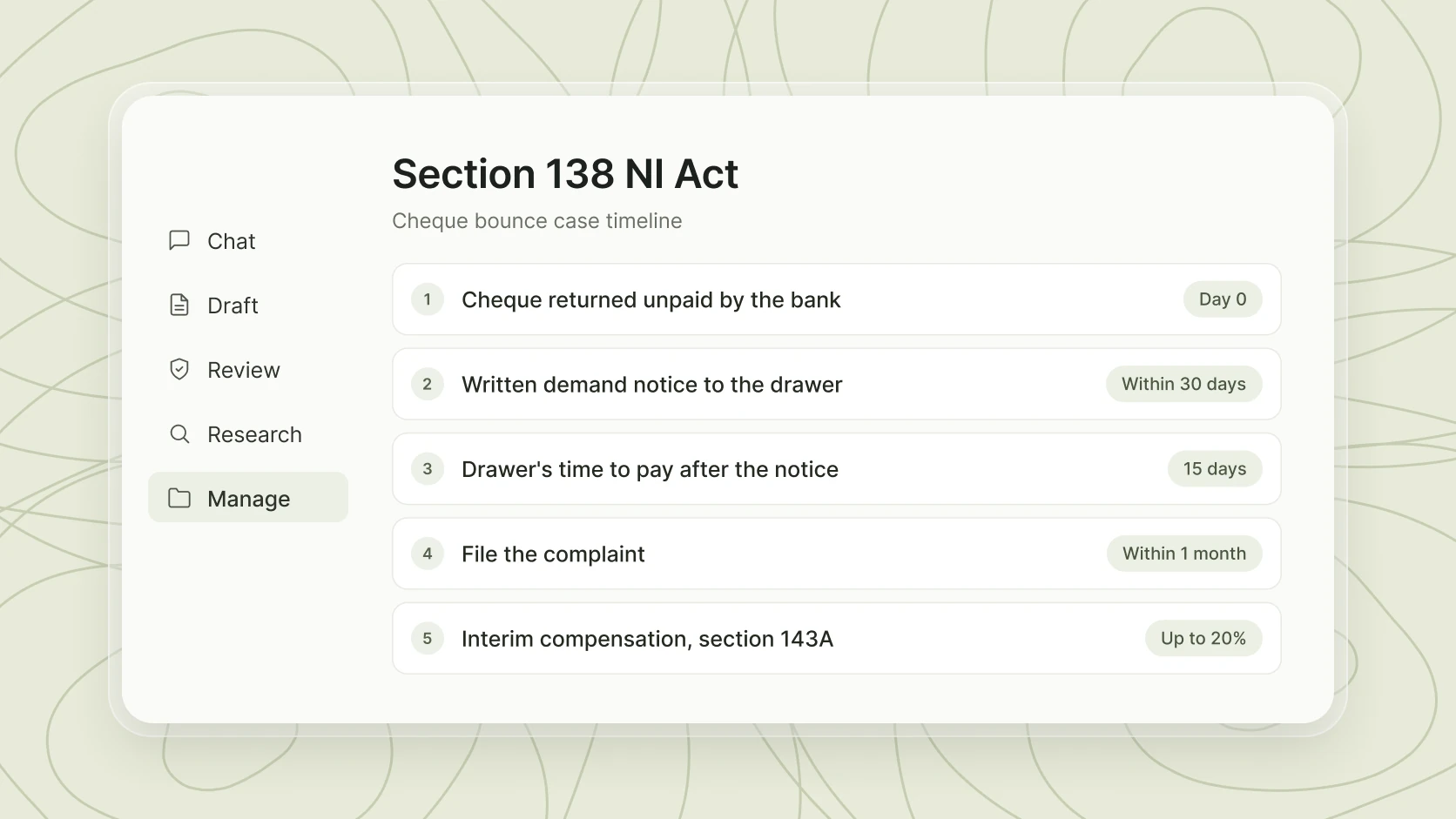
Build a dated ledger when dishonour information arrives. The cheque date, the date the bank’s information reaches the payee, notice dispatch and notice receipt serve different purposes.
| Event | Timing under the NI Act | Record to preserve |
|---|---|---|
| Cheque presentation | Within six months of the cheque date or its validity period, whichever is earlier, under clause (a) of the proviso to section 138 | Cheque, deposit slip and bank records |
| Information of dishonour | The payee’s receipt of the bank’s information starts the notice period | Return memo, bank communication and receipt date |
| Written demand notice | Within 30 days of that receipt, under clause (b) of the proviso to section 138 | Notice, dispatch receipt and tracking |
| Payment opportunity | 15 days from the drawer’s receipt of notice, under clause (c) of the proviso to section 138 | Delivery, refusal or return records and address evidence |
| Complaint | Within one month of the date the cause of action arises, under section 142(1)(b) | Limitation calculation and supporting dates |
For presentation, establish the cheque’s actual validity period rather than assuming that the statutory six-month ceiling is always available. The notice deadline runs from receipt of information from the bank, not automatically from the date printed on its return memo. The complaint period is one month, not a fixed 30 days.
The proviso to section 142(1)(b) of the Negotiable Instruments Act, 1881 permits the court to take cognizance of a complaint made after that period if the complainant satisfies it that there was sufficient cause for the delay. A late filing should have a precise chronology, supporting evidence and a request for condonation; a strong underlying claim does not itself resolve limitation.
Drafting and serving the cheque bounce legal notice
The written notice under clause (b) of the proviso to section 138 of the Negotiable Instruments Act, 1881 must demand payment of the cheque amount. Identify each cheque, the dishonour, the amount due on the instrument and the transaction said to create the debt or liability. State the 15-day payment opportunity under clause (c) of that proviso. If other sums are mentioned, distinguish them clearly from the demand for the cheque amount.
Reconcile the cheque amount, ledger, invoices, notice and proposed complaint before dispatch. Where several cheques or transactions are involved, a schedule can make each instrument’s chronology clear.
Preserve the address source, dispatch proof, tracking history, delivery confirmation and any returned envelope. A refusal, an unclaimed article or a disputed address may raise different service questions; retain the full record rather than treating a tracking entry alone as conclusive proof of receipt.
When does the cause of action arise?
Under clause (c) of the proviso to section 138 of the Negotiable Instruments Act, 1881, the drawer has 15 days after receipt of the demand notice to pay. If payment is not made within that period, the cause of action for the section 138 complaint arises on the following day. Section 142(1)(b) then allows one month from that cause-of-action date to make the complaint, subject to its provision for condonation of delay.
For each cheque, record the date the payee received dishonour information, notice dispatch, notice receipt or the facts relied on to establish service, and expiry of the payment period. Do not calculate complaint limitation from notice dispatch alone. Where receipt is contested, plead the service facts and preserve the evidence supporting the date used.
Filing the complaint: court, pleadings and documents
File after the payment opportunity has expired and after confirming limitation and territorial jurisdiction. Under section 142(1)(a) of the Negotiable Instruments Act, 1881, the complaint must be in writing and made by the payee or holder in due course. Under section 142(1)(c) of the Negotiable Instruments Act, 1881, no court inferior to a Metropolitan Magistrate or a Judicial Magistrate of the first class may try a section 138 offence. Identify any representative and the authority under which that person acts.
Annex or keep ready the following:
- the cheque and records showing its presentation;
- the bank return memo and related communication;
- the demand notice and proof of dispatch;
- tracking, delivery, return or refusal records and address evidence;
- agreements, invoices, ledgers or correspondence supporting the debt or liability, as applicable;
- authority documents where the complainant acts through a representative; and
- a limitation calculation and, if the filing is late, a request for condonation with supporting material.
Set out the statutory sequence in dated paragraphs. Follow the applicable court’s filing, affidavit, electronic-filing and original-document requirements.
Where the drawer is a company
For a company-drawn cheque, identify the company as the drawer and ordinarily arraign it as an accused. Section 141(1) of the Negotiable Instruments Act, 1881 can also extend liability to a person who, when the offence was committed, was in charge of and responsible to the company for the conduct of its business. Section 141(2) addresses directors, managers, secretaries and other officers where the offence was committed with their consent or connivance, or was attributable to their neglect. Identify a signatory’s involvement and plead the relevant basis for proceeding against each individual; a job title alone does not establish an ordinary director’s responsibility for the company’s business. The provisos to section 141(1) of the Negotiable Instruments Act, 1881 also provide a defence where a person proves lack of knowledge or due diligence, and exclude certain government- or financial-corporation-nominated directors from prosecution under that Chapter.
Territorial jurisdiction under section 142(2)
Section 142(2) of the Negotiable Instruments Act, 1881 uses the manner of presentation to identify the court. If the cheque is delivered for collection through an account, jurisdiction lies where the branch of the bank at which the payee or holder in due course maintains the account is situated. If it is presented for payment otherwise than through an account, jurisdiction lies where the branch of the drawee bank at which the drawer maintains the account is situated.
The Explanation to section 142(2) treats a cheque delivered for collection at any branch of the payee’s bank as delivered at the branch where the payee or holder in due course maintains the account. Support the jurisdiction paragraph with the relevant account and bank-branch records, not merely a party’s correspondence address or the location of the underlying transaction.
Trial procedure: summary trial and case management
Section 143 of the Negotiable Instruments Act, 1881 provides for summary trial of section 138 cases, while permitting the Magistrate to proceed as a summons case in the circumstances stated there. It also says that an endeavour should be made to conclude the trial within six months from filing of the complaint. That is a statutory objective, not a guaranteed disposal date.
Presumptions and evidence
Under section 139 of the Negotiable Instruments Act, 1881, the court presumes, unless the contrary is proved, that the holder received the cheque towards discharge, in whole or in part, of a debt or other liability. The presumption is rebuttable on a preponderance of probabilities. Under section 146 of the Negotiable Instruments Act, 1881, a bank slip or memo bearing the bank’s official mark denoting dishonour supports a presumption of dishonour unless that fact is disproved. Section 145 of the Negotiable Instruments Act, 1881 permits the complainant’s evidence to be given on affidavit; under section 145(2) of that Act, the court may summon and examine an affidavit witness on its own motion and must do so on an application by the prosecution or the accused.
Manage the proceeding against the court’s actual orders for service, appearance, plea, evidence, cross-examination and arguments. For complaints filed on or after 1 July 2024, the Bharatiya Nagarik Suraksha Sanhita, 2023 applies in place of the Code of Criminal Procedure, 1973; section 531 of the Bharatiya Nagarik Suraksha Sanhita, 2023 governs proceedings pending on that date. Keep bank records, notice evidence, authority documents and hearing orders in one chronology. For an approach to organising those records, see How to Create an AI Legal Case Timeline: A Lawyer’s Workflow.
Interim compensation under section 143A
Section 143A of the Negotiable Instruments Act, 1881 applies prospectively. In G.J. Raja v. Tejraj Surana, the Supreme Court held that the provision applies only where the section 138 offence was committed on or after 1 September 2018, when section 143A came into force. It does not apply to an earlier offence merely because its trial remains pending.
In a case to which it applies, section 143A permits, but does not require, the trial court to order the drawer to pay interim compensation of up to 20% of the cheque amount. In a summary trial or summons case, the power arises where the accused pleads not guilty to the accusation; in another case, it arises upon framing of charge.
Payment is due within 60 days of the order, extendable by up to 30 days for sufficient cause. If the accused is acquitted, section 143A requires repayment with the interest specified there, within 60 days of the order of acquittal, again extendable by up to 30 days for sufficient cause. An application or response should address whether the provision applies, the trial stage, the amount sought and reasons for the court to exercise its discretion.
Appeal deposit under section 148
In an appeal against conviction under section 138, section 148 of the Negotiable Instruments Act, 1881 empowers the appellate court to order the appellant to deposit a sum of at least 20% of the fine or compensation awarded by the trial court. The power is not an automatic deposit in every appeal. A deposit ordered under this section is in addition to any interim compensation paid under section 143A.
The ordered sum is to be deposited within 60 days, extendable by up to 30 days for sufficient cause. The appellate court may direct its release to the complainant; section 148 also addresses repayment with interest if the appellant is acquitted. Read the trial and appellate orders closely when advising on the amount, release and repayment.
Compounding a section 138 offence
Section 147 of the Negotiable Instruments Act, 1881 makes offences punishable under the Act compoundable. A commercial settlement and an order recording compounding are distinct. Record the parties, covered cheques, payment amount and method, deadlines, consequences of default and steps each side will take in court.
Once the agreed conditions are met, place the settlement and request for compounding before the court handling the proceeding. Keep the resulting order with the payment record; signing a settlement document alone should not be treated as the court’s disposal of the complaint.
Practitioner checklist: from dishonour to disposal
- Confirm cheque validity, presentation and the date dishonour information was received.
- Send the written demand within 30 days of receiving that information.
- Preserve address, dispatch and service evidence.
- Calculate the 15-day payment period from notice receipt, then the one-month complaint period from the resulting cause of action.
- Support jurisdiction under section 142(2) with account and branch records.
- File the cheque, return memo, notice, service evidence, authority documents and debt-supporting records; for a company-drawn cheque, address the company and each individual accused.
- Track the trial route, whether section 143A applies, any interim compensation order and any section 148 appeal deposit.
- Where terms are agreed, document settlement and obtain the appropriate court order on compounding.
Legal information disclaimer: This article provides general information about Indian law, not advice on a particular matter. Apply the governing law, court rules and facts to each filing.
Next step: explore Lexi for legal workflows used by law firms, litigators and in-house teams.