بقلم Lexi Team
Published: 21 October 2026
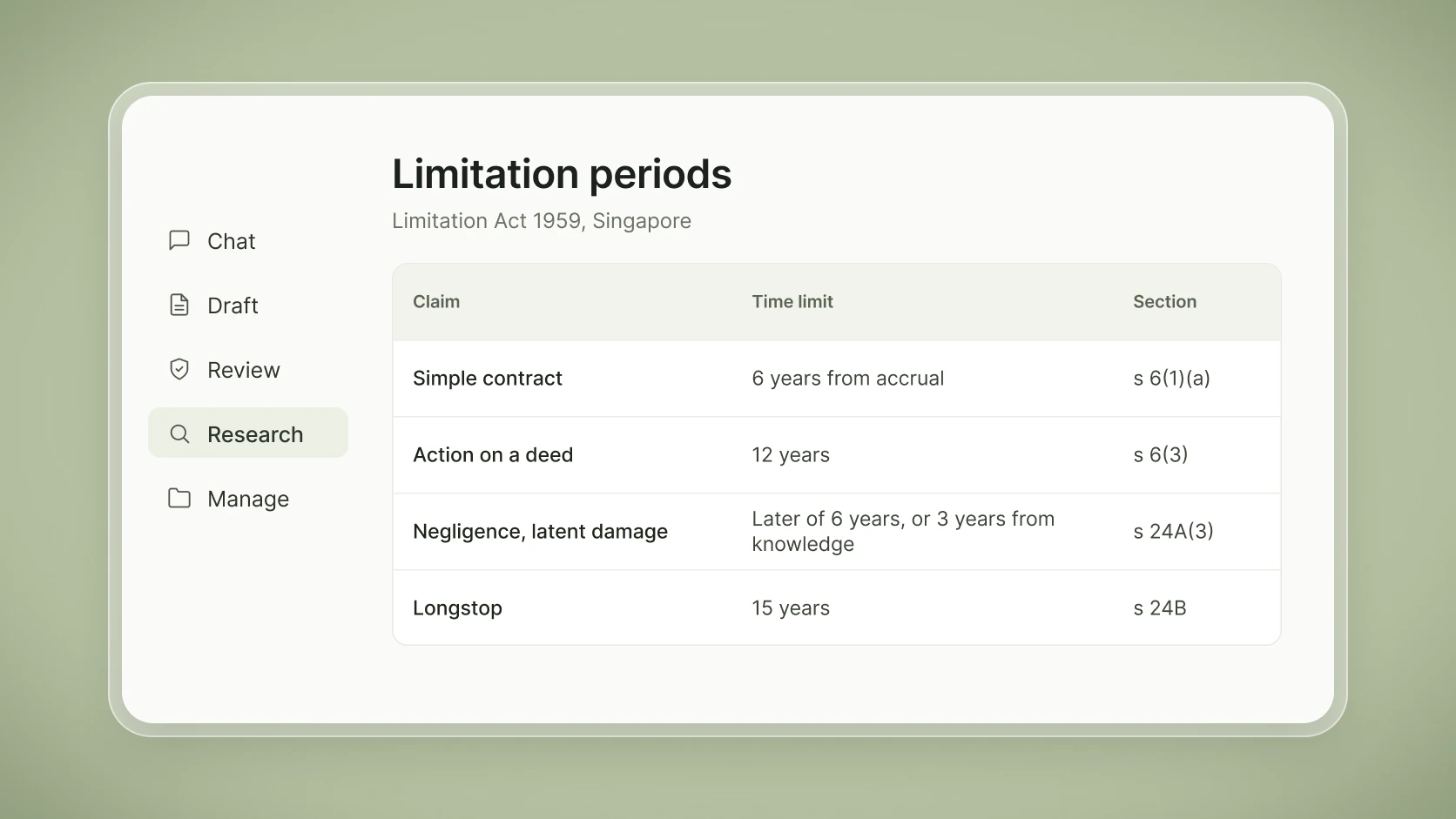
The limitation period in Singapore for a contract-related claim depends on the cause of action and when it accrues, not simply on the earliest date in the file. Under the Limitation Act 1959, an action founded on contract generally must be brought within six years of accrual (section 6(1)(a)); an action upon a specialty generally has 12 years (section 6(3)). A non-personal-injury damages claim for negligence, nuisance or breach of duty, including a duty arising under a contract, may instead fall under section 24A(3): six years from accrual or three years from the statutory date of knowledge, whichever expires later, subject where applicable to the 15-year longstop in section 24B. Personal-injury claims under section 24A(2) follow a separate timetable.
The distinction matters. An action upon a specialty may have a different period from an ordinary action founded on contract. A claim for damages for negligence, nuisance or breach of duty may require a separate analysis under sections 24A and 24B. Treating them all as a single “contract limitation period” risks applying the wrong statutory track.
The limitation period in Singapore starts with the claim, not the calendar
The first question is not “when was the contract signed?” It is: what action does the claimant propose to bring?
Section 6(1) of the Limitation Act 1959 provides, subject to the Act, a six-year period from accrual for specified actions, including actions founded on contract and tort.
- Identify each proposed cause of action separately.
- Identify the instrument relied upon, including whether the claim is said to be on a deed.
- Identify the obligation, breach or other event said to give rise to the action.
- Record the evidence for each potentially relevant date.
- Then select the statutory provision and calculate a provisional deadline.
A single dispute can involve claims with different limitation analyses. A contractual debt claim, an action upon a specialty and a claim for damages for breach of duty should not be assumed to share one expiry date.
First check: is the action upon a specialty?
Section 6(3) of the Limitation Act 1959 provides a 12-year period from accrual for an action upon a specialty. An action on a deed may fall within that provision, but the fact that a deed forms part of the transaction does not establish that the proposed action is upon a specialty.
Review the executed instrument, the right being enforced and the relief sought. For a potential action on a deed, record:
- the complete executed instrument and its execution and delivery details;
- the provision creating the obligation relied upon;
- the pleaded basis of the claim and the relief sought; and
- the event and date said to give rise to the cause of action.
If the action is properly characterised as one upon a specialty, section 6(3) is the starting point. If it is an ordinary action founded on contract, consider section 6(1)(a) instead, subject in each case to other applicable provisions of the Act.
Ordinary contract claims: six years under section 6
Section 6(1)(a) of the Limitation Act 1959 provides a six-year period from accrual for an action founded on contract. The period is not automatically measured from signature, an invoice, a demand or the date on which a dispute came to light. Any of those dates may matter on particular facts, but the question is when the particular cause of action accrued.
In Ang Sin Hock v Khoo Eng Lim [2010] SGCA 17, the Court of Appeal held that a claim for the proceeds of a jewellery consignment accrued when the sale should have been completed under the consignment terms (at the end of February 1999), or at the latest when the defendant represented that the goods had been sold, not when the claimant later chose to sue.
When did the cause of action accrue?
Build a chronology tied to the elements of each proposed action, rather than relying on the transaction’s general timeline. Identify:
- the contractual obligation or other duty alleged;
- the event said to constitute breach, non-performance or actionable loss;
- when the elements of that cause of action were present; and
- the documents, notices, payment records and correspondence supporting or challenging that date.
A payment clause may establish a due date. A notice requirement or condition precedent may affect when performance was required. Repudiation and termination may raise different questions depending on the claim advanced. Analyse the operative terms and pleaded basis before fixing an accrual date.
Deadline issue-spotting checklist
Use this sequence to identify the issues and evidence needed before fixing a filing deadline for each proposed claim:
- Identify the cause of action. Describe the claim precisely, rather than calling it a “contract dispute”.
- Classify the action. Determine whether it is upon a specialty, founded on contract, or a damages claim within the distinct regime for negligence, nuisance or breach of duty.
- Establish accrual. Link the alleged date to the obligation, relevant event and supporting documents.
- Select the statutory period. Section 6(1)(a) sets six years from accrual for an action founded on contract; section 6(3) sets 12 years from accrual for an action upon a specialty.
- Identify calculation questions. Record the accrual date and relevant period, then check the applicable time-computation and filing-day rules before settling a last filing day.
- Consider provisions affecting time. Assess acknowledgment, part payment, fraud, concealment and mistake where relevant. Keep sections 24A and 24B on their own track.
- Confirm commencement requirements. Apply the relevant court procedure before advising on the last day for filing.
Worked dates: an ordinary contract claim
Assume an ordinary claim founded on contract accrued on 10 January 2020, with no provision postponing or otherwise affecting time. Six years under section 6(1)(a) gives a provisional deadline of 10 January 2026. That anniversary is a working date, not advice on the final filing day: check the applicable rules for computing time and commencing proceedings, including any court-filing requirements.
Acknowledgment and part payment: apply the statutory scope
Under section 26(2) of the Limitation Act 1959, an acknowledgment of a debt or other liquidated pecuniary claim by the person liable, or a payment in respect of it, can cause the right of action to be treated as accruing on the date of the acknowledgment or last payment. It does not revive a right of action already barred under the Act. The chronology must therefore establish whether the acknowledgment or payment occurred before the applicable period expired. Under sections 27(1) and 27(2), an acknowledgment must be in writing and signed by the person making it or by that person’s agent. Separately, in Ang Sin Hock v Khoo Eng Lim [2010] SGCA 17, the Court of Appeal held that a later written promise to pay could found a fresh contract with its own accrual date; that is distinct from reviving a barred action under section 26(2).
Preserve the acknowledgment, payment record and surrounding correspondence. Who made the statement or payment, what liability it concerned and when it was made all matter. Test those facts against the statutory requirements.
Fraud, concealment and mistake
Section 29(1) of the Limitation Act 1959 addresses actions involving specified fraud, concealment of a right of action by fraud, or relief from the consequences of a mistake. Section 29(1)(b) concerns concealment of the right of action by the fraud of a person covered by the provision. Where section 29(1) applies, time does not begin to run until the claimant discovers the fraud or mistake, as applicable, or could with reasonable diligence have discovered it. In Chua Teck Chew Robert v Goh Eng Wah [2009] SGCA 40, the Court of Appeal held that section 29(1)(b) did not postpone time: the claimant could with reasonable diligence have discovered the payment shortfall from receipts he had signed and accounts he had received.
Delayed awareness of a claim does not, by itself, establish fraud, concealment or mistake. Identify the statutory ground, the relevant person and the evidence bearing on discovery and reasonable diligence.
Keep section 24A on a separate track
Section 24A of the Limitation Act 1959 concerns actions for damages for negligence, nuisance or breach of duty, including where the duty exists by virtue of a contract. It is not the general deadline for an ordinary breach-of-contract claim.
For a non-personal-injury claim within section 24A(3), the applicable period is six years from accrual or three years from the statutory date of knowledge, whichever expires later. The statutory knowledge inquiry is not simply when the claimant first noticed a dispute. Personal-injury claims under section 24A(2) require a separate analysis and are outside the scope of this article.
The existence of a contract does not settle whether section 24A applies. Identify the duty alleged, the damage claimed and the legal basis of the action before selecting this track.
Apply the section 24B longstop where relevant
For a damages claim within its scope, section 24B of the Limitation Act 1959 sets a 15-year longstop running from the date of the act or omission alleged to constitute negligence, nuisance or breach of duty and to which the claimed damage is attributable, or from the last such date if there is more than one. The claimant’s date of knowledge does not move that longstop. Section 24B does not apply to personal-injury claims.
Where sections 24A and 24B may apply, calculate both the section 24A deadline and the section 24B longstop under their statutory terms. Record the evidence for accrual, knowledge and the act or omission alleged. If classification or knowledge is disputed, give those issues separate attention rather than relying on one undifferentiated deadline.
Worked dates: section 24A(3) and the longstop
Assume a qualifying non-personal-injury claim concerns an act or omission on 1 March 2012, accrued on 1 June 2013 and has a statutory date of knowledge of 1 June 2025. The six-year accrual date under section 24A(3) points to 1 June 2019; the three-year knowledge date points to 1 June 2028. Although section 24A(3) uses the later date, the section 24B longstop points to 1 March 2027. On those assumptions, the longstop is the earlier constraint. The final filing day still requires the applicable time-computation and court-filing checks.
Final review before advising on the deadline
- Confirm the cause of action and whether it is upon a specialty or founded on contract.
- Identify the documents and events establishing accrual.
- Apply acknowledgment, part-payment, fraud, concealment or mistake provisions only where their requirements are met.
- Keep sections 24A and 24B separate from the ordinary contract analysis.
- Use the Limitation Act 1959 applicable to the claim and confirm the relevant commencement and filing requirements.
Legal information disclaimer: This article provides general information about Singapore law, not legal advice. Limitation depends on the claim and its facts; obtain advice from qualified Singapore counsel before relying on a deadline.
Building a limitation chronology? Explore Lexi for AI-native legal technology for law firms, litigators and in-house teams. For related contract-document risks, read The Template Trap: Risks of Copy-Pasting Contract Clauses and How to Reduce Them.