By Lexi Team
Employment Act Singapore termination rules do not treat every exit alike. Termination with notice, payment in lieu of notice, dismissal for misconduct and retrenchment raise different questions about process, payments and the reason recorded for the decision.
For employers, the starting point is the actual reason for the exit. The contract, internal decision record and termination letter should tell a consistent story. A change in the label used in a letter does not change the underlying facts.
Employment Act Singapore termination: check coverage first
The Employment Act 1968 generally covers employees under a contract of service, including managers and executives. It excludes domestic workers, seafarers, civil servants and statutory-board employees. Part IV coverage limits, including salary thresholds, concern specific protections such as working hours, rest days and overtime. They do not determine whether the Act's general termination framework applies.
The Act's definition of dismissal includes employer-initiated termination with or without notice. It can also include a resignation that the employee proves was not voluntary but was forced by the employer's conduct. Before choosing a route, review:
- the signed contract, amendments and incorporated policies;
- the employee's start date, service history and pay arrangements;
- the evidence supporting the proposed reason for exit; and
- any collective agreement or other applicable obligation.
Termination with notice under section 10
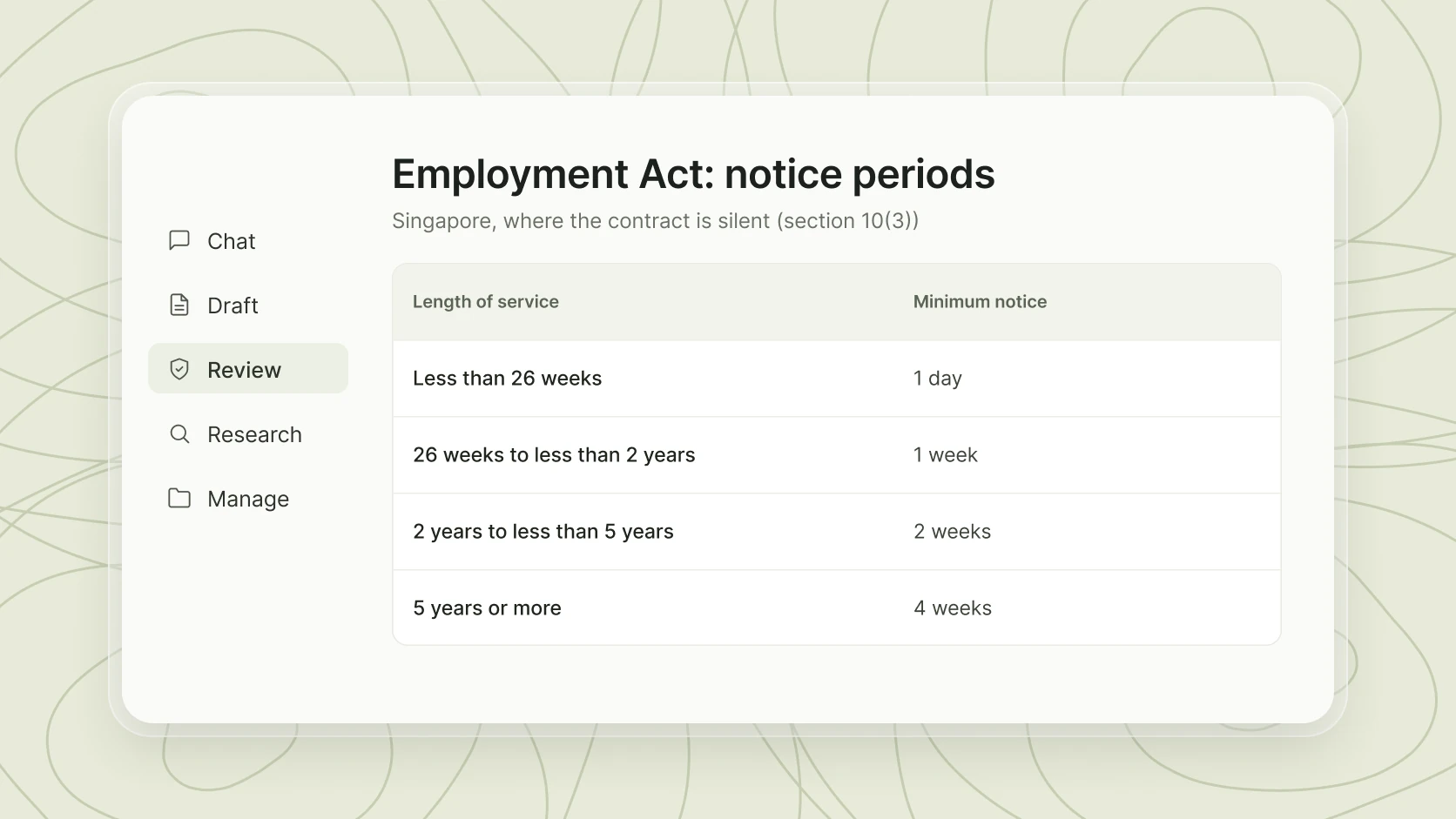
Under section 10 of the Employment Act 1968, either party may give notice of termination. The notice period must be the same for employer and employee. An agreed notice period determines its length; where the contract has no notice provision, section 10 provides this default schedule:
| Length of service | Notice period |
|---|---|
| Less than 26 weeks | 1 day |
| At least 26 weeks but less than 2 years | 1 week |
| At least 2 years but less than 5 years | 2 weeks |
| At least 5 years | 4 weeks |
Notice must be in writing. Check the executed contract rather than a template, particularly where the notice period changes after probation or with service. Confirm the intended last day and how the period is calculated before issuing the letter.
A fixed-term arrangement needs separate attention. Section 9 of the Employment Act 1968 addresses contracts for a specified period or piece of work that end when the period expires or the work is completed. Check the actual contract and circumstances before treating a non-renewal as straightforward expiry.
Payment in lieu of notice under section 11
Section 11 of the Employment Act 1968 allows either party to end the contract without serving notice, or without waiting for an issued notice to expire, by paying the other party the salary at the gross rate of pay that would have accrued over the applicable notice period or its unserved balance.
Payment in lieu is not, by itself, a finding of misconduct. State the mechanism accurately in the letter and check the notice period, gross rate of pay, any part-period calculation and the contractual treatment of benefits and variable pay. An agreed notice period need not match section 10's default schedule, which applies only when the contract has no notice provision. The agreed terms must still comply with the Act's applicable requirements, including equal notice for both parties.
Misconduct dismissal under section 14
Section 14 of the Employment Act 1968 permits an employer, after due inquiry, to dismiss an employee without notice for misconduct inconsistent with the fulfilment of the express or implied conditions of service. An allegation alone is not a concluded finding. Identify the conduct, examine the evidence and give the employee an opportunity to respond before reaching a decision.
There is no substitute for a process suited to the allegation. Preserve a dated record of the material put to the employee, the response, relevant mitigating circumstances, the decision-maker's reasons and the final outcome. Check the contract and disciplinary policy as well as the statutory requirement. Do not assert misconduct in a termination letter when the employer has not established it.
Wrongful dismissal and dispute risk
Giving notice or paying in lieu does not, by itself, settle whether a dismissal was wrongful. Examples include dismissal for a discriminatory reason, for exercising an employment right, or on a stated ground the employer cannot substantiate. The Tripartite Guidelines on Wrongful Dismissal set out further examples.
In JGP v JGQ [2026] SGECT 1, the employer paid salary in lieu of notice, but because it relied on alleged dishonesty as the reason, the tribunal treated the section 14(1) due inquiry requirement as engaged, found the dishonesty unproven and held the dismissal to be without just cause. The employee was compensated for lost income without any deduction for the notice pay.
An employee alleging wrongful dismissal generally must file a claim with the Tripartite Alliance for Dispute Management (TADM) within one month after the last day of employment; exceptions may apply. TADM mediates these claims, and unresolved claims may proceed to the Employment Claims Tribunals. Preserve the relevant contract versions, payroll records, correspondence, inquiry materials and decision notes promptly.
Where a dispute also involves a separate contract claim, our guide to limitation periods for Singapore contract claims provides context, but contract limitation rules should not be substituted for employment claim deadlines. If the contract contains a dispute resolution clause, review its wording and the available statutory processes; see our Singapore arbitration clause checklist for related drafting considerations.
Retrenchment requires a separate assessment
Where the business is reducing roles or workforce needs, do not present the decision as an individual disciplinary finding without a factual basis. Retrenchment may still involve notice, final pay and contractual obligations. Assess retrenchment benefits and notification duties before announcing the exercise.
Employers with at least 10 employees must notify the Ministry of Manpower (MOM) of retrenchments within five working days after notifying the affected employees. Retrenchment benefit is generally expected for employees with at least two years of service under the Tripartite Advisory on Managing Excess Manpower and Responsible Retrenchment. Review the applicable terms and guidance when deciding the amount. Tripartite guidance does not replace statutory duties. Document the business reason, selection approach, employee communications and payment decisions.
Employer termination checklist
- Confirm the facts. Identify the employer, employee, applicable contract, service period and actual reason for exit.
- Choose the route. Distinguish notice, payment in lieu, misconduct dismissal, fixed-term expiry and retrenchment.
- Check the governing terms. Review the Employment Act provisions, signed contract, amendments, policies and any collective agreement.
- Investigate where required. For alleged misconduct, record the evidence, employee's response and reasoned decision.
- Calculate payments. Check notice or payment in lieu, leave and other amounts due. Where the employer terminates with notice, final salary is due on the last day of employment. If the employer terminates without notice, it is due within three working days of termination. For misconduct dismissal, pay final salary on the day of dismissal or, if that is not possible, within three working days.
- Issue consistent documents. State the actual route, effective date and payment treatment, then retain the decision record.
- Address follow-up obligations. If the employer has at least 10 employees, notify MOM of any retrenchment within five working days after notifying the affected employees. Respond promptly to a challenge.
The practical sequence is fact first, legal route second, letter third. A clear record cannot prevent every dispute, but it helps the employer explain why it chose that route and how it calculated the resulting payments.
Legal information disclaimer: This is general information, not legal advice. Singapore law and guidance may change, and the applicable position depends on the contract and facts.
Next step: Explore Lexi's legal technology for in-house teams and legal practitioners when reviewing employment contracts and termination documents.